




|
|
Last Minute
Photo: Tribeca Festival
|
Technological changes which reshape society as dramatically as the mass adoption of the internet are few and far between, and they almost never happen so quickly. In his Oscar-nominated short film Last Minute, Michael Cusumano uses the tale of one boy’s neglected homework assignment to explore how different things were just a few decades ago. We recently met to chat about how the idea developed, how he went about recreating the recent past and what a strange experience it was for his young star, Espyn Doughty, to whom the world of the 1980s was completely alien.
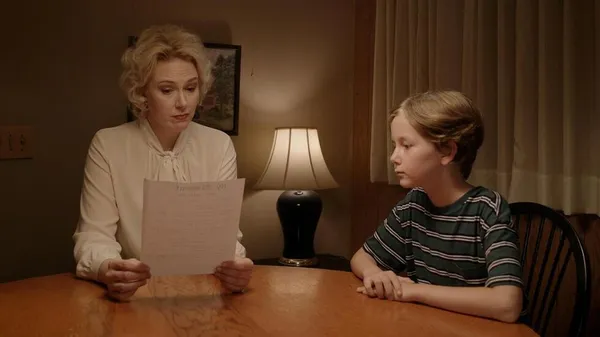
“The idea for Last Minute came to me about three years ago when I was chatting with my sister who lives in New Jersey,” Michael says. “I don't have any kids of my own, but I have three nephews, and they were all about middle school to high school age at that time. We had just had a giant blizzard and I remember saying ‘Oh, I bet they're enjoying their snow day.’ My sister was like, ‘Oh, they don't have snow days anymore, because remote learning due to Covid took away all the snow days. Now when it snows they stay home and they go on the computer.’ And it just hit me like, ‘Oh my God, they have no idea what it was like when I was growing up,’ and that my childhood is now history.
“It just got me thinking, how many other things from my childhood are now alien to today's children? That got me thinking about all those things, and the first thing that popped into my head, of course, was homework, because I'm a horrible procrastinator. I always have been. I remember those late nights trying to get your homework done when you didn't have anything you needed to do it, and you really got yourself in a predicament, and just how creative you had to before the internet was there to bail you out. And I was like, ‘I bet kids today have no idea.’
“I bet adults don't realise just how alien that has become to them, because the people who remember it watched the film and they were just like, ‘Oh my God, I remember all that and I haven't thought about it in forever. And I was right that young people are kind of fascinated by what it's like when you had all this mental space just to think about things and how outside the box and creative you had to be to get things done. So that was the impetus for the film. I thought that lends itself perfectly to the structure of a short film because it had the deadline and the urgency, but also the structure of itself was going to be really tight. It was going to be very focused on this mother and son.”
I note that there will also be audience members who relate to the mother and yet who don’t remember life without the internet.
“Oh, yeah. The people who grew up being kids who had the internet are now adults who have the internet. I was really on the cusp. That's why I set the film when I did. It could have been set anywhere before the Nineties and it would have worked, but I really wanted to focus in on the last people to have this experience. It’s 1989, which is literally on the cusp of a new decade, but also they don't realise the Internet is right around the corner.
I did a lot of research to make sure every detail in the film was accurate, and I think AOL – America Online – existed at the point that the film was set, but it hadn't yet come to market. Nobody outside of the tech world knew it was coming so it was just there in the background, lurking.”
We talk about the process of recreating the past.
“The star of the film was also our production designer, Charity Schubert,” he says. “She did incredible work researching and scouring the Internet for details. She found the last – I believe – bottle of liquid paper in America, that could be purchased. I actually have a production design credit on the film because I did all the sketches, but the real work of making it happen was all Charity. Actually, so many of our team contributed, it made me a little emotional on the set. Everyone wanted to contribute to the film. Our sound engineer brought in his parents’ speakers, and he brought in wine glasses. Everyone was bringing in their grandma's quilts. We had an abundance of quilts. I couldn't even get them all in the film. If you look closely at one shot, you can see a stack of them under a table. But I didn't have the heart to refuse anybody's grandma's quilts.
“It became this tapestry of our whole crew getting their own memories, and I like to think that when they watch it, they can spot something on it. But just on my own role as director, I thought my job was to control the vibes and the mood, because more than any Eighties reference, I was really concerned about it feeling like it used to feel for me. I wasn't concerned about, like, ‘Oh, let's have a Rubik's Cube and an ALF and a Michael Jackson poster.’ I wanted to have the lampshade I remember, the way I remember the light feeling when you were up late doing your homework, and the kind of brown carpet and the yellow light. I was much more concerned about that.”
How did he go about preparing Espyn to enable him to convince as somebody who grew up in that world?
“That was really fun because he's such a great young actor. It was his first time on film. He's a theatre kid, and we just plucked him out of the theatre community in Louisiana and threw him in front of a camera for their first time. He took to it like a duck to water. But I we did a lot of rehearsals over Zoom with him and Charity, who played his mother, and they figured out all the scenes. But I realised when I got to set [that] I overlooked introducing him to all the technology, so every scene, there was a brief period before we shot where we had to go over it and be like, ‘This is a phone book. This is how a phone book works.’ He was loads of fun because he had this wonderfully enthusiastic eagerness to explore this stuff. Things that I thought were boring, he looked at them with wonder, like, ‘Oh, wow, you can just look up everyone. Everyone's just listed in this phone book.’
“The first take of day one, he had to pick up a landline. He attacked it with a lot of energy, and he just completely got tangled in the landline. I realised immediately he had no idea what he was doing. He picked it up from the wrong end. He had the face and the receiver in his hands and the cord was everywhere. I was like, ‘Cut, cut! Alright, this is how a landline works.’
“This is my second time working with just about everybody on the film. Film. Part of the big reason the film got made is because Charity Schubert and I got back into filmmaking two, three years ago with our first film back and called Napoleonic Code, and we had a wonderful experience. You know, you're so tired and relieved when you finish a film, but we were just like, ‘We’ve got to do another right now, immediately.’ Because I have this idea I like and the team's in place and tomorrow is promised to no-one. Who knows if the team will all stay in place?
“We just turned right around and did the second film and just basically called up everyone who worked on it the first time and tried to get them back. We got pretty much everybody. Every actor in the film was my first choice, so I really lucked out there. The characters were written to the people involved because we went down and premièred our first film in Louisiana Film Prize, which is a festival that has only 20 shorts, but they just show all those shorts over and over again for a weekend, and I basically went shopping. You know: ‘I like that actor. That actor has a wonderful energy. I bet I could use that.’ And lucky me, they were all enthusiastic and eager to hop on board.”
Finding locations, it turned out, was tougher than he had anticipated.
“I was so overconfident. It was murderous. I was rewriting and working on the drafts. I was like, ‘I'm really excited about this idea, and I don't want to waste it on a bad execution.’ And we just, for the life of us, couldn't find a location that satisfied us. Everything was just not quite right. We didn't have the budget to build a whole living room and everything. We were getting ruined by stainless steel appliances in the kitchen and the walls that weren't right in the living room.
“I tried to shut it down three weeks out, but my wonderful assistant director, Melissa Goslin, was just like, ‘Give it a chance. We'll find something.’ She was actually on the ground in Louisiana while we were in New York, and she said ‘If you don't have it in a week, we can talk about rescheduling,’ but we found this one location that was just perfect, and it did account for most of the locations in our film. It was two houses that played every location that was interior.”
Did they have long for the actual shoot?
“Oh, God, no. We were so tight. It was three days and it was 24 scenes and I think eight locations, plus we did the dream sequence, and we had a photo studio where we had to set it up a certain way, so we were moving fast. If you look at the film, you can see like that actually played to our advantage because it forced me to be creative, forced me to be economical.
“There are certain scenes where I just knock out 90 seconds of dialogue in one shot. I had to take a lot of time figuring out a way that felt natural and organic to the scene and would tell the story. But the impetus for that was me going ‘I don't want to be doing six, seven set-ups for one simple dialogue exchange. We're going to knock this out in one shot.’ And hooray for my team, they kept pulling it off – especially Espyn. I was worried. Is that his first time in front of a camera? He's 12 years old. Is he going to be able to do a 90 second take? But he never messed up once.”
People always say that every film is a learning experience, but it seems like one where you've probably picked up quite a lot of new skills.
“Yeah, it really did teach me about preparation. I mean, there's no such thing as too much preparation. Some people worry about it suppressing the spontaneity if everything is over prepared and over rehearsed and you know exactly when the camera is going to do before you get to set, but I think that only ruins spontaneity if you stick to that rigidly. In my experience, working on this film, it just made everybody feel comfortable. We're open to the things that happen on the set if we, if we want to try something different, but we know we have a version of this scene that works. We rehearsed it, we blocked it.
“Having that as a kind of safety net when you're shooting, I think it takes a lot of the pressure off. The scene outside the bookstore where they're running to get in the bookstore and it's closing in their face and they're trying to get the information, that was all supposed to take place in the car, all the dialogue was supposed to take place in the car, and they're supposed to screech around and just see the bookstore at the last shot. But the period car we arranged for the film wouldn't move. It being 40 years old. I should have seen that one coming.
“That's something I learned. 40 Year old car, turn the keys a few times before you get to set, see if it runs. But the fact that we had the scene down pat, emotionally, for the actors, we knew exactly the dynamic and the comedic timing, meant that we could take it and quickly reblock it to take place on the sidewalk. I was just running up and down like a madman, making sure there was no anachronisms, there's no WI FI signs on the storefronts that were going to give us away. But we just lucked out.”
One never really knows, with comedy, how well it's going to work until one shows it to an audience. What was it like watching it for the first time like that?
“It was nerve racking because one thing we discovered, as opposed to our first film, which was almost theatrical, it was very cinematic. As a director, so much of it was just in my head. I'm just like, ‘I know how these scenes are going to play together because it's a lot of quick scenes. I know how the energy is going to crescendo here and fall back down as it gets late into night.’ So the whole time on set, I'm the only one who's able to see the whole thing in my head. You have to just trust yourself and have your team trust you that this is going to work. Then you put it all together and you hope that you were right.
“One thing we discovered was we really depended on the music to glue it all together. The other one, there was just very sporadic music as punctuation between the scenes. This one is so much more of a montage of so many quick scenes, it really needed music to just make it congeal into a whole. And then we had one screening. We had our friend who was doing our graphic design and our posters., so we just showed her a working print just so she could work on a poster. And it didn't have the music. And I'm watching her watch joke after joke with no laughs at all, stone faced.
“I know she's not there to be an audience and laugh, but I'm just watching her as she didn't realize she was the first one to see it put all together, and [thinking] ‘Oh no, this is going to go down like a lead balloon.’ But once you finish the sound mix and it takes on its final form...” He smiles. “I was there in Louisiana with a packed theatre at a première at the Louisiana Film Prize. I looked over at Charity, who was counting. ‘Oh, wait, the first laugh.’ We got the first laugh. And then the second laugh. Okay, we got the second laugh. Okay, we're good.”
They’ve done really well, because now they're qualified for the Oscars. So how does that feel?
“That is utterly surreal. It has done well, it's really resonated with people, which is what I was hoping for because Eighties nostalgia is such a well worn trope, I was a little intimidated to do it. From The Wedding Singer to Stranger Things and everything in between.
“Another lesson I learned was just trust the audience. Make the film you want to make, and if you succeed, people are going to pick up what you're putting down. I really wanted people to think about how that period compares to today and what we may have lost, and was it worth the price tag? Because often you don't really think about the things you're giving up to technology until you have looked back with the fullness of time.
“Everyone wants to come up to me after the film and tell me about either the time they didn't do their homework or the time they had to bail out their kid, and it's hitting audiences in a way that's incredibly satisfying. I'm just thrilled. And as for the Oscar thing, I'm just, I mean, I couldn't think about. You can't think about that while you're working, and when I found out that the film prize which we ended up winning was going to be Oscar-qualifying this year, I was just like ‘Nope, not thinking about that. I can't edit and make choices knowing that is hanging in the balance of every edit I make in the film. I'm just going to pretend I didn't hear that and finish the film as best I can, and then whatever happens happens. But now we got very lucky. We won a film prize. We got to play Tribeca, which was a thrill, especially as a New Yorker. It's been great. It's been absolutely great.”