





Eye For Film >> Movies >> Ulya (2026) Film Review


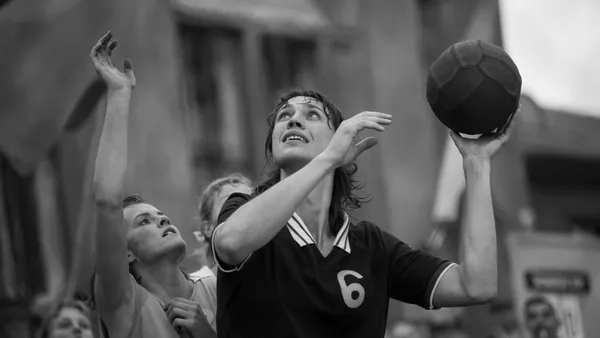

Lativian basketball star Uljana Semjonova was, quite literally, head and shoulders above the rest when she rose to prominence in the game she came to dominate throughout the Seventies and Eighties. Viesturs Kairiss shows how her career began in this origin story, which is certainly one from the heart from its co-writer and male star Karlis Arnolds Avots – who instigated the idea, having known Ulya, as she became generally known, from childhood. A photo during the end credits with the star before her death in January 2026, also indicates her endorsement.
There’s no doubting his sincerity in the role of the destined-to-be 7ft Ulya or his largely sensitive performance, but still the fact he is a man, whose teenage days are long behind him, playing a female teenager, can’t avoid pushing you out of the movie at key moments, especially when issues surrounding her gender arise. Also, while of course finding a 7ft actress would no doubt be tricky, even Avots isn’t as tall, so if the camera can lie for him, why not a female star?
Leaving that aside, this year's Latvian Oscar submission for Best International Film is a straightforward story that’s elevated by the often impressionistic directing from Kairiss, which tries to take us into Ulya’s headspace in ways the script doesn’t. Nevertheless, the impenetrability of Ulya’s thoughts and motivations proves tricky to overcome and there’s always a sense of us being at arm’s length. The boxy aspect ratio and black and white cinematography add both confinement and a smudgy melancholy to the mood, which is the film’s strongest asset. That is further underlined by a score that drifts towards the mournful from Estonians Ramo Teder and Marko Veisson, who are better known as folk duo Puuluup and who previously wrote the evocative music for documentary The Lynx Man. The film is screening at Thessaloniki Film Festival and opened Tallinn Black Nights Film Festival after premiering in Cannes Un Certain Regard earlier in the year.
Ulya was a reticent teenager, and Avots plays her with a watchful lack of confidence as she finds herself plucked from her rural environment by scouts from TTT Riga, unsure even whether she wants to leave her family. Once in the city, fitting in again proves difficult as she towers above the other girls in the team, who also view her as having special treatment. While solidarity will gradually emerge, Kairiss is less successful at articulating the rise of her skills on the court.
As a newcomer to the sport, it’s no doubt accurate to portray Ulya as ungainly to begin with but the film never really gets past this. Like it or not, there are expectations around sports films showing some sort of trajectory but the games towards the end of the film are hardly more dynamic or fluid than those at the start. Ulya’s story ought to be a fascinating one, despite their good intentions, it feels like the filmmaking team have dropped the ball.
Reviewed on: 12 Nov 2026