





Eye For Film >> Movies >> Mr Benn (1971) Film Review

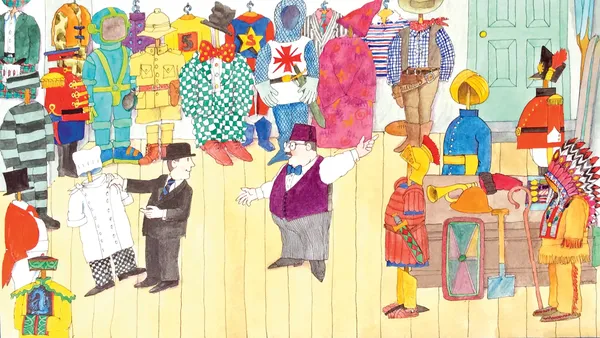

Mr Benn was an essential part of many people's childhoods from the 1970s onwards. It was a gentle piece of television, softly spoken with line-drawn, water coloured animation. David McKee adapted the series from the picture books he had previously written and illustrated. Two of these were published before before the series began.
Each episode was narrated by Ray Brooks over deliberately scrappy but often complex illustration. The erratic lines and blotchy paint appear, at first glance, to be at a artistic level attainable by a young child. It is an active engagement with its audience, art that they could imagine making. The camera zooms and pans over static images, an animation style that has more to do with the left bank of the Nouvelle Vague than Disney. The jazz musician Don Warren (Duncan Lamont) provided the music, a quirky rhythmic tune on wind and xylophone.
Mr Benn is the quintessential office worker, outwardly boring, clad in a business suit and bowler hat (English national dress). There was nothing cool or retro about that in the 1970s. It was the uniform men wore while running the numbers in the accounts department. A somewhat shy bachelor, he lives alone at 52 Festive Road, London.
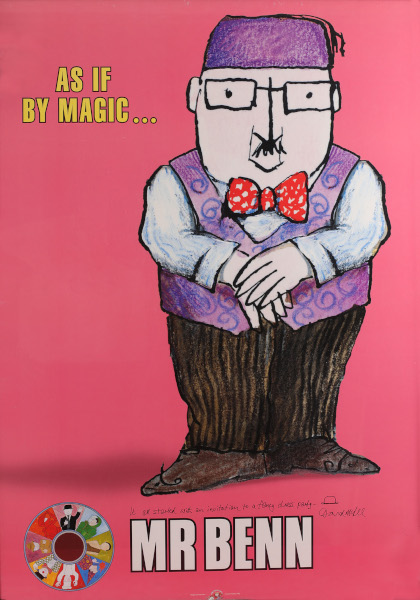
Structurally the episodes are almost identical. They normally start with Mr Benn at home. The camera pans along Festive Road showing details that will come into play later in the episode. Mr Benn leaves his house and find himself at a costume shop on an obscure back street. Inside the shopkeeper appears 'as if by magic', a strange little man wearing a fez. A costume is chosen and taken to the changing room. In his new attire Mr Benn steps out of the changing room into a new world, one that fits the costume. Calmly and intelligently he resolves some issue that he comes across, after which the shopkeeper invites him to return. His act of katabasis changes changes Festive Road, often for the better. Arriving on his doorstep he looks at a physical souvenir taken from the other side.
David McKee validates the expediences in the imagined world, a world of talking animals, fantastic beasts and magic carpets, and how those expediences influence our own. He also provides a clear delineation between that world and the mundane. The costume shop is a portal between the two and the shopkeeper a gatekeeper. The child watching always knows which is which, and is always brought back home.
The genius of the show is that McKee can present sophisticated ideas in very simple terms. In the first episode, The Red Knight, Mr Benn, dressed as the knight, encounters a very sad dragon. The dragon used to light the fires for everyone in the kingdom until a matchmaker came along. He set fires, blamed and badmouthed the dragon. Once his competition was out of the picture the matchmaker raised the price of matches to almost unaffordable levels. (Decades later Microsoft would call this strategy FUD: Fear, Uncertainty and Doubt.) Mr Benn puts things to rights. Returning home to 52 Festive Road he finds a box of matches from the kingdom in his pocket. McKee taught children about cooperation, conflict resolution and animal welfare.
One thing to remember is that this is television from the early 1970s. Nothing in the show could ever be described as racist but in some places the language use can be problematic. The episode The Cowboy is an example. These days Native Americans would be referred to differently.
Reviewed on: 13 Nov 2026


Director: Pat Kirby, Leo Nielsen
Writer: David McKee
Starring: Ray Brooks
Year: 1971
Runtime: 210 minutes
Country: UK
Festivals:
Search database: