




|
|
Les Indes
Photo: Swiss Films
|
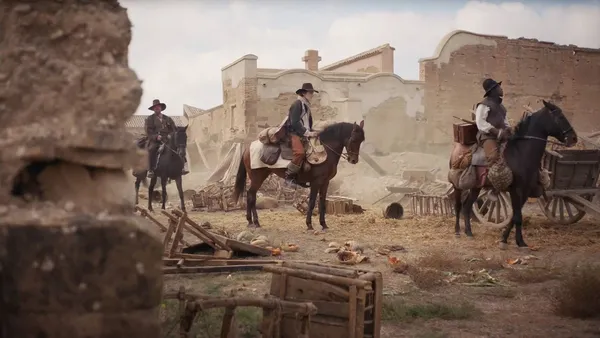
In the 1650s, Diego Valázquez was tasked with painting three portraits of Spanish princess La Infanta Marie Theresa to be sent to potential suitors. One of them was France's Louis XIV, also a child at the time, who she would go on to marry, bringing peace between France and Spain. In Les Indes, debut directors Nicolas Chapoulier and Pauline Julier – who are also a couple in real life – imagine what happened between the two courts. In their version of the story, a young Spanish nobleman (Théo Urtubey) is sent along with two soldiers (Lazare Minoungou and Raphaël Thiéry) on the mission, which involves crossing dangerous territory between the two countries. The nobleman has dreams of heading to the new colonies, and exploring the nature there, but he soon encounters the savage realities in his own backyard. Les Indes had its premiere at Venice Film Festival and most recently played in competition at Thessaloniki, where we caught up with the filmmakers to chat about it.
Did the idea for Les Indes start with the painting or a desire to make something about that period?
Pauline Julier: We started with the idea of the painting.The first move was this diplomatic portrait, which is very well known. We had this Velázquez in mind.
Nicolas Chapoulie: Although they were not the only ones to make a diplomatic portrait.
PJ: The second move was this period, because it's a very important period in terms of what we wanted to express.
Was the fact that there was a lot of mystery surrounding what happened to the painting between the two courts part of the attraction, because it gave you the opportunity to put your own imprint on it?
PK:Yes. Actually, historians don't know that much about it. It was a kind of black hole that opened up the doors to narrative fiction. The thing we know is that the painting was travelling, but we don't know how. By horse, for sure. But how many people were involved? When did it travel? How long did it take? It’s not clear. So we had this open space in which to do things. It's also not clear how it got to the court. That's why we decided to have this cut at the end, saying: “We don't actually know exactly what happened, so you have to fill in the gaps.”
We were also very interested in this kind of forest, which is wild and afterwards this garden [the planning of Versailles] with its [manicured] cut. This is the kind of friction we were interested in.
This idea of the natural world versus humans is a big part of the film. So are paintings and you incorporate several other works of art into the film. Tell me about that?
PJ: It was more an interrogation of how to bring in the imaginations of the characters of the time and how they looked at other places and how did they project ideas of the New World? And maybe the nobleman, Alejandro, had an opportunity to see these paintings somewhere. Not in books because printing wasn't so widespread at the time but maybe the way he was raised at court gave him some knowledge of the world. So the idea was to bring these paintings into the editing process. But it wasn't clear how much to include or how to incorporate them. We were working with around 20 paintings, considering this one, then that one. It was part of the colonial idea, but also part of the idea of describing the world. I mean, it was colonial, but at the time it was also about curiosity.
|
|
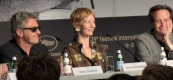
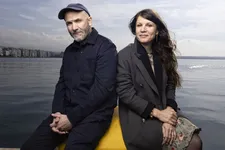
Nicolas Chapoulier and Pauline Julier in Thessaloniki
Photo: Thessaloniki International Film Festival/Studio Aris Rammos
|
Were there challenges to shooting the film, because you're in the middle of nowhere for quite a lot of it, or at least it appears that way. I was particularly thinking about the winter scenes, which must have been a challenge to shoot.
PJ: Actually, we were lucky as it wasn’t suppose to snow and it snowed.
NC: We were looking for a sad sky and that particular area of Switzerland is a really special place, with a depressive landscape. And we arrived, and it was sunny for days, we were like, “F***!”. Then the snow arrived so we had to figure out what to do.
PJ: It wasn’t written like that in the script.
It’s interesting that was a happy accident because it struck me while I was watching the film that you can really hear the sound of the snow falling, which isn’t something you tend to think about much
PJ: Thanks. We actually had some big issues with the sound of the snow. We had one recording on set, and another from the sound designer and we had another one and all of them thought theirs was best. But it was also about how to make it sound natural using our technical recording methods. Snow is like wind for a sound designer; it's a nightmare. So how do you create the sensation of snow?
Did you use the actual sound of the snow in the end, or did you use the sound designer's version?
PJ: It was a mix between the different snow.
The idea of silence is also a key one in the film and you have a mute character who uses sign language. Tell me about that decision. Did you develop the sign language yourself?
PJ:Actually, it's a real one. It's a language that comes from America. It was a diplomatic language between Indigenous peoples. At the time, we thought it might work because it's very plausible that they learned that in the colonies. It was used as a trading language and it’s very possible that they came back with it. We had to find the only person in France who still knows that language. In the United States, there are a few people who know it, but there are very few speakers left.
NC: But it's actually an easy language because it's a very contextual method. The sky is ideas of ‘good’, ‘healthy’ and ‘spiritual’. It's very connected to natural elements. Each person can invent things in the process. It was important to us because we put nature at the centre, and we danced with nature through this kind of language. For us, the two soldiers, Jehan and Antoine, come from the Old World. We are in the Renaissance where Alejandro, a teenager, represents the New World. It’s like the beginning of Descartes – “I am a thinker and I am the centre of the world”.
How was it to work together, since you’re also a couple?
PJ: It was hard. The shooting was hard but the writing and the postproduction was beautiful. The shooting was a bit more complicated because we have our own practices. I come from the art world, and he comes from theatre. We each have our own ways of working. Usually, I make my own decisions, and he makes his. It was a bit of a fight, but we managed to find something in those contradictions. They brought something more radical to the film, and pushed the limits of narration. Shooting was a challenging moment, but we found a way through it. I think we're going to make another film together.
What made you want to make a film in the first place, since you both have your own different careers?
PJ: It was really a desire to make fiction, and also the feeling that perhaps we could be stronger together. If there are two of us, than each with our own direction. Personally, it was also easier to do something together. Louis XIV is played by our oldest son.
The children’s scenes that bookend the film are interesting. We sense the boredom, for example, of La Infanta, which she’s stuck waiting in a hallway. Even she is a cog in the wheel of a bigger machine
PJ: Regarding the children, it was also very clear to us from the writing that we wanted to have a beginning and an ending that mirrored each other. It could be, you know, a shot and reverse shot between the two gazes of the children.
You mentioned you’re thinking of making another film, can you tell me about that?