




|
|
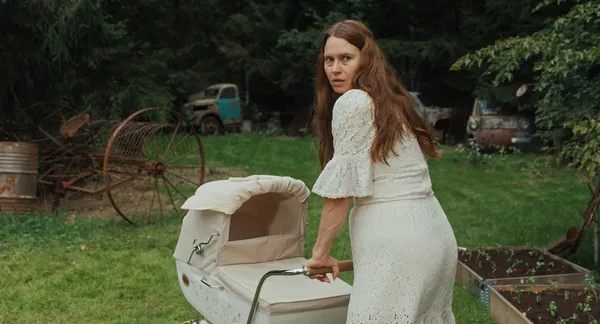
Seidi Haarla in Nightborn
|
Finnish director Hanna Bergholm's maternal horror Nightborn follows Saga (Seidi Haarla) and her British husband Jon (Rupert Grint) as they plan to start a family. Moving to the house in the Finnish forest that holds memories of her own childhood, everything feels perfect. But after the birth, Saga must reckon with the terrifying reality of what she has given birth to.
Nightborn is Bergholm's sophomore feature. She made her feature début with the body horror Hatching (Pahanhautoja), about a gymnast who discovers an egg and hides it from her overbearing mother.
In conversation with Eye For Film at the London Film Festival, Bergholm discussed the film's personal roots, drawing on Finnish mythology and her love of Charlie Chaplin and Federico Fellini. She also reflected on telling stories with visual language, homing in on emotional truth, and learning life lessons.
The following has been edited for clarity.
Paul Risker: What does cinema mean to you personally?
Hanna Bergholm: My parents were filmmakers, and so, they showed me loads of films. I grew up watching and loving films — all the old classics from all around the world. And I always felt that film is my mother tongue, and my way of communicating is to make films.
It's because my parents were filmmakers that I knew that this profession existed. Otherwise, I had little realistic knowledge about filmmaking. I knew what the job of the director was. I knew it was working with a group of other people, and I was aware of how great that collaboration could be. And also, my mother was a freelancer. So, I knew all about the struggle of trying to get your project financed and that things could collapse.
So, for me, making films was never about the glamour or the red carpet. It was about the actual work, about communicating with people and also about being in love with the cinematic language. And knowing it's not easy, my attitude was to just get on with it, and push the projects forward together until we succeed.
PR: A feature film is a milestone moment, but how do you look back on the transition from your debut Hatching, to this, your sophomore feature?
HB: Well, my debut film Hatching helped to finance the second film. That first film was such a wonderful experience, especially since it was also an international coproduction. It was wonderful to realise I could actually reach out to people from other countries and that when we talk about art and filmmaking, these borders don't exist. It’s about this community of different people from different countries coming together.
And then coming to the second feature, it was wonderful to work again with the same French sales company, Goodfellas, and with the same UK SFX team.
The experience of releasing my first feature Hatching went so well — it was sold to over 75 countries. And maybe because it was my first experience, I just took it for granted that films go that way — hooray. And now, Nightborn has also sold worldwide, which I'm very happy about. But I realise people are struggling nowadays and we live in an era where I feel culture is not valued as much as it should be by political decision makers.
We should never take it for granted that we can make films. We need to protect that privilege and especially those institutes like the BFI. So, it's important to put money into art and culture.
PR: What was the genesis of the idea for Nightborn?
HB: It started with my own experience of becoming a parent. So many people were telling me how I should be feeling. “Oh, it must be so lovely now you are just chilling out and cuddling with the baby.” But the baby was screaming all the time and I couldn't chill out. I just felt so much rage and confusion, and I didn't know where to put those feelings. So, I decided to put them into a film. Then, I started to collect stories from other parents about their experiences. From there I started to put the story together from all these real-life elements I'd heard about. But then, it took me a while to realise how to actually make this into a film and what the world would be. And it wasn't until I realised that I could use the old Finnish mythologies about all these troll creatures living in the forest that it really hit me what the right landscape would be for this film.
PR: So, it had a lot of different roots.
HB: Yes, and in terms of folklore, it served as inspiration, but then I also made it up.
It's also the kind of film that people can see however they like. Some people say it's an entertaining horror film, while some people, especially women, have actually said it's not a horror film at all — it's not a fantasy, it's a kind of documentary. So, you can see it in many ways, and personally, I call this film emotional realism because I'd say that I'm telling the story as the main characters are experiencing it. I'm telling their emotional truth.
PR: What struck me was how you used comedy as a way to accentuate the darker and unpleasant experiences of the characters.
HB: Our everyday lives are full of comedy. Even when we face the most tragic situations, we end up acting in very comical ways just to try to cope. But like you said, underneath that humour, there are genuinely painful feelings.
Nightborn is interesting because if you watch it alone, you might feel the pain. But when people have watched it together, there has been a lot of laughter. It's fine to laugh and it's fine to feel the painful side of it, because they coexist.
And I like filmmakers like Charlie Chaplin and Federico Fellini, who can have deeply tragic scenes in their films, and at the same time are hilarious, which is life.
PR: During the birth scene there's some inventive cinematography on display that draws our eye. A film is supposed to immerse us so we suspended our disbelief, but there's no denying there's an artistry to film that wants a response.
HB: One thing that is important to me is that every shot should always say something. And the way we should think about cinematography and every aspect of cinema is that it's telling a story. For example, in our film, I wanted to tell the story from the main character's point of view, meaning that we only cut to the wide shot when we want to show how she is experiencing a situation. The logic of the cinematography and the editing comes from her emotional experience. And what I find wrong is that in some film schools, there is this master shot technique where in every scene, you shoot the master shot first. It might be good for some scenes or even for some films, but the whole point of cinematography should be asking what the scene is about. And that's how you should tell the story. So, forget about the master shot technique.
PR: One of the things that stood out to me was the transition from hope to despair. Even the images of nature, the sunlight and the trees feed the early hopeful vibes, which we of course know will quickly be consumed by the story’s darker tones.
HB: The inspiration for the overall visual style came from nature and the forest colours. Then, with Saga feeling trapped in the house with this baby, the idea was that we will never see outside the house. Usually, you would like to see outside to get some depth for the images, and that was a deliberate choice not to. In one way or another, we just never see outside, and so, it becomes claustrophobic. This was a feeling I wanted to create, which comes from the experience of being a parent. If your child doesn't sleep at night, then you're up all night with them. And that's why I wanted the baby to be a night baby, so the mother is sat all night in darkness with her child.
What happens is that at the same time as Saga experiences being trapped looking after the child, she's not communicating with the father. And so, there's also this miscommunication between them, leaving the father on the outside. He doesn't know how to be involved as the child's other parent. And so, it creates the situation where they never find the right way of sharing the parenthood of this child, which is the tragedy of the story. And what also happens to this main character is that her body breaks during childbirth and she is left alone in that experience. Then it's about how she faces herself, in her changed body.
PR: One of the themes of the film is transformation, specifically how a child changes the couple's relationship. It's interesting to look back on the film, because the impression we have of them as a couple dramatically changes.
HB: I really wanted to tell a story about how it has been their dream to have a child, and then suddenly, this child breaks the connection they share. The husband especially tries in every way he can to be present, but for her, everything just seems wrong, which is sad. So, when he tries to offer advice, it just annoys her. Then when he tries to pay her a compliment, it doesn't seem to be enough. And when he tries to help her by telling her what he's feeling, she gets even more annoyed, as she does when he tries to give her space. Nothing is right and so, it's just a sad situation.
PR: Is filmmaking a transformative experience where you change as a person?
HB: Well, one thing I did realise even more when making this film was how important it is to look at other people, especially your children, for who they are. It's also about confronting who you are as an individual and not to focus so much on how you think things should be. So, in the context of this film, which is about parenting, don't listen to what kind of parent you should be or what your children should be like. Instead, ask who is your child? What are their needs? What kind of person am I? And just accept that and start building relationships from there.
Also, when it comes to the parent's relationship in this film, where they go wrong is they don't really listen to each other or acknowledge, accept and admit their own feelings. Saga shuts down and that's why she gets so annoyed with her husband.
So yes, I realised even more how important it is to accept ourselves and others as they are and just start from there.
Nightborn screened at the 2026 London Film Festival, at the Fantasia International Film Festival and in Karlovy Vary. It was released in UK theatres on 30 October. It will be released on Blu-Ray and DVD on 14 December and on digital 21 December.