





Eye For Film >> Movies >> The Devils (1971) Film Review



When a film which caused controversy in previous decades is rereleased, critics and commentators often proclaim loftily that it’s “tame by today’s standards”. But, as this “director’s cut” restoration proves, The Devils could never be described as tame by anybody’s standards.
There was no director quite like Ken Russell and his 1971 masterpiece is a dazzling, frenetic assault on the senses and sensibilities. Its nudity, violence, explicit sex scenes and sadomasochistic depictions of torture and mass hysteria resulted in a fully-fledged “moral panic” at the time of its original release.
Religious associations, from the Vatican down, and bien-pensant critics lined up to condemn it as blasphemous and/or immoral. The British Board of Film Censors demanded hefty cuts. And it remained banned in several countries for decades.
Even now, it’s still not an easy watch. Its scenes of mediaeval torture and orgiastic derangement are relentlessly graphic and brutal. But that’s because this story of a fabricated witch-hunt – based on Aldous Huxley’s non-fiction book The Devils Of Loudon and John Whiting’s play The Devils, both inspired by real events during France’s 17th-century religious wars – is driven by a fierce outrage at the hypocrisy and injustice of using religion as a tool of persecution for political ends and cynically allowing mass hysteria to take hold of an entire community.
By the end, you’re left in no doubt as to what Russell feels is true obscenity – and exactly who he thinks the real “Devils” are here. But it would be a mistake to think this is a one-note wallowing in the gutter, or an earnest, finger-wagging polemic.
The opening scene, as Louis XIII of France (Graham Armitage) stars in his own masque as Venus emerging from the waves, while Cardinal Richelieu (Christopher Logue) tries to conceal his boredom is simultaneously playful, beautiful, shrewd and blackly comic. Classic Russell in other words. As is the immediate cut to a column of soldiers advancing through a bleak, windswept landscape, driving Protestant Huguenot prisoners along like cattle.
They are led by the Baron de Laubardemont (Dudley Sutton) an enforcer for Richelieu on his way to take possession of the strategically important town of Loudon and destroy its fortified walls to prevent Huguenot rebels taking refuge there. But the late governor has made the town a refuge for both sides and given the local priest, Urbain Grandier (Reed), written authority to maintain its neutral status.
Grandier uses this to defy the Baron and lobby the king directly to stop the demolition. The townsfolk largely support him, but his worldly, dissolute lifestyle (including seducing several women) has made him some powerful enemies.
These include Sister Jeanne de Agnes (Vanessa Redgrave), the Mother Superior of the local convent. She is simultaneously infatuated with Grandier and stricken with guilt and shame for her feelings, which only intensify when she learns he has secretly married Madeline de Brou (Gemma Jones), who had previously considered joining the convent. She happily colludes with a plot by the Baron and a local merchant (John Woodvine), the father of one of Grandier’s conquests, to accuse the priest of communing with the Devil. As her accusations become increasingly wild and lurid, the entire convent – and the town – is caught up in them…
It’s a frenetic ride, but one that builds to a sombre climax and this 4k restoration, supervised by superfan Mark Kermode and based on an edit assembled by Russell in 2004, restores nearly 10 minutes of material missing from previous versions, filling out and enriching Russell’s vision.
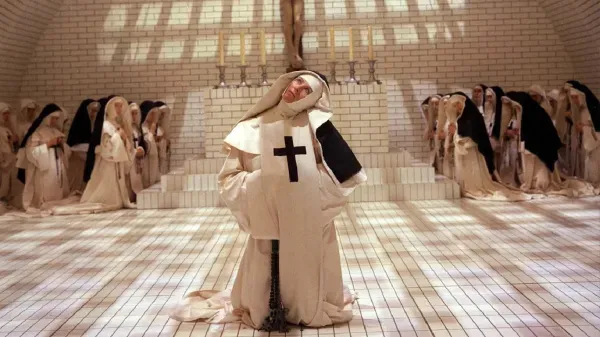
Most notable is the “rape of Christ” sequence, one of the cuts demanded by the BBFC. In it the nuns, caught up en masse in Sister Jeanne’s erotic delusions and encouraged by a professional witch-hunter (Michael Gothard), pull down a sculpture of Jesus on the Cross, and have their various ways with it. Yes, it’s shocking and provocative. But it’s also a vividly satirical indictment of the Church’s hypocrisy and fear of female sexuality.
It all adds to a sense of escalating madness, in which the viewer is enmeshed as closely as the characters. And the images of mass denunciation and bodies piled into pits would have had extra resonance for an audience watching barely 25 years after the end of the Second World War and the age of the dictators.
The scenes showing the genuine intimacy and emotional charge between Grandier and Madeline feel like an escape from a nightmare, as does a beautifully shot moment when Grandier takes solitary communion in the countryside on his way back from lobbying the king – unaware that the campaign against him is in full swing.
Reed is fantastic in arguably his finest screen performance. His Grandier is deeply flawed, and deeply aware of it, but achieves a tragic grandeur as persecution only intensifies his determination to hold true to his principles and never confess to charges he knows to be lies.
It’s a tour de force of screen acting, to rank alongside his other magnificent turn for Russell in Women in Love and his “back from the wilderness” swansong in Gladiator; performances that all the drunken chat show appearances, self-parodying “hellraising” and straight-to-video schlock of his later years will never erase.
He’s more than matched by Redgrave, whose hunchbacked, sexually frustrated abbess could easily have been a one-note caricature. But she’s a complex, intelligent woman crippled literally and metaphorically by her misguided devotion to a church which uses and discards her with contempt. The dream sequences where she imagines herself freed from her vocation and her disability, playing Mary Magdalene to Grandier’s Christ, could be risible but achieve genuine tenderness and pathos.
The supporting cast are superb, too. Sutton – no stranger to challenging projects since his early role as a gay biker in Sidney J Furie’s The Leather Boys – is a chilling mixture of cold power politician and lip-smacking sadist. Melvin inhabits the role of Mignon, Grandier’s fellow cleric – appalled by his colleague’s libertinism but jealous of his popularity – so completely that he could have stepped straight from a Renaissance altarpiece. And you’ll never watch a repeat of George and Mildred in the same way again after seeing Brian “Mr Roper” Murphy as a quack doctor who takes perverse delight in using his surgical instruments for intimate examinations of the “possessed” nuns.
The actors are matched by excellence in all the other departments. David Watkin’s cinematography vividly evokes both the lush decadence of the king’s court and the grimy reality of daily life. Peter Maxwell Davies uses early music and original compositions to create an eerie, dissonant soundtrack. And Derek Jarman – soon to plough an equally original directorial furrow with the likes of Jubilee, Caravaggio and Edward II – contributes some truly revolutionary set designs, eschewing realism to create a disorienting checkerboard that emphasises the skewed perspectives and black-and-white certainties of the church authorities.
Occasionally Russell’s sensory bombardment slows the narrative thrust a little. And there are the trademark absurdist touches – like Reed defending himself from an attack by Woodvine’s outraged father with a mummified crocodile – which even some fully paid-up fans find trying at times.
But these are minor flaws, the price you pay for watching a truly original talent at the top of his game. It’s hard to imagine a film generating this much controversy these days – because, frankly, it’s hard to imagine anyone giving such an idiosyncratic talent scope to tackle such contentious subject matter. But the result is the exact opposite of immoral; it’s British cinema – and cinema itself – at its deeply moral, bold and endlessly inventive best.
Reviewed on: 03 Nov 2026



Director: Ken Russell
Writer: Aldous Huxley, Ken Russell, John Whiting
Starring: Vanessa Redgrave, Oliver Reed, Dudley Sutton, Max Adrian, Gemma Jones, Murray Melvin, Michael Gothard, Georgina Hale, Brian Murphy, Christopher Logue
Year: 1971
Runtime: 114 minutes
BBFC: 
Country: UK
Search database: