





Eye For Film >> Movies >> Les Indes (2026) Film Review



Everyone is a cog within the wheels of state in Nicolas Chapoulier and Pauline Julier's 17th-century set feature debut. Even the royal La Infanta Maria Theresa of Spain has a very specific role – to be married off in a way that benefits the country. For this purpose, three paintings were created by Diego Valázquez as the sort of historic version of a dating app, to be sent to various courts in other countries. Les Indes, which is playing in competition at Thessaloniki Film Festival, imagines what happened to the artwork that was sent to Maria Theresa’s future husband Louis XIV – then just a child himself – in France.
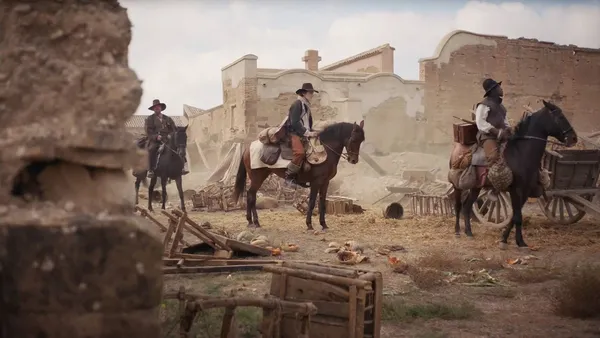
Tasked with the transportation job are young nobleman Alejandro (Théo Urtubey), a privileged dreamer who longs to venture to the New World, who is accompanied by battle-hardened soldier Jehan (Raphaël Thiéry, who looks as though he could have been carved from the landscape) and Jehan’s long-time cohort Antoine (Lazare Minoungou), now mute after having had his tongue cut out at some point in the Thirty Years War. Les Indes is a film built on opposing elements, the New World versus the Old World, the common man versus his overlords and shifting landscapes from desert terrain to snow. Even the construction of the film means it is bookended by the oppositional view of Maria Theresa and Louis.

Julier and Chapoulier draw on ideas from a Western as the trio attempt to make their way through the borderlands between France and Spain. The fluid territory is a sort of Wild West, where the next person you encounter could be friend or foe no matter what their mother tongue. Beyond that, it’s nature that holds the upper hand, with its presence recalling films as diverse as Kelly Reichardt’s First Cow and Lucretia Martel’s Zama.
The directors stick with these men, whose stories will be swallowed by history, as they face harsh landscapes, captured in all their stark glory by Sylvain Verdet. Les Indes isn’t just visually arresting but attentive to the ambient noise of the environment – rarely has the sound of falling snow been captured so evocatively. Their battle with the elements is in direct contrast to the affluent court at Versailles, where lavish gardens are being planned under the instruction that, "Nature must serve the state".
Alejandro may be dreaming of far off shores – an exoticised and romanticised imagining that the directors reinforce with intercuts of cartography, books and photography that he has been enthralled by – but the unknown is right on his doorstep. An encounter in a village which sees him drawn into a seasonal ritual every bit as primal and savage as anything he believes he might come across elsewhere. Meanwhile, the class divide that separates him from his fellow travellers begins to break down in an environment when they can only rely upon one another.
This desire for communication is encapsulated by Alejandro’s attempts to learn the sign language used by Antoine (a real-life trading language that was employed in the Americas). Julier and Chapoulier's film is a testimony to the multitude of lives that underpinned the ones history remembers and a reminder that paths can just as easily lead to war as they can peace.
Reviewed on: 14 Nov 2026