




|
|
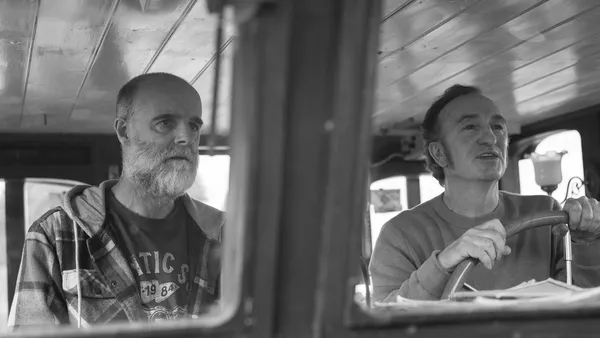
Brian F O'Byrne and Gary Lydon as Colum and Gerry in One Sweet Hour. Director Declan Recks: 'I think the more you like these people, and the more you're on the journey with them, the more invested you are'
Photo: Courtesy of POFF
|
Gentle comedy drama One Sweet Hour steps into the life of Gerry Byrne (Gary Lydon), an Elvis Presley impersonator, who tools up and down the Irish waterways to the pub venues he’s ‘toured’ for years. We meet him at the graveside of his father and he gets another shock when his brother Colum (Brian F O’Byrne), who left to become a monk years before suddenly turns up on his doorstep.
Director Declan Recks and his regular writing collaborator Eugene O’Brien gently probe at the brothers’ relationship and the shared trauma of their childhood offering the hopeful possibility of change and reconnection in a film that invites second viewings. One Sweet Hour had its world premiere at Tallinn Film Festival this week, where we caught up with Recks to chat about it.
Although the film tackles some serious subjects, including violence and grief, it does so with a light touch and plenty of humour, which Recks says partially sprang from O’Brien and he having shared projects together before.
|
|
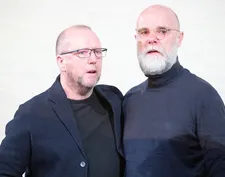
Declan Recks and Brian F O'Byrne in Tallinn
Photo: Courtesy of POFF
|
“It’s the fourth film that myself and Eugene O'Brien have done together. With our very first film, Eden, we felt like it lacked humour. As a result, it's quite serious. It did well for us, but we just felt it was a shame we didn't try to balance it a bit more.
“That was definitely foremost in our thoughts this time, getting the tone right and not making it too heavy. Obviously, it has some very emotional scenes, but I think the more you like these people, and the more you're on the journey with them, the more invested you are. Then the really emotional scenes really do bowl you over a bit more. But you don’t want to be beating people over the head with it.”
Bringing the film to Tallinn is also a bittersweet moment for the crew, since it was one of last roles taken on by Gary Lydon before his death in April.
“I don’t think any of us have really come to terms with it,” says Recks.
“We've only watched the film once as a cast and crew, without Gary there, and he never got to see the film.
“The last thing you saw was him coming in for some ADR, about six weeks before he died. That was the only bit of the finished film he saw.
“I think he's terrific in it. I’d worked with Gary a lot over the years, and when myself and Eugene started working on the film, it was always going to be Gary. We brought the script to him and said, ‘Look, we want you to do this part’.
“So I was always written for him. The only consolation we have is that we know he enjoyed his time on the film. He really threw himself into it and I was sitting beside his son James was at the cast and crew screening, and he said that he knows Gary had the best time and loved working on the film with Brian O’Byrne.”
He adds: “He was really coming into his own, he went straight from working on this film to another film as the lead. I’ve never seen him happier.
“But I'm delighted that his family and his partner all saw the film and loved it.”
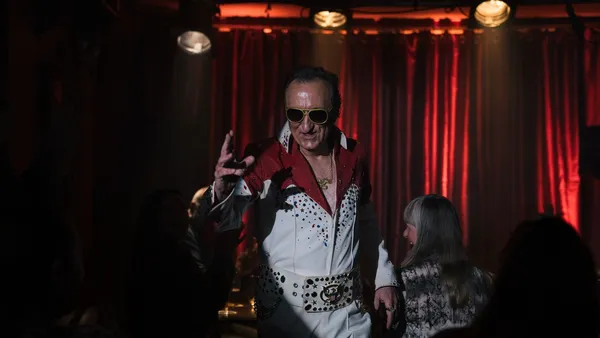
Pitching how good Gerry was as an Elvis act was also the subject of a lot of discussion. “We thought, he can’t be brilliant, but he can’t be completely shit,” says Recks. “But I think because we come to him at a point where things are not going great, we can allow for him to be not so good. I think the people who go to see him probably remember him from when he was really good. I knew he could sing because he’d been in a production of Borstal Boy. His son was in a band, so he set him up with a karaoke machine at home so he was practising with that.”
|
|
Gary as Gerry performing as Elvis. Declan Recks: 'We thought, he can’t be brilliant, but he can’t be completely shit'
Photo: Courtesy of POFF
|
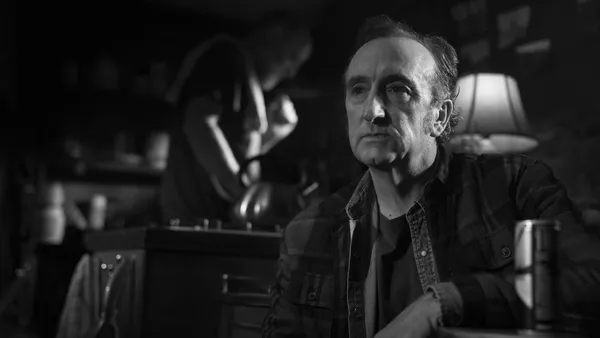
Formally, the film is interesting; it is mainly shot in black and white but with moments that bloom into colour, most notably when Gerry takes to the stage as The King for his “sweet hour” of performance. Recks says the choice, made with cinematographer Owen McPolin, was to help bring the audience into Gerry’s frame of mind. He also says they choose the square aspect ratio for the barge because “it felt like it trapped Gerry and his brother on the boat”.
He adds: “It forced us to keep them really close together. We also decided early on that we wouldn't ever see them in over-the-shoulder shots, just singles, to create that sense of being trapped. To trap the characters in the boat and force them together.
“Also, the black and white: his life doesn't have any colour. I know it's a bit literal, but that's what we thought. The moments of performance, it’s his one escape, when he manages to put on this mask and forget about his troubles.
“His journey is always forward, with a mantra of, ‘Don’t look back’ It’s a great Irish male trait to just keep going and just keep your head down and don’t think about the past. But if Colum hadn’t come into his life when he did, it would definitely be a very different ending for Gerry. The message of the film is that it’s never too late to tackle things and I think the ending of the film is quite upbeat.”
In terms of the barge where much of the action unfolds, it did present some challenges, although the director says it was certainly a lot easier than his previous feature Tarrac, which involved shooting rowers on the Atlantic Ocean.
He says: “Being on the canal was much simpler, obviously because you're going very slowly, but it does have its own problems in that, if you want to restage something, you've got to pull everything backwards – and they’re not designed to go backwards, they’re only designed to go forwards. We had a great marine coordinator, so we always had two boats with us to tow the boat and get it back.
“We spent about ten days on the barge in total. We only shot the wheelhouse and anything outside on the actual boat. We planned the schedule around where we were going. Then we spent about six or seven days just in locations for the performances, and then the last seven days on set for all the interiors because shooting on one of those boats is a real challenge.
“Obviously, as a low budget film it was quite a big thing to build a set but I said to the producer, either we build a set or you give us two more weeks. It was a good decision and it allowed us a lot more freedom in terms of where we put the camera.”
One Sweet Hour is built upon small details, so that indications of what has been going on in Gerry’s life are indicated not by labouring the point but by showing a scar here, and a whisky bottle there.
|
|
Gary Lydon as Gerry. Declan Recks: 'I think he's terrific in it. It was written for him'
Photo: Courtesy of POFF
|
Recks explains: “Gerry’s way of dealing with life is repetition and having a routine. That’s why we felt it was important to show the repetition and get people into that rhythm. That's how he's managed to control his life. He has to have order, and that's why he's not drinking at the moment.”
He adds: “There was a lot of pressure on us from funders to make the whole drinking a bigger deal but we just felt like we've seen all that before and audiences are quick so we’ll just give them a little clue and they'll put the pieces together. There were scenes in there but we said, ‘We don’t need them, let’s just chop them out and let’s trust the audience will pick up on these subtle clues and put it all together. I think it's far more interesting because of that.”
It’s also a film that could easily stand up to a rewatch, which was something the director also had in mind.
“We were conscious of that and also Brian brought a lot to that as well. He was on board from a couple of months before we started shooting and Gary was on from the beginning, so we managed to sit down and have actual conversations about the script. Brian brought a lot to that character because originally his character was coming in with a mission to save Gerry but Brian said, ‘What if I don't know why I’m here and I don't know what's going on?’ It made it far more interesting for the audience if he's kind of trying to figure out what he's supposed to be doing. I find those films satisfying where you can go back and get more meaning out of it.”