





Eye For Film >> Movies >> Liz Here Now (2026) Film Review



The architecture of power and responsibility in late Sixties America comes under scrutiny in this salient adaptation of Todd Connor’s childhood memoir. It’s a tribute to the woman Connor credits with saving his life, and it makes for a compelling drama, with complex characters and impressive performances all round.
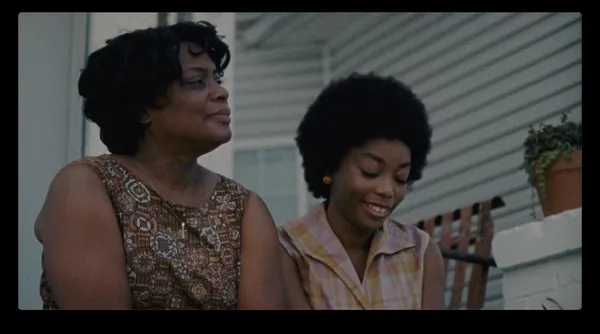
Heading up the cast is Aunjanue Ellis-Taylor as the titular Liz, a mother of two grown children who works as a maid and nanny for the wealthy white Connor family. They’re the kind of people who hold parties attended by the local mayor, and Liz prides herself on her proximity to them, confident that they would help her if she ever really needed anything. Her kids see the world very differently. Her daughter Debra (Caisey Cole) has barely spoken to her since losing her husband in an incident with the police, towards whom she felt that Liz showed far too much sympathy. Son Troy (Patrick Newson), who still lives at home, is involved in the civil rights movement and the fraught racial politics of late 1960s Oakland. A friend of his gently suggests that she try speaking to her white contacts about the situation there, to see how far she gets.

Real understanding of how powerful white people perceive her comes to Liz in a more devastating way when she finds little Todd (Brady Wagner) covered in bruises. For all the discussions of abuse that go on today in cinema, it’s rare to see physical damage like this on a child, and some viewers will find it acutely distressing. It’s obvious that it can’t be ignored. The difficulty is that Liz can’t persuade anyone to take action. It gradually becomes apparent to her that the boy’s mother, Jane (Rachelle Lefevre), is suffering from some form of psychotic illness, placing both Todd and his sister Chrissy (Aniela Zeig) in danger. Their father, Frank (Ryan Wesley Gilreath), a doctor, is aware of this but determined to handle it himself, fearful of scandal. When Chrissy too suffers a horrific injury, Liz feels compelled to take drastic action.
There’s a delicate balance of emotion between Frank and Jane, a sense that they once loved each other and are both, in their own ways, trying to hold onto that, but his demanding job and sometime need to escape from the pressure of caring for her has convinced her that he’s having affairs, leading to pathological jealousy which she takes out on the children at the slightest perceived infraction. It’s equally clear that, despite this, she loves them and wants to be a better mother. In one scene, where she sits at her dressing table and the camera plays with her multiple reflections, she reaches out to Liz for advice, impressed by the easy way she connects with them. There is a moment of real connection and warmth as Liz tries to help, but of course, her real advantage is that the kids are not terrified of her. With the best will in the world, what Jane has done is hard to undo.
There’s an awful loneliness about Jane, skilfully captured by Lefevre. She’s isolated both within her family and without. For all that her neighbours are ready to back her up in defence of white privilege, none of them actually wants to spend time with her, aware that she’s unbalanced; and that exacerbates her condition too. Though circumstances place them increasingly at odds, Liz is her best hope of friendship. We observe this exquisitely unhappy family in contrast with Liz’s own, where we are teased with the prospect that she and Debra might reconnect, their differences being as much generational as personal, and the house is always full of warmth. Director Sterling Macer Jr captures this in little ways. Troy helps Liz prepare a business proposition she wants to make as she shows him how to fasten his tie. She and her husband Clayman (Cedric Mays) argue, but it’s always clear that they have one another’s best interests at heart.
Macer Jr, an actor himself, brings out the best in every member of his cast. Ellis-Taylor brings the forcefulness she’s known for but keeps it under wraps for a long time, locating Liz in a complex web of insecurities. At a party, the camera moves through the room at her height, the smartly dressed white men around her literally looking down at her as she serves them. One must step back from a modern perspective to realise that in Liz’s eyes this is a good, empowering job, so she has simply taken it for granted that she will be respected. Over the course of the film, the language she uses to describe herself changes. Macer Jr never belabours the point, but we see her come into a fuller awareness of herself, her place in US society, and the real source of her power.
Bookended by Super-8 scenes as the family poses for photographs, the film diligently recreates an age not so very long before our own, blending visual nostalgia with deep social discomfort. In the process, it gives viewers room to appreciate the effort involved in its heroine’s journey and the courage it took for her to stand up in circumstances when far too many people look away.
Reviewed on: 15 Nov 2026


Director: Sterling Macer Jr
Writer: Sterling Macer Jr, Grant Nieporte, Caleb G Brown, based on the memoir by Todd Connor
Starring: Aunjanue Ellis-Taylor, Rachelle Lefevre, Caisey Cole, D.J. Stroud, Patrick Walker, Ryan Wesley Gilreath, Brady Wagner, Cedric Mays, Patrick Newson Jr., Aniela Zeig
Year: 2026
Runtime: 127 minutes
Country: US
Festivals:
Search database: