





Eye For Film >> Movies >> Musk (2026) Film Review



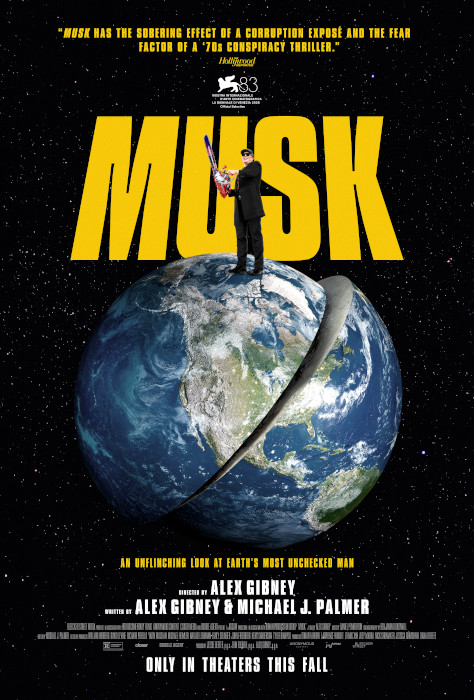
He’s the wealthiest man in the world, with legions of adoring fans and no shortage of detractors – so why has the new documentary about Elon Musk struggled to attract viewers in US cinemas? Yes, it’s long, at three hours and 42 minutes, but films of all kinds have been getting longer lately and this doesn’t seem to put people off. The bigger reason would seem to be simply that people don’t know it exists, after the unprecedented blocking of its advertising and trailer across X, YouTube, Facebook, Instagram and TikTok. It’s almost as if somebody doesn’t want you to see it.
A seasoned documentarian with impressive credits to his name, Alex Gibney is known for delivering sensitive analyses of difficult subjects, yet Musk, when given the chance to contribute to the telling of his own story, declined to be interviewed by him. Gibney handled this in a manner congruent with his subject. Woven throughout the film are clips of an ‘interview’ with a virtual Musk, built entirely out of things he has previously said. In another context this might be considered scandalous, but given his own behaviour, it’s difficult to criticise, and it’s well worked out so as to avoid inaccurate representation of his expressed views. His head is too big, making him look a little creepy, but that might be read as metaphor, and mercifully it is not until the end of the film that viewers are required to deal with (partially) nudified versions of him.

What the interview does is help to inform a timeline taking us through Musk’s life from the point where he first set up a company in the US – with his false claim that he started with nothing – to his involvement in the 2024 US election and, subsequently, his leadership of the DOGE project which is estimated to have led to the loss of 14 million lives around the world. There are occasional references to his childhood, including the domestic violence he was likely witness to, and the incident in which his father shot dead three intruders as they fled (and got away with it, of course, because that was how things worked in South Africa at the time). Did those things shape who he was as a person? The film makes no attempt to analyse this, but does later incorporate his notorious quotes about empathy being dangerous. One can see how a kid growing up in such circumstances might have convinced himself of that.
This is one of several points in the film at which Musk comes across as profoundly damaged. Most survivors of abusive homes do not go on to harm others, of course, but there is perhaps a special kind of damage caused not by abuse but by a lack of boundaries, and Musk’s wealth has put him in a position where for much of his adult life he has had no boundaries at all. His ranting about Covid lockdowns is notably disproportionate, suggesting that it was one of very few occasions on which he was told ‘No’ – not that he listened, obliging his workers to come in anyway, and statistics on the damage that did are reproduced here.
If it is difficult to find comparators through which to assess his behaviour on the world stage, the same is not true of his personal relationships. Justine Musk (the author of Starter Wife) makes a substantial contribution here. It may be an artefact of the editing, or of passing time, but she comes across as significantly less willing to make allowances than she did in her book. There is also a lengthy interview with Ashley St Clair, the sometime Conservative opinion-provider who had a child with him and saw him lose interest as soon as the kid was born. Assorted small sons run around after him when he is promoting engineering projects or appearing at political events. The only one of his 13 known surviving children to speak is daughter Vivian, from whom he became estranged after her transition. She really doesn’t come across as the helpless victim, incapable of knowing her own mind, that he portrays her as.
There is a lot more that could be said about each of these relationships and its fallout, but keeping things concise is the challenge facing Gibney throughout. Naturally, a good part of the film is focused on Musk’s business endeavours, with several accomplished former colleagues coming forward to share their thoughts. Musk receives some praise as an engineer, but that doesn’t extend to his companies’ products. There is some grim imagery in the section on Tesla cars’ poor safety record, with due attention to his decision to strip out highly effective but expensive lidar systems in favour of cameras. Gibney suggests an additional possible motive for that which contributes to a thread throughout the film concerning his interest in information-gathering, monitoring and control.
If there’s a weakness to the film, it’s that there are relatively few threads like this, and it can feel quite episodic. This may partly be a consequence of caution. In some areas, Musk is quite explicitly called out as a scam artist, but in others the evidence simply isn’t there to enable this to be addressed in a legally safe way, no matter what conclusions viewers may draw from what they do see. What does come through quite clearly is the subject’s childlike quality. It’s obvious that this has endeared him to a number of people, sometimes to their later regret. It’s equally obvious that it makes him dangerous, as his poorly regulated emotions result in impulsive decisions with sometimes catastrophic effects on other people.
It’s barely touched upon directly – one absurd claim to genius aside – but Gibney makes reference to Musk’s fondness for computer games in the construction of extended sets behind interviewees, and in little interlinking sequences. There’s some nice work here and it helps to bring a little consistency to the project.
Ultimately, there’s not a great deal in the film that will be new to those who have already been paying attention, but bringing it all together across different fields has value, and highlights the sheer number of incidents which, under normal circumstances, would be career-ending or at least destructive of public trust. There is a sense that Musk’s ability to date to get away with it all is due in large part to momentum, which certainly made this an interesting film to watch as the results of the US midterm elections, ahead of which he spent $446m attempting to bolster the losing side, came in.
Musk comes across as having a genuinely passionate commitment to the future, but just not one that squares with the vast scale of damage being done in the present; and when one has grown up with the same science fiction novels, it’s easy to see how much of his supposed wisdom is borrowed and poorly understood, exercised with no regard to the warnings in those same tomes. In endeavouring to provide real insights about the man, Gibney has to dig through a weight of illusion and affectation. The danger is that what he finds underneath it all is interesting only in its consequences and has, otherwise, little with which to compel attention.
Reviewed on: 06 Nov 2026


Search database: