





Eye For Film >> Movies >> American Doctor (2026) Film Review



It’s always a difficult ethical question in filmmaking: how far should one go in showing atrocities onscreen? Most directors would rather win people over with persuasion than with shock. They don’t want to traumatise their viewers. They certainly don’t want people to avoid a film because of what they have heard about its imagery. There are also concerns about respect for the dead, and for their living relatives. Sometimes, however, other concerns override all this. At the start of Poh Si Teng’s American Doctor, one of its subjects begs her to show one particular image: dead and dying Palestinian babies, all in a row. “This is what my tax dollars did,” he says.
It is not disproportionate, here, to use an image of dead children. Multiple reliable sources have confirmed that children are being killed in Gaza at a disproportionate rate. Dr Feroze Sidhwa explains that, in every city in the area, healthcare workers regularly see children who have been shot in the head. They themselves are also dying at such a high rate that it’s obvious they are being deliberately targeted, especially when it comes to ‘double tap’ strikes – bombing an area, waiting a short while and then bombing it again so as to kill or injure the people who have gone to help. The third group is journalists. The Israeli regime depends on subsidies from other nations. It is not in its interests to let the truth get out.
“When you feel so mad that you wanna roar, take a deep breath and count to four,” a small girl advises one of the film’s other participants, and it’s good advice for viewers too.
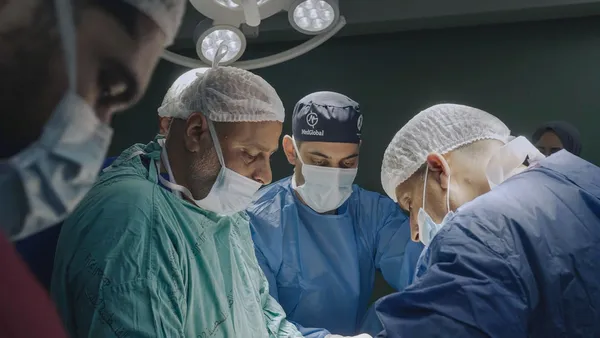
There are three of American doctors in total, going to Gaza to do what they can. Feroze serves in a relatively peaceful area in the middle of the Strip. Thaer Ahmad is in Nasr Hospital in Khan Younis, dealing with the fallout from near constant attacks. Mark Perlmutter is still in the US when we meet him. hugging goodbye to a wife who understands the risk he’s taking all too well, though it is his dog who protests and tries to stop him from leaving. He has to fly to Jordan and then find a way to cross the border by car, packs of antibiotics – which Israel refuses to let through to those in need – hidden throughout his baggage.
A fourth doctor, unsuccessful in his efforts to get to Gaza, helps in whatever ways he can. This enables the film to move between intense scenes within Gaza itself, and the US, where it’s easier to breathe, to stand back and think about what it all means, what else might be done to staunch the horrors beyond patching up individual wounds in hospitals overflowing with the dying. It’s often said that less is more in this situation. People who feel overwhelmed tend to retreat into apathy, so documentarians avoid showing the worst of the horrors. The thing is that, as anyone who has engaged directly with medics in Gaza will know, when we hear people screaming in blood-splattered hallways and see children lying on trolleys with their limbs barely attached, Poh is avoiding the worst of the horrors.
We see doctors preparing for a medical workers’ advocacy meeting in the US. Doctors strive not to be political, but in this case many feel compelled to do things differently. They are tired of studio news presenters treating it as controversial when they say that hospitals should not be bombed. Some clearly struggle to understand how human beings can think like that. The fascinating idea arises that genocide itself might be modelled as a disease, making it possible for it to be understood and treated in a politically neutral way, perhaps getting at its underlying causes in a way that has been impossible heretofore.
On a clip from a US news programme, we see one doctor trying to explain that there hasn’t been a meaningful ceasefire in Palestine since 1948. We see what the relentlessness of it all means for those trying to help; their exhaustion met by the guilt they nevertheless feel when it’s time to leave. Finally, a postscript updates viewers on what has happened since the main shoot was completed. It’s no prettier. Thaer talks of the need for accountability and justice. First and foremost, one might think, there is a need simply for life.
Reviewed on: 06 Jul 2026