





Eye For Film >> Movies >> Forsaken (2026) Film Review



Samuel Paty was a middle school teacher in Éragny-sur-Oise, a northwestern suburb of Paris. On October 16, 2020, he was killed and beheaded by the 18-year-old Abdoullakh Anzorov, a Chechen immigrant from Russia, in a terror attack. Paty’s “crime” was that he had allegedly shown the caricatures of Prophet Muhammad at the civics classes for the eighth- and ninth-graders published in the magazine Charlie Hebdo that itself had been the target of the terror attack five years previously.
Alongside Anzorov, two of the “inspirers” who led the defamation campaign online, one a radical imam and the father of the girl who was the first to accuse the teacher of blasphemy, were also jailed, while several grade school students received short prison or suspended sentences for unwittingly helping the assailant.
Directed by Vincent Garenq, who is somewhat of a true crime docudrama specialist with films including Guilty (2011) and Kalinka (2016) under his belt, Forsaken tells the story of Paty’s last 11 days, from the disputed class until the very murder. It premiered out of competition at Cannes and had almost no festival exposure, which resulted in the film being largely overlooked by the critics, but it somehow found its way to the newly renewed Skopje Film Festival. Nevertheless, it is one of the most important “topical” movies of the year.
We meet Paty (Antoine Reinartz) on the day and just before the murder. Through the unsubtle, yet highly effective instrument of voice-over narration, he informs the viewers that he never wanted to be a hero or a famous person, but rather an anonymous one left alone to do the job he was paid for.
The plot then jumps back to 11 days earlier and to the class. The topics of it are the freedom of press and freedom of speech, and Paty uses the disputed Charlie Hebdo caricatures as the curriculum-approved example. Before showing them, he informs his students what he is about to do, encouraging those who might be offended by them to avert their eyes or to briefly exit the classroom, which some of them do, before coming back to take part in a debate.
At the same time, the student Bashira (Emma Boumali) is in trouble for skipping classes and behaving disrespectfully towards the teachers and school administration, and when she hears about the incident, she thinks of how to get out of the trouble with her parents. She conceives a lie about being kicked out of the class by a racist islamophobe of a teacher, and her father Kader (Nedjim Bouizzoul) starts a campaign against Paty. One of the first to join it is the controversial preacher and activist Tahar Amara (Azize Kabouche) who steers it into a radically manipulative direction.
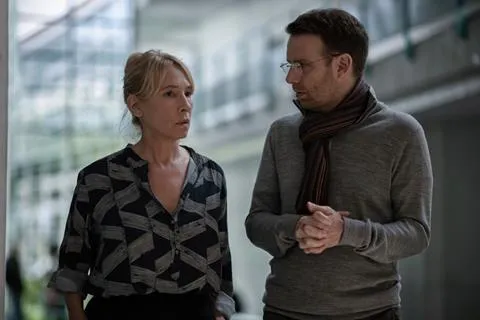
The school staff, lead by the principal Lainon (Emmanuelle Bercot), however, have to deal with the threat by going through several procedures, all complicated and some contradictory, while the authorities try to avoid any kind of responsibility. The teaching staff also becomes divided, with the minority defending their colleague’s professional ethics, another minority siding with those who attack him, and the silent majority just wanting the status quo to be re-established.
While everybody just waits for the whole thing to blow over, Paty feels more and more forsaken and abandoned by his students, their parents, his colleagues and the very system that should have protected him. And then, Anzorov (Guzman Battle) appears in front of the school…
Working from the script he co-wrote with Alexis Kebbas, based on a non-fiction book by Stéphane Simon and input from Paty’s sister, Mickaëlle, Garenq tries and manages to teach his own lesson on the importance of civil liberties, but also on the responsibilities needed for society to function. Using the precise language in the dialogue, he distinguishes between the religious freedom and the constitutional secularity of the state. Also, he offers a study in social psychology and psychology of the masses, pointing out that Amara and Kader did not enjoy the support of the majority of the local Muslim community for their action, but got their attention online, via social media. They themselves, or, more precisely, the lack of control over them, is the point of Garenq’s lecture, as is the confronting the incompetence of the different security and social services in French society who are paralysed by bureaucracy more interested in public image than doing the necessary “dirty” work.
The style he opts for is unspectacular, precise and somewhat plain. The director’s hand remains pretty much invisible, so Forsaken at times looks like an observational documentary, for better or for worse. The latter certainly stands for the lack of additional lighting, which makes certain scenes appear unnecessarily dark and murky. One other minor issue might be the lack of the period specific – and it is the time of the pandemic measures – details, but for the story and the point of the film it is of a secondary importance.
Garenq makes up for everything by the detailed character build-up and the instructions to the actors regarding how to play them. The interpretation of Samuel Paty by Reinartz is suitably restrained and subtle, as he portrays Samuel as an archetype of a good teacher dedicated to his job, albeit slightly clumsy in details (reading jokes from a notebook is a lovely touch of “dad humour”), a good father, good friend and model citizen. However, most of the heavy lifting is left to Bercot, who plays the principal as a woman who genuinely wants to help and resolve the situation, but whose hands are tied by the same system she serves.
Reviewed on: 19 Nov 2026