




|
|
Rule, Britannia
|
“I feel very strongly that the debate around refugees in our country has become incredibly polarised, and there isn't really any room left for sensible debate or dispute discussion,” says Max Fisher, reflecting on his short film, Rule, Britannia. “I wanted to make a film which explored some of the core themes about why we have an asylum policy, why is it important to look after other people who are in danger, or why might you not do that. At a time when it seems like either you welcome refugees, on the left, or you say “We don't want any of them here,” on the right, there doesn't seem to be any middle ground.”
In taking on one of the most contentious issues in UK politics, Max’s film has attracted a lot of attention, and now it has qualified for both BAFTA and Oscar consideration. For him, though, what’s most important is starting a conversation.
“I think people who have concerns about migration and refugees, it's important that they are heard as well and that they are not just completely demonised and made out to be racists across the board. I wanted to try and find a middle ground to explore these issues, and it seemed to me like this idea of some refugee vigilantes sinking and having their lives in danger was the perfect way to do that.”
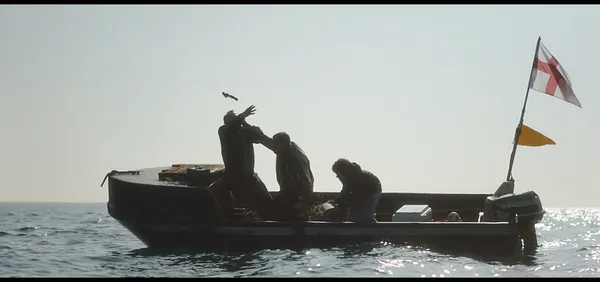
The film, which follows two brothers with a good bit of alcohol in their systems and not much experience of handling boats, also features a child, the son of one of them, which serves as a reminder that some people are brought up to be hostile to those they see as outsiders.
“All of my work involves children in one way or another,” says Max. “I think I'm stuck in my own childhood in a way, but I have three young children of my own. I feel like if we walk in step with this growing tide of casual racism, it won't be long until our children live in a world which we might not even be able to conceive now, where really hateful politics are the norm, where our children are dealing with levels of political division and hatred that are inconceivable now.
“So the idea is that this one guy on a drunken bender just thinks ‘Oh, yeah, cool, I'll take my son out with us. That'll be a laugh.’ And then he sobers up and finds himself in the consequences of having come along with his brother into this place. Now they're stuck on a boat in the middle of the Channel with nowhere to go. And that as metaphor for what will happen if we walk in step with these politicians, the Farages of the world, is a very important part of the film.”
Ensuring that we pay attention is a brutal opening scene in which we see a child in severe distress in the water, gradually getting pulled down by unseen currents. That must have been a very difficult scene to film.
“We had to find a child who was comfortable in shooting that drowning scene, and then we had to find a really good water safety team,” Max explains. “We didn't shoot any of it in a tank. That shot is in the sea, for real. I wanted this very arresting image at the start of the film. This is a little white boy who could be from anywhere in the UK, drowning. I wanted just to put it in the face of the viewer. This is possible, this can happen. Because so many of us, our lives are never threatened, right?
“I guess I could crash my car or whatever, but these real life and deaths situations are alien to most Brits in a way that they are not to so many Somalians or Sudanese or Afghans or Eritreans or people who flee civil war and famine to come here. So I wanted to create this very arresting image of a child drowning and really confront the audience with it without explaining it. That was an important thing for the whole film. I didn't want it to be too on the nose. I wanted just to say ‘This is what a child drowning could look like.’
“The filming of it was really traumatic and difficult. His dad was there and really struggled to watch. I remember sitting in the sound studio when we were doing the ADR and getting him to do those gurgles, and I remember turning around and seeing his dad, and his dad's face was as white as a sheet, and a couple of people in the sound booth were in tears. His dad turned to me and said ‘His granny can never see this.’ I mean, I imagine his gran probably has seen it. Tom [Page-Turner] is a brilliant actor and his family are all very proud of him, but what I'm saying is the intensity of portraying a child drowning like that was a really big responsibility.”
I tell him that I think it’s also important in establishing that human conflicts pale in comparison to the threat posed by the sea, which is much bigger and scarier than any individual out there.
“That's right, and I feel that very strongly. That was one of the reasons that we wanted to film out in the sea. My co writer, Ayman Alhussein, he is a refugee who has done a longer boat journey. He did the one across the Med, which is much more dangerous, I think, than the one across the Channel.”
They involve different dangers, I suggest, thinking of how much shipping there is in the Channel.
“Yes, different dangers. And we were very clear that we wanted to be right out there and to feel this terrifying force and size and scale of the sea. We had something like seven boats, so we had this big marine team. We had a kind of unit base which was on a big crane – we needed a crane to pull the boat up when it sank. And we had diving boats. We were a flotilla, but still we felt tiny in the face of the Channel and these huge tankers going past.
“You think, God, what where would your life have to be for you to get onto an overloaded dinghy with your kids – run by awful people who have no capacity to take that risk – with human traffickers, to try and cross the Channel? All of us on the shoot got brought down to Earth by the experience of shooting out there. And it was incredibly hard.
“The boat was rigged to sink, because a boat doesn't sink that easily. In order for the boat to actually sink, we had to have it rigged with sandbags, and early on in the experience, the one when the man stands up to take a pee and he holds onto the flag, he fell in and part of the boat broke off, and the boat started to sink for real. So the actors were bailing out in between takes. It was really scary. In the end, we had to bring the whole shoot a little bit closer to shore. Not very close to shore, but just so that the swell and the wind weren't baffling us quite as much. And then we painted out some of the horizons in post because I really wanted the film to feel always like there is nowhere to go, there's nowhere to hide. We’re so tiny in the face of this great, huge body of water.”
The film just seems to keep getting more relevant. Since he shot, people have been putting themselves at risk in the Channel in all sorts of ways, and Daniel Thomas slashed a dinghy out at sea, plus there have been threats to the very services that rescue people in such peril.
“It is unbelievable how this process has happened and the timeline,” Max says. “We first wrote it in 2024 when there was no real anti-refugee vigilantism at all. And then the original guys, who called themselves Operation Overlord, I believe, started to go over and slash dinghies on the shore in Calais. They started to confront the people on the shore. And then there was a split within that group and Danny Thomas started to lead his own operations. The crazy thing is we wrote drafts of this script which we abandoned because we felt like they were fanciful and it didn't make any sense. It could never happen. And Danny Thomas has been going out and doing it.
“You know the famous video where he's out stabbing up a rescue boat? We wrote that scene and then we just threw it out because we said, ‘Well, no one's ever going to do that.’ And now he's doing it. It’s surreal and saddening to see how what we wrote as a sort of allegorical exploration of where hateful ideology could take us is now everyday news. It doesn't even seem that weird anymore.”
There is another aspect to the film, I note, whereby the father and the boy begin to recognise their similarity to the refugees in that situation, which is something that we're yet to see in that way in real life.
“I think there is some empathy and I do think there's hope for humans,” he says. “I do think there's hope for the UK, actually. It was a fascinating experience writing the film. Ayman Alhussein and I wrote the film together and it was very important to me that I had that other voice that could share this experience, because I wanted to write a film right where the right wing guys were saved by the refugees and that changed them. That was my art, the way that I had planned it.
Ayman lived in the Calais jungle and he's experienced all sorts of terrible racism and treatment by these types of people, as have so many refugees. And he was insistent, no, you can't just tie this off with a happy bow just for the sake of wanting to make a film with a nice three act structure, he says: this is not reality. The reality is much more complex and much deeper and in a way darker. And so he and I really wrestled with each other across the creative process.
“In the end I realised that he was right and that we couldn't resolve these characters just like that, and that what we needed was an open ending which raised questions rather than tried to give answers. That's the really important thing for me. I want to make films which make people think, which make people on both sides of the divide think, right? Not films which say hey, you know, it's this or it's that, because why bother speaking to people in your own echo chamber anyway?
I would like to think that many people are like the Rob character, who essentially doesn't like migrants and came out on this trip but has had this experience and now that he and his son are in danger, he's had a bit of a shift. I'd like to think that those people whose minds are in that place could watch the film and could maybe think, ‘Yeah, okay, maybe I get that.’”
Finally, we discuss the awards race.
“I very much hope that we will move forward in that,” he says, but adds that the film was not about trying to win awards. “What I want is to start conversations around the state of our country, so it's great that we're in the running for these big awards, but what I really want is eyeballs on the film and exposure, and I hope to get the film in front of as many people as I can and continue playing festivals and continue starting conversations. That's the main thing.
“Of course it’s good just to be mentioned in the conversation alongside such talented filmmakers who I admire. There are so many brilliant short films. I have followed the film around the festival circuit and I have been amazed by the quality of short films, not just in the UK but all over the world. It's a great honour to be listed amongst those.”