





Eye For Film >> Movies >> Fjord (2026) Film Review


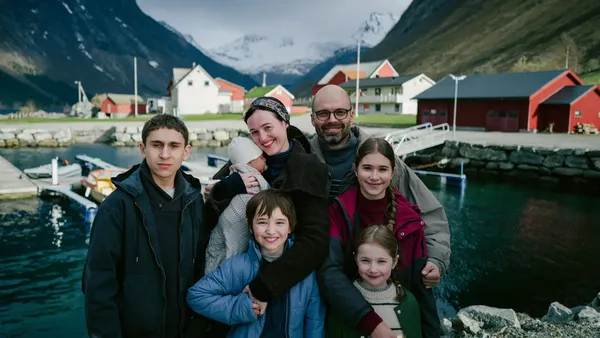

Cristian Mungiu’s Fjord opens on a landscape that seems almost too vast for human argument. In a northern Norwegian fjord town, tall mountains tower over valleys and coasts where sunlight barely reaches, blocked as much by geography as by the season’s short days. Into this cold, immense beauty arrives the Gheorghiu family: Romanian father Mihai (Sebastian Stan), Norwegian mother Lisbet (Renate Reinsve), and their five children.
They are devout Christians, raising their children with strict religious discipline. Their teenage daughter Elia (Vanessa Ceban) and son Emmanuel (Jonathan Ciprian Breazu) do not have phones. They do not listen to modern music. Early on, after scolding Elia, Mihai tells her, with the stern certainty familiar to many immigrant fathers: “You need to learn to admit when you’re wrong.” It is a line that will eventually turn back on him.
The Gheorghius’ new neighbors, Mats (Markus Tønseth) and Mia Halberg (Lisa Carlehed), live according to a very different set of assumptions. Mats’s daughter Noora (Henrikke Lund-Olsen), from his first marriage, belongs to the same generation as Elia and Emmanuel, but she carries the wounds of another kind of upbringing. Her freedom is modern, digital and permissive, yet it has not protected her from psychological distress. While showing her new neighbors around, Noora threatens to cut her wrist if they do not get on a boat with her, and then does exactly that.
Mungiu sets up a drama that cuts both ways. When Elia goes to school with bruises, the Gheorghius are reported to Child Services, and the question of parenting becomes a question of law, assimilation and state power. What begins as a story of an immigrant family adapting to a new country turns into a courtroom drama. Still, Mungiu refuses the easy satisfactions of a courtroom verdict. Everyone is placed on trial. The parents, the state, the neighbors, the school, religion, secular liberalism and even the audience itself.
The courtroom, with its seaside view and floor-to-ceiling windows, almost has no business being a courtroom. Yet it becomes a place where words that sound similar reveal chasms between them. Discipline, abuse, freedom, protection, faith, autonomy – each term changes meaning depending on who is speaking. Mia, who becomes the family’s legal representative, is the most compelling moral presence. Played with superb restraint by Carlehed, she occupies a fragile center, trying to understand both sides while refusing to surrender her own beliefs. In a film pulled between religious conservatism and progressive secular authority, she becomes the rare character who listens without collapsing into neutrality.
Mungiu’s eye moves between the juggernaut and the barely visible. He shows us an avalanche, and a town that barely flinches at the sight of it. He also shows us a bruise on a child’s back, and builds an entire social, legal and philosophical crisis around it. The suggestion is clear. Human beings are merchants of meaning, but the currency changes from place to place. What one culture understands as discipline, another reads as violence. What one parent calls freedom, another sees as neglect.
The Romanian director is also sharply disillusioned about the idea of a single, unified Europe. The Gheorghius arrive in Norway only to discover that Europeanness has tiers. There are jokes about vampires, names are mispronounced, and a subtle hierarchy opens between East and West, between those who belong comfortably to the continent’s liberal self-image and those who are admitted into it with conditions attached. Mungiu has always been alert to institutions and the violence hidden inside procedure, but here he widens the frame. Fjord becomes about Europe as an idea that sounds noble until people from its supposedly equal parts are forced to live under one another’s assumptions.
At moments, notes of satire reverberate through all the ice. Romanian embassy officials appear, Mihai turns to social media, and American rhetoric about religious freedom enters with an almost absurd charge. Mungiu knows this territory too well to treat it innocently. He sees how quickly sincere belief can become performance, how quickly a family crisis can be absorbed into larger ideological wars. Fjord arrives at a time when many forces within Europe are trying to solidify the continent’s Christian identity, often by declaring war on liberalism while borrowing its language of rights. The challenge is understanding that contradiction without flattening it.
Stan and Reinsve give controlled, muted performances, though neither are always allowed the full range their casting promises. Mihai and Lisbet are less vehicles for star performance than pressure points in Mungiu’s argument. That restraint is defensible, but it also leaves parts of the family emotionally underlit. Systems around them are prioritised at the expense of psychological release.
Still, Fjord is powerful precisely because it is untidy. That is a compliment. Mungiu does not solve the quarrel between religious freedom and progressive freedom, nor does he pretend that both sides are equal in power or harm. He asks harder questions. When does one person’s freedom begin to injure another? Is there a meaningful difference between a slap, a kick and a hit? Should all corporal punishment be treated as the same moral atrocity? And can a state protect children without becoming another instrument of coercion?
Mungiu offers no comforting answers. History suggests that no one is easily broken to another person’s will. By the end, the question hanging over Fjord is the one Mihai himself raised at the beginning: can a man who demands that his child admit when they are wrong learn to do the same himself?
Reviewed on: 20 May 2026


