




 |
| Gays Against Guns |
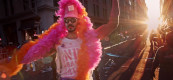
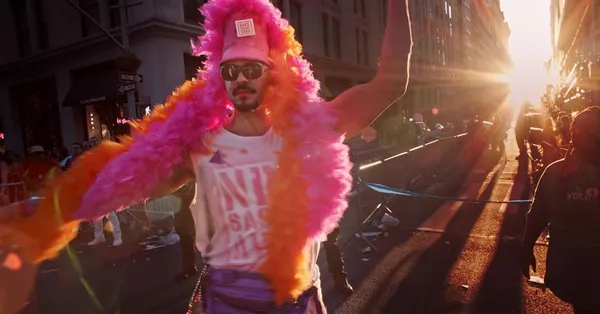
The movement against gun violence in the US is expansive these days, and multifarious, but still, Paul Rowley’s documentary Gays Against Guns – named after the campaign group it features – may show you a side of it that you haven’t seen before. It’s spectacular, colourful, full of energy and capable of finding healing humour in bleak situations. It also includes the commemorative ritual of the human beings, veiled white figures who walk solemnly carrying pictures of fatal shooting victims, ready to talk about their lives to anyone who asks. It’s a movement that was born a decade ago following the shooting at the Florida nightclub Pulse, but it now has a presence which extends to providing support and pushing for change in relation to shootings in many different communities.
The documentary, recently screened at Newfest, is also a very personal project for Paul, who is himself a member of the group. Born in Dublin, he headed for NYC as soon as he was able to, eager to join its thriving scene. Was he able to plunge straight into that community, I ask, or was he a nervous newcomer?
“Oh, I was very nervous,” he says, with a smile. “I mean, I was a youngster. I was just coming from Ireland where we had some gay culture, a lot of underground bars and that kind of thing, but it was still totally illegal to be gay, so there was all the culture that you'd imagine goes on with that. So coming to New York, I went to my first Gay Pride march. I stood on the corner of Christopher Street and saw the Dykes on Bikes driving past. It was such an emotional moment, just crying on the side of the street and feeling like, wow. I felt like I jumped into the future.
”New York and the US has been really good for me as a queer person. I've made so many great connections and I really do feel, as I mentioned in the film, that I've done a lot of things that I may not have really pushed myself to do If I was still in Ireland. I don't know. It would have been a different life. But I do find the diversity in New York and the diversity also within the queer community here so inspiring, constantly – which is kind of where the film came from, because the Pulse attack was such a direct attack on all of that, and it was felt so profoundly around the world by so many of us. That was kind of the catalyst, that was what sparked me on the opportunity.
And the movement, Gays Against Guns, is also about queer people giving something back to that society that's made the better things possible.
“I think so. So many of these rights were so hard fought for. We see footage in the film from the first Christopher Street march in 1970, and when you think of the strides that people started to make there, you know – and then of course, we had the impact of the AIDS crisis, which set us all back decades, if not more. And then fighting back against the Republicans here and all of that through the Nineties and the Noughties. And then in the 2000s, we started to feel like things were possibly going to be okay. We were getting gay marriage, and there was a lot more tolerance and acceptance and even celebration among the general public. We see ourselves on television, you know? We see trans people getting elected into public office, so we really feel that the movement is starting to pay off – all the work of these people.
“I think that's why Pulse was such an assault. You know, the idea that somebody would walk into a gay club and murder all these people and do it with weapons that had been legally purchased. And then Rick Scott, who was the governor of Florida at the time, I just remember so clearly during all the press events around the shooting, he would never used the word ‘gay’. He never used any words to describe the community, but we've seen, of course, especially now, the second Trump presidency, the escalation of that sentiment, of that disregard.”
So how did he start making contact with the survivors of the Pulse shooting?
“I got involved with Gays Against Guns on the first day that they protested, because so many people were like, ‘Oh, I want to do something.’ But it's like any of these giant issues, especially in a country like the US. It's like, ‘Where do I start? What do I do?’ Especially with guns, I think, because it's just so entrenched in so many Americans’ sense of national identity to be gun owners. So it's always been this issue that people go like, ‘Oh, it's too big anyway.’
“I've never really been fully immersed in it because of coming from Ireland and not having grown up in that culture of gun ownership or military weapons being owned by civilians, so I showed up to the Gays Against Guns Pride march with my camera, and then I started to volunteer. I was volunteering with the group for several years, making videos for their social media and helping them out with graphic design and that kind of thing.
“About three years in, maybe 2018 or 2019, I thought, ‘Well, I've met so many incredible people and I've learned so much from them, maybe I need to sit people down and do a series of interviews, for archival purposes, if nothing else: to document this movement. Then I was like, ‘Okay, maybe there's a documentary here.’ I had Just finished a short film called The Red Tree in 2018, which was about Mussolini's prison island for gays, and I was like, ‘Okay, what do I want to do next?’
“Initially, I thought I was going to make a short film, and then it just kept expanding because it's such a hugely complicated issue and there are so many ways to come into it. And then through Gays Against Guns members, I met survivors. Antonius, the artist, is one of the key participants in the film. I met him at A Gays Against Guns action where he was being a human being.
“Bailey Reeves’ family I met through my volunteer work with Gays Against Guns, because for November is Transgender Month of Remembrance, Transgender Day of Remembrance being the main focus. I had designed a social media campaign throughout the month of November in 2019, where each day we would honour the life of a trans person who had been shot, with a social media posting and a placard, much like the placards that are carried in the streets by the human beings. And one of those people that we featured was Bailey. Bailey's mom saw this and reached out to us on Instagram, so I sent her a copy of the placard. And then when were really sure were going to make a documentary, I said ‘Would you be interested in speaking to us?’ Because Bailey's story really connects with me personally.”
A lot of films about the community treat us as if we're completely separate from everybody else, I observe, so it's a powerful thing to talk to a family and show how other people are affected when we're attacked. The way that Gays Against Guns is working with other kinds of survivors of other attacks is about knitting everybody together again and stopping that king of division.
“I think that's really important,” he agrees. “There's so much divisiveness. There always has been. You think of that famous speech that Sylvia Rivera gave in Washington Square park In the early Seventies when she's screaming at these cis white men, she's like, ‘I'm putting my body on the line for your freedom,’ and these guys are laughing at her. In many ways we still see a lot of that discrimination continue and a lot of that license continue within the community. So I was really aware of that making this film, and Gays Against Guns are really aware of that, too.
“I think that kind of intersectionality and that kind of supporting of each other is vitally important, because at the end of the day, what do we want here? You know, we want people not to die. We want people not to get shot. We want people not to take their own lives because they're being so horrendously bullied at school. I think that's the main message of the film: the idea that we can move towards a society of less violence.
“To me, that's really the goal, where we can stop people being afraid to walk down to the corner shop to buy a pint of milk because they're trans or because they live in a neighbourhood where queer people have been marginalised.”
I liked Antonius’ story, I note, because he's talking about what happened at Pulse over a long period of time, and he's talking about his recovery process and everything that he's been through since. It seems that often when the news reports on shootings, people say ‘Oh, well, only two people died,’ or similar. ‘It's not that bad,’ And they're not looking at the scale of damage that it does to people's lives beyond that, and that lots of people are injured and have long term problems. That’s a really valuable thing to have in the film.
“Thank you,” he says. “Yeah, I think it's the focus of the film was, in a way, to shine a light on individual stories because one death is too many. And like you say, one person getting shot, well, that bullet goes through many more people beyond the person that gets shot. I've been at so many vigils and gun violence prevention rallies over the last ten years, and you meet so many people who have lost family members, lost kids, lost partners to guns. They all say the same thing – ‘I wish I'd done something sooner’ – which is so heartbreaking, you know? That somehow they now feel that kind of guilt and that blame. There are so many subtle ways that gun violence impacts people that we never hear about.”
The movement took off very fast, perhaps because there is all that experience of campaigning within the community, expertise ready to be turned to something else. But there's also all the artistic talent and the community that really comes to the fore in the film.
“Absolutely, yeah. There's such an incredible group of creative people. There’s that speech that Tigger gives early on in the film when he talks about hoe we have singers and dancers, and as he's saying that, this woman walks past the screen, and that's Rollerena from Studio 54. I mean, you've got people in that room that have been in the trenches for many years, but are also bright and shining creative lights within the New York artistic community. I think that's what's so different about Gays Against Guns. They really lean into their creativity and really lean into this exuberance that I think is so successful in cutting through the everyday interactions that Americans have fallen into, in terms of meeting the other side on the street.
“If you go to a Trump rally or if you go to a pro life rally, you're going to get the same kind of response from people that is hard to get around by just meeting them on their turf, whereas if you are providing something more spectacular, something more outrageous, even something funny about a very serious issue, then like John Waters says in the film, ‘If you make somebody laugh then you might be able to change their mind.’ I think there's a lot of truth to that. The creativity ranges from the street graffiti drag to the very colourful placarding, the singing, and then the solemnity of the human beings, which is, again, such a queer way of representing victims of gun violence.”
John Waters tends to be in every East Coast gay documentary, but there’s a good interview with him here. What was he like to work with?
“He's wonderful,” he says, smiling. “He was so generous with his time. We went to his house to film right before Covid. His assistant had said, ‘Well, John is super busy, so you've got about a half an hour to set up, and then a half an hour for the interview.’ So, fine. Of course we get there and none of the bloody microphones are working, and John comes in ready for the interview. I'm literally on the knees on his living room floor trying to get the microphone to work. I just turned up to him and said, ‘It was working earlier!’” He laughs. “But he was great. I mean, he's so witty and he's so smart, and he's so on the nose in a really good way. There's no bullshit, you know? He gave us a wonderful interview.”
Also significant in the film is the way that he connects it with the changes that have happened in Ireland over the last few decades. Is that something that inspires him personally to think that an issue on this scale can be tackled effectively in the US?
“Oh, absolutely. I'm a child of the Seventies, so even though I grew up in the Republic, I was still very much surrounded by what was happening in the north all through my childhood. I remember getting up in the morning and going to my mum's bedroom, you know, and we'd have a cup of tea and listen to the news, and it was like ‘people are starving themselves to death,’ you know? I feel like the dialogue around that was so divisive and it felt like none of this would ever change. And at least for Irish people in the Republic, and probably up north too, it did. So the fact that we did actually manage to get it together – and granted, you know, things are not entirely peachy in the north, as we just saw last week with the marchers, but at least people are not afraid to go into shopping centres anymore or to get on a bus. You know, these people are not looking underneath their cars for bombs on a daily basis – so the fact that this thing that seemed so impossible to change has changed, I think does give us a lot of hope.
“We had the marriage referendum as well, the fact that the Irish people got the first country to vote marriage equality into the Constitution by a referendum, that's pretty amazing as well, within my lifetime. So, yeah, it does give me hope, and it's interesting because there is a lot of hopelessness around gun violence in the United States, when we talk to people who have been working on this issue for many years, oh God. One step forward, two steps back. While I can understand that, I think that being in a hopeless place when it comes to political issues is not serving anybody. There's got to be ways to kind of reconfigure that feeling, right?
“I often think about how in the gun violence prevention movement at the moment, when we feel that very little progress is being made, we have to remind ourselves they were actually holding up the dam all the time. Because without the hundreds of thousands of people who were fighting for safer gun laws in the US on a daily basis, I can't even imagine how much worse it would be.”
He mentioned the current regime, but it feels to me, I venture, that when that tips, the US is going to be ready for a change on a scale that it hasn't been for a long time.
“I agree with you. I really hope so, and I think that's something that we're starting to see now in the newer, younger candidates who are putting themselves forward for election, who are candidates who are not afraid to speak like regular people, to speak the truth about issues that are really impacting people. And I think what's interesting is some of the younger folks especially who would have traditionally come from conservative Republican backgrounds, they may not agree with everything that Abdul El-Sayed is saying, but they certainly agree with him a lot more than the guy he's running against, who's a crook. So I think that the veil has been lifted. I think – and I say this as an outsider who's lived here for a long time – a lot of the entitlements that Americans have relied on, a lot of the things that Americans have just assumed were going to be always the way they are, are starting to change and we're starting to see a shift politically that is maybe the first sign of cracks in this monolithic two party system. So that gives me some hope.”
Finally we talk about Newfest. How does it feel to have the film there?
“Fantastic.” He grins. “You know, Newfest is the first queer film festival I ever went to. It was the first time I saw gay films in a cinema. And you know, I'm coming from the era of VHS rental tapes, later DVDs, and it took a really long time, especially in Ireland, for me to be able to access the cinema made by people from my community, so it's really a full circle moment to bring the film to Newfest, bring it back to New York, have Gays Against Guns and all these folks there to celebrate the ten year process that has been their direct action work and also the making of the film.”