




|
|
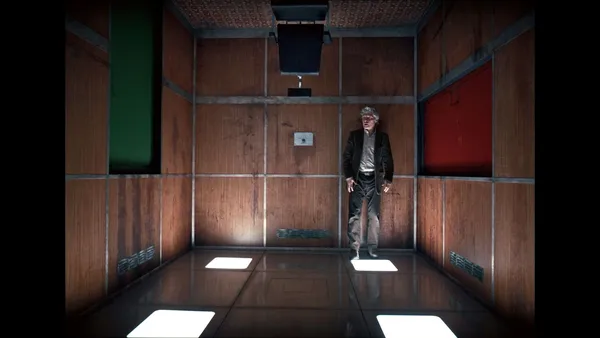
Dainius Gavenonis as Vilis in the elevator. Kristijonas Vildžiūnas: 'We tried to spin it and do all the tricks before we proceeded to final design and the production of our actual sets'
Photo: Courtesy of POFF
|
A man finds himself revisiting his life sheet becoming trapped in a surreal elderly lift containing a mysterious machine called the Dice-Ching-O-Mat that becomes a gateway to different memories. Vilis (Dainius Gavenonis) has dedicated years to translating the Chinese I Ching at the expense of everything else in his life, especially his children, who are now grown up. He is told by a voice he has three chances to save his family – a task that will see him travel out of the elevator and into his past in an attempt to find the “green door”. A story of reconnection that also offers a strong genre element, Lithuanian director Kristijonas Vildžiūnas’ film premiered at Warsaw Film Festival earlier this autumn. We caught up with him to chat about it as it played in the Baltic Competition at Tallinn Black Nights 30th edition.
Tell me about the amazing production design of the lift that you’ve trapped your lead character in. Why did you choose the lift as your liminal space and how did you work with your production designer on the look?
Kristijonas Vildziunas: It was quite, quite a long, long trip to make it. We started quite early thinking about that, and later we made a maquette. A big one that was about 1.5 metres. And we tried to spin it and do all the tricks before we proceeded to final design and the production of our actual sets. The production designer is very experienced, Jurģis Krāsons, and I was working with him for the second time. He also made fantastical sets in my last film Songs For a Fox. It was about lucid dreaming and all the dream artefacts were very surreal. We thought about what it could be, because this space represents everything about the character, his mind, actually.
With the metal looking almost like a face on its wall, you've turned the lift into a character
KV: Yeah, it is a character. So we decided it was the best way, not just to have an abstract thing to reflect his mind. It is his personal history, first of all, because he was raised in the Soviet Union, and he was riding those Soviet lifts. And maybe he had some trauma, like being stuck in an elevator when he was a child. In the first scene where he's pressing the help button and saying, “Help!”, who is talking with him? His grandmother. That's unusual...
Are you a person who does the I Ching?
KV: I did. It's a poetic text and a very strange text for us Europeans. It's not really accessible for Europeans like people in Asia. I wanted the occupation of the main character to be something which requires a lot of attention, a lot of time to translate academically. It takes 10 to 20 years if you're doing something else like teaching lectures. It takes years – I consulted with an Asian scholar. For the character it was the perfect occupation. He was immersed in that book, he lost himself in the symbolism of hexagrams and these layers of the text, and then he just detached from the real word. As he says he does not remember his children when they were small.
He nurtured this baby of a book while ignoring his real babies.
KV: I wanted to talk about the return. I've seen maybe two films on a similar topic about a father and adult children, and their children are supposed to rediscover their fathers, or to find a new relationship; to understand father, etc. So they are returning to their father. This film is the opposite. It's the father returning to his children. But for half of the film, he cannot grasp the problem. He's trying and trying because...He is searching for the green door. What is the meaning of the green door? He cannot recognise the problem and that the green door is the emotional connection with the children. So it takes him half of the film and when he does grasp it, he decides it's already too late. They are distant, and they don't need him. When he drops everything and he comes out trying, this is the answer.
Tell me about the casting, did you have Dainius Gavenonis in mind?
KV: Dainius was actually in one of my previous films, Seneca's Day. And I was kind of reluctant to confirm him, because somehow I didn't want him to repeat himself, because he was also playing a father in that – and I didn't want to repeat myself. But then we started to talk and to rehearse a little bit, and somehow, I realised we could succeed. At the end of the day, he surprised me, especially because he did most of the stunts himself – he has seen somebody he's making a constant tricks himself – 95% of them Is that a relief or a worry for a director? On the one hand you save on the budget but in the other you must be thinking: “Oh God, don't break anything.”
|
|
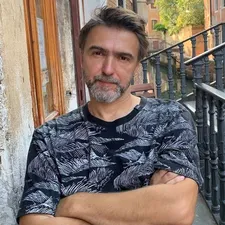
Kristijonas Vildžiūnas: 'I was shifting towards magical realism in my last two films, and this is a culmination, I would say'
Photo: Courtesy of POFF
|
KV: I forgot about it. We were so preoccupied about the set and how to construct it. It was very, very challenging logistically. We had to do the shoot with two lifts because you can only shoot when the back wall is removed. So you need to remove different walls for different angles. Then one should be like a centrifuge and the other like a gyroscope. We got quite close to the shooting of the space but, with the actor? How are we going to do that?!
It must have taken quite some time to sort of get from that to the finished product.
KV: Yes because, as I said, it was a character that had to reflect all the various things as well as connecting to the I Ching geometricality, the hexogram, and the number six. Also the main driver is the dice-ching-o-mat. We spin an antique disc, which is attached to a case from the 70s. I would say it was really finished by the music. When I was editing, I thought, ‘It’s too weird for the spectator to see this strange machine rising from the ground. So I put the music box music over the top to act like a glue and finalise the character. The budget was really small for such an ambitious idea.
Are you already thinking of future projects or do you think you want to take a break after something this ambitious?
KV: I put a lot into this project and I am feeling a little bit flat now. And in terms of my development of my own ideas, I was shifting towards magical realism in my last two films, and this is a culmination, I would say. I have nowhere to go in this direction, so I need to rethink. I’m also fascinated to talk to spectators and understand how they see it because this film has quite an open structure and it’s open to interpretation.