




|
|
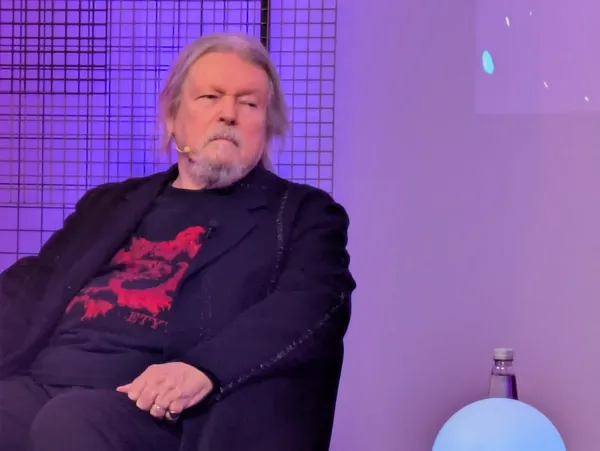
Sir Christopher Hampton at the POFF 2026 event
Photo: Amber Wilkinson
|
Oscar-winning screenwriter Sir Christopher Hampton took part in a masterclass, From Stage to Screen: The Art of Adaptation, to kick off Tallinn Film Festival’s industry event Discovery Campus this year.
The British veteran, who has won Academy Awards for his work on The Father and Dangerous Liaisons, talked about his early days in the industry, including the influence on his writing of High Noon director Fred Zinnemann and Hollywood great Sir David Lean, despite neither of the projects he had worked on with them ever actually being made in the end.
Sir Christopher also gave short shrift to questions surrounding the use of artificial intelligence for scripts, saying he was “more interested in real intelligence”. He added: “For me, it’s nothing other than a sort of super-Google. I don't think there's any replacement for original creativity.”
The writer’s own intelligence has been lauded since he was an under-graduate at Oxford University, when his play When Did You Last See My Mother? – a tale of angst and gay desire – led to him becoming the youngest playwright in the modern era to have a West End production. Reminded by interviewer Neeme Raud of this achievement, the 80-year-old joked: “I'm getting close to approaching being the eldest.”
Looking back at his career, he says that initially he thought that moving from stage writing to screenplays would be easy. But it was trickier than he thought after theatre, which had “come naturally” to him.
“When I started to write films – and the first film screenplay that I wrote, which was made, was an adaptation of. Ibsen's A Doll's House with Claire Bloom and Anthony Hopkins back in 1973. I didn't realise that moving from a stage play to a film was more than simply repeating the dialogue in front of the camera. I hadn't quite understood the differences between the two mediums, and it took me about 10 years, I think, thinking about it as much as i could, to figure out how not to make a film from a play which smelt like the theatre.”
He adds: “The mistake that I made, I think, was that I thought that it was easier to write films than it was to write plays. In other words, you think a film gives you enormous liberty – you can jump from London to Hong Kong in one cut, you can sort of do what you like. But that liberty imposes on you a number of constraints that, um, that I hadn't been aware of before.”
Zinnemann and Lean’s very different approaches to the business of filmmaking helped him to discover the knack. The script for Zinnemann was about the last days of the Second World War but was subsequently cancelled by a new studio head, as they were on location preparing to shoot.
“What Fred Zinnemann was interested in was narrative,” he says. “He was not interested in any kind of deviation. So his reaction to the liberty of the medium was to say, ‘We have one job and one job only and that is to tell the story. I worked with him every day for nine months, and he was absolutely relentless. He went scene by scene and cut everything that wasn’t completely germane to the story.”
Lean, who he worked on Nostromo with – another project that was ultimately never made due to Lean’s death – had a different approach which the young Hampton also took on board.
He recalls: “It was a very complicated novel set in South America in the 19th century, and a very different kind of education began.”
He notes that Lean was “quite frightening” and also a task master who nagged him to write the first draft quickly.
“He kept ringing up saying, ‘How's it going? How's it going?’ So I wrote the first draft in about seven or eight weeks and gave it to him – and then the work began. It was relentless for a year.”
He adds: “His theory, which I think is not a bad theory at all, is that every film is divided into six or eight or ten chapters and within those chapters, it's absolutely vital for the audience's attention, not to wander from the line that you're taking them on. He said it should be like a rope of steel that goes through the chapter. And he said, the most important feature factor in all of this is the final image of one scene and the opening image of the next scene. So, you should always pay attention to how one scene flows into another, even if it's a different occasion or a different subject. It should always have a certain cohesion.”
In the wide-ranging chat, which considered working on set with various directors and the way that his scripts have become increasingly economical down the years, the screenwriter also found time to praise the star of Dangerous Liaisons, Glenn Close, who will receive an honorary Oscar at the next awards after being nominated eight times previously but failing to receive a statuette.
“About time,” he says. “I was very happy to hear that.”
He also notes that Close was vital to the final scene in Dangerous Liaisons, underlining why it’s important for writers to be on set, since there had been talk of ending the film with a caption until the actress said, “No, I can act that.”
Speaking about his success, he says that there’s more projects that don’t see the light of day.
“It’s one of the things they don’t tell you about being a screenwriter. Which is if you have a long career and are in a position where 20 of your scripts have been made, what they don’t tell you. Is that 40 of your scripts haven't been made. So one out of three films getting made is a pretty good average but it’s something you sort of have to accept. There’s a lot of wastage on the way, a lot of projects that you will spend six or nine months or a year writing which will never be seen in any form because they somehow haven't been, haven't been financed.”
As for the art of screenwriting now compared to the start of his career, Sir Christopher – who is heading the main jury in Tallinn – says it is fundamentally the same as it has always been. “It’s basically people sitting around the campfire, telling each other stories. And that's as it should be.”