




 |
| The Unknown |
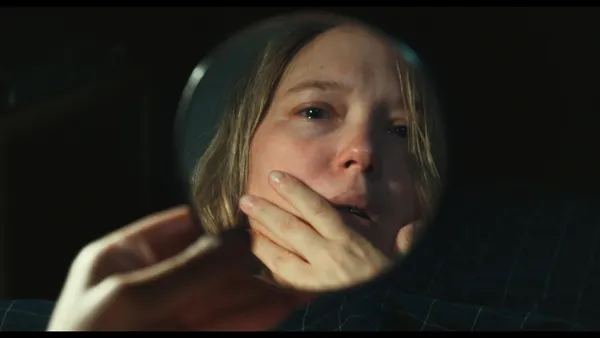
In French filmmaker Arthur Harari's body-swap fantasy thriller The Unknown (L'Inconnue), David (Niels Schneider), a socially awkward photographer shares an intimate encounter with a stranger (Léa Seydoux). When he wakes up the next morning, his one-night stand is gone, and to his horror, he finds he's trapped in her body. As he searches for the stranger, he discovers he's part of a body swap chain and the resolution he seeks is out of his reach.
Harari co-wrote with director Justine Triet the Oscar-winning crime drama Anatomy Of A Fall (Anatomie d'Une Chute). The pair previously worked together on the screenplay for Triet's psychological drama Sybil, starring Virginie Efira and Adèle Exarchopoulos. His previous directing credits include the revenge thriller Dark Diamond (Diamant noir), and the World War II drama Onoda: 10,000 Nights in the Jungle (Onoda), about one Japanese soldier's refusal to accept his country's surrender,
In conversation with Eye For Film at the 70th London Film Festival, Harari discussed how the film's fate rested on Seydoux's shoulders, the irrationality of ideas, playing by literary rules, and how cinema is a "vampire-like thing."
The following has been edited for clarity.
Paul Risker: The roots of The Unknown are somewhat a family affair. I'm curious what else may have formed the film's genesis.
Arthur Harari: Well, the film is an adaptation of a comic book by my brother, who is a cartoonist. He came up with this idea, but when he started writing, he encountered this [mental] block. I thought the idea was incredible, and I encouraged him to go on. He was still not sure, and for a few days, I was obsessed with it — I thought it was brilliant, not just as an idea for a comic book, but maybe for a film.
And then I saw a film with Léa Seydoux, which struck me. I knew she was a great actress, but in France by Bruno Dumont, she was just amazing. So, I knew that I wanted to make a film with her about the same subject as my brother's idea. I told him that I wanted to write the comic book with him because he needed somebody to write with, and that I would then make a film. But if Léa had not been interested, then I might have dropped it, because I didn't want to do this without her.
PR: What is the allure of Léa Seydoux that compelled you to only want to make the film with her?
AH: It's not easy to analyse these experiences where somebody literally jumps off the screen and is so singular and intensely present. It really is a question of presence and Léa has a presence that nobody else these days has. I'm not sure it was the case 10 years ago. She has always been an interesting and mysterious actress, but now there's something physical and unique about her presence, even when she's in a bad film, which is rare.
There's just something that happens when she's in front of the camera. I spoke with her about it, and even she's not completely sure what happens herself, which is interesting. And it's not the type of thing that's a technique or a skill — it goes beyond that. Instead, it has something to do with the risks she takes when she's in front of a camera, and also the idea that she's an icon of femininity, and she's extremely famous. And in The Unknown, behind her face lies the consciousness of a man. To film that was very exciting.
PR: Thinking about this lack of knowing, writers like Ray Bradbury and Stephen King have spoken about the strange nature of ideas. Bradbury has even described it as sitting in a room and listening to voices in your head. Ideas are not necessarily the product of a conscious or deliberate intention.
AH: It's something that isn't rational and, in this case, it didn't come from me, it came from my brother. I didn't know this, but he told me recently that he had a dream, and he woke up one morning with this idea about a body swap that wouldn't be a simple type. Instead, the character will find himself part of a body swap chain. My brother felt good about the idea because it has something to do with identity and otherness, and he didn't want to address only a single topic.
This is the best way to come up with an idea because you don't know where it comes from, and whatever the irrational thing that happens, it answers a question that you didn't know you had. And after my brother told me about the idea, I began my own journey with it, which was very stimulating.
PR: Identity is a theme that will always resonate because it's something we are all grappling with. However, in your imagining of the body swap story, the nightmare is the result of a choice where the character gets something they wanted and at the same time something unexpected.
AH: What I found stimulating from the start is that the genre itself is well established and well known, but it has never really been explored in a different way than the comical, sexual or horror we're familiar with. But you can take it seriously by going back to what fantastical literature was in the 19th Century, where you take a singular, impossible element and throw it into the real world. Then, you observe what happens from the point of view of the person concerned. Once we found this road, it wasn't necessarily easy, but it was constantly exciting and challenging.
PR: Do filmmakers define genre or is it the language of genre that guides the filmmaker?
AH: I would say it's both. To me, it's funny because The Unknown is a genre film — it has to do with fantasy or fantastique, as we say in French. But for some viewers it's not, because you don't really follow the rules, although it depends on what rules you're talking about. If you're talking about particular rules like in Hollywood and horror films, which I'm a fan of, then okay, it doesn't appear to follow these rules. But if you go back to Franz Kafka or to Guy de Maupassant, Nikolai Gogol or Robert Louis Stevenson, then I think I'm playing quite close to these rules. I'm not deliberately refusing what the genre brings, but it depends on what genre we're talking about. But also, I know that once I'm inside that particular shape, and I don't even know how or why, my own vision will influence the genre itself and bring it into another space.
And the literary influence on The Unknown is almost more important than the cinematic influence. I'm a big cinephile, so there are influences everywhere, but the way an experience can be shaped through narration, literature has for some time been more inspiring.
PR: There some stories, like Homer's The Odyssey that are considered foundational stories. Can we consider or define literature as foundational in comparison to cinema?
AH: Cinema is always this vampire-like thing. It draws from the opera, from painting of course, and photography is at the core of it. The revolution that photography created was huge — it changed everything centuries ago, and it's still extremely vivid. And at the same time, cinema is new and yet it seems very old, as if everything has been done. I'm not sure if this is true. So then, it's a question of what you are looking for; what you are digging for.