





Eye For Film >> Movies >> Adam's Apple (2026) Film Review


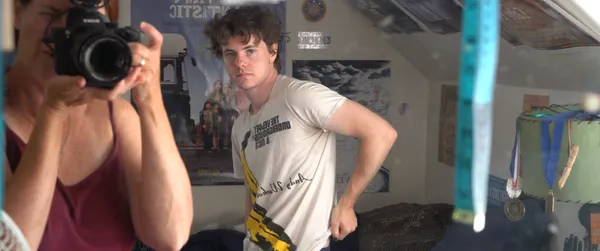

It’s not uncommon for people to think that transitioning from one gender role to another is something that happens all at once, almost magically, during twelve hours in an operating theatre. Recently, some Americans have apparently become convinced that it can be accomplished in an even shorter time at the hands of a school nurse. In reality, it’s a process as much psychological and social as physical. Amy K Jenkins’ documentary, which screened at the 2026 Scottish International Film Festival, tells the story of Adam Sieswerda across two decades, also tracking the stories of his family members, who have their own journeys to go on.
It’s when he’s in fifth grade – ten or 11 years old – that Adam, digging about in the loft with his mother, finds his first grade journal, which proclaims that he wants to be in a movie. “Okay, let’s make a movie,” his mother suggests – and it is there, perhaps, that the film begins to attain conscious form. It extends backwards in time through a series of home videos and forwards, beyond a certain point, through Jenkins’ footage. There is a montage of birthday footage, with singing – always missing the bit where the celebrant’s name is traditionally mentioned – and birthday wishes. On his 13th birthday, Adam wishes for his dad to start calling him Adam like pretty much everyone else does. His mother is supportive throughout, though sometimes afraid for him. His younger brother doesn’t see what all the fuss is about.
For Adam’s father, the difficulty comes from a sense of loss. He feels that for two and a half years he had a little girl, and that she was then taken away from him. Two and a half is right in the middle of the typical age range at which people develop a sense of gender – before that, it’s really just other people’s projection. Adam’s mother remembers him always being in his Superman costume as a small child. He remembers wanting to be an elf, but that wasn’t the only reason he went by Twinkletoes for a while – it was a way of avoiding using the name he had been given, the one that signified girlhood. He does reference that name himself, later, having acquired some degree of comfort with it as an artefact of his past, but most viewers will recognise its oddness. There is nothing about him, in any of the footage, that resembles a girl.
The ordinary material of growing up mingles here with trans-specific experiences. Adam is excited to get his first camera. He gets into Dungeons & Dragons. He gets his first girlfriend. He likes playing guitar. He loves driving but one day crashes his car in the snow. He recalls being about six before he realised that he was never going to spontaneously develop male genitals. He watches other trans guys on YouTube and worries about his voice not being deep enough. He loves sports but struggles to keep up because of his binder. Eventually he will get surgery so he doesn’t need one anymore. A doctor recommends that he receive hormone treatment, and he and his mother go through menopause at the same time, but with very different feelings about it.
Everything changes when Covid hits in 2020. Adam’s parents have a good understanding of what’s happening, and stick to lockdown protocols. In closer proximity, and with a different sense of priorities, his father undergoes a subtle change, begins to see him more clearly for who he is – at the same time as experiencing that frustration common to parents of teenagers, as Adam chafes at the bit, anxious to get out and about again, complaining about everything. For Adam’s mother, this is all the more difficult because he will soon be going away to college, and she will have to face life without him. At college he will come out to a lot of people. He will participate in LGBTQ+ rights demonstrations. But his transness will assume its proper proportion: just a detail of who he is. In understanding this, in teasing it out of the whole, Jenkins restores some perspective to cinematic narrative, and delivers an intimate portrait of a family just trying to figure itself out, like any other.
Reviewed on: 25 Oct 2026