




 |
| Getar Hero |
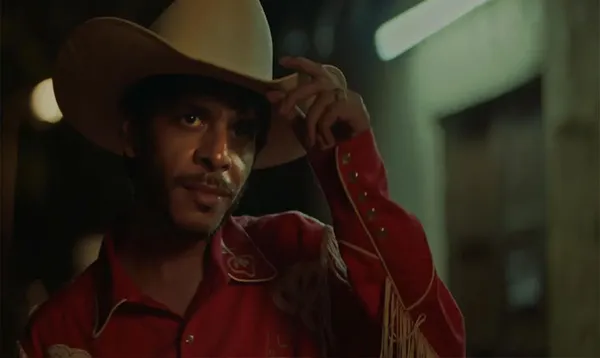
Getting off a train in Mumbai, a man (Shashank Arora) wearing an elaborate red and white cowboy costume discovers to his horror that his guitar has been stolen. His efforts to find another one in time for a job he can’t afford to miss propel him on a series of adventures, eventually drawing him into a musical performance with the potential to change his life. This is Getar Hero, written and produced by Sneha Mehta and Teddy Stern, directed by the latter. It has now qualified for the 2027 Oscar race, so Sneha and Teddy met with me to tell me their story.
“Teddy and I go way back,” says Sneha. “We've actually been best friends since middle school. I won't tell you how many decades that is, but it's more than you think, and we've been working together pretty much since the baby egg project back in school. Of course my family background is Indian, and Teddy was always a wonderful, accepting, safe space of a friend for me. I was able to share with him my obsession with Bollywood movies, Bollywood music, and then later all the cinemas of India. So we have a really long creative working relationship and a really long shared love of Indian film.”
“Years later, Sneha was working at this Bollywood media company and they were looking for someone to cut trailers and I jumped at the opportunity,” Teddy adds. “That became working together for nearly ten years at this company, and I started travelling to India. I really fell in love with Mumbai. We started shooting commercial work there and seeing all these amazing places and meeting all these amazing people. But commercial work is not self expression. We started to talk about maybe doing our own project there someday.
“Eventually we left that company to start our own company, which is to say we were basically unemployed, but we had all of these airline miles from flying back and forth to India, and they were set to expire. We bought two round trip tickets to Mumbai to make our project finally, and then and only then did we set to work actually deciding what we were going to do. At the time my wife was pregnant and I was having this dream about having my guitar stolen – I'm a musician – and not being able to show up to this important gig. In retrospect I realised I was having provider anxiety, freaking out about what it meant to become a dad – and that anxiety became the genesis of our story.
“I think we both were feeling out of place, and something about dropping a cowboy in the middle of Mumbai really excited both of us. There was some comedic opportunity of course, but I think also just that fish out of water thing I think anyone can relate to. We have all these dreams and ambitions to express ourselves, and of course, life pulls you in a different direction. That tension became the main driving force in the movie.”
This isn’t a straightforward tale of a man who has missed out on the good things in life, I note. He has other good things.
“Absolutely,” he says. “It's funny because at the time were writing this, I wasn't a dad yet, and of course, in the course of editing it, I was a dad, so my feelings about the cowboy’s predicament also changed during the time were making this movie. [I was] seeing it less about simply denying your dreams, but that your dreams change and how you view yourself changes.”
The costume does a lot to establish the character, but how did they go about finding an actor who wasn't overwhelmed by it?
“We knew that we needed to find an actor who was also a musician,” he says. “I think, as a musician myself, it's really important that we have someone who could actually play their instrument and sing the songs necessary in the movie. That's not a really long list of people, and this particular name came up in conversations with some of the filmmakers we know in India. Shashank was posting stuff online, too, so he basically had the part before we even reached out, because we had seen what he was capable of.
“I don't recall exactly how the conversation began, but he never took the costume as this ridiculous thing. He really wore it. It didn't wear him. I feel like he brings this earnestness to the part that makes it work. It doesn't make it feel like a spoof. I just love the way that he performs the part. He says so much with his eyes. There's the archetype of the cowboy, you know, the silent type kind of thing, but I think you see the sadness in his eyes and the desperation. I mean, when we were filming, we shot all these shots of clocks. This idea of like, we need to let people know he's under the gun here. But Shashank's eyes are more powerful than any clock. We ended up cutting out all of them but one, because he does so much with so little dialogue, you know?”
“Yeah, absolutely,” says Sneha. “Shashank has a very open face and a very empathetic face. He just became that character. He took it really seriously. There was nothing silly about it for him, and I think that's why he wears the costume and not the other way around. But we knew that in addition to the person having a great voice, they were going to have to have a great face, because the cowboy is written to be an archetypal cowboy character. He's written to be stoic. He is written to have very few lines of dialogue. Shashank is just the right actor for this part.”
They also have an Elvis in the film. Where did they find him?
“I so appreciate that you appreciated him because he is a really personally important to me and Teddy,” Sneha says, beaming.
“If you scroll back on my Instagram feed, you'll see many years ago, a photo of me with him,” says Teddy. “He has a dental device in his mouth. We made this commercial with him that was deemed too strange to release. It was hilarious. He's a really talented comedic actor. We knew someday we would need to cast him in something. This part was basically just written for him.”
We discuss the practicalities of the shoot.
“Some of it is shot kind of documentary style, as you know, on the streets,” says Teddy. “The train is actually a set. There were two cars, and it was a dilapidated sort of studio that had a couple of cars on springs, as I recall, and we kind of shook the train to make it appear as if it was moving. We had maybe 15 or 20 extras. I've been making movies since middle school, so I understand, like, when you have two friends and you want to make a movie about a war, you put the camera on the ground and you have your friends walk in a circle around it, and it looks like you have hundreds of troops, and that's kind of what we did. In fact, with the camera in that scene, I'm one of the people just going back and forth in front of the lens to try to add a little more motion. But as far as the street stuff is concerned, a lot of those shots are long shots. We wanted to absorb the atmosphere of Mumbai.”
Sneha recalls an incident during filming.
“We were in a predominantly Muslim area just after Friday prayers had let out. Shashank crosses the street. He lets traffic go past him, and then there's a little boy who just stops and stares at him. We're filming him from above, from an elevated pedestrian walkway, and everyone who's just let out of prayers is staring at him. That really did happen, and that is something we really wanted to share with people because that's the real Mumbai. That's the real Mumbai that Teddy and I have worked in and fallen in love with. And we knew that we didn't want to just film this on sets. We wanted this city to be part of it.”
“It also works,” Teddy observes. “The fact that he gets these eyeballs in on him, right? He's dressed strangely. He's sometimes recognised on the street because he's a cowboy.”
That unusual look is probably what gets him his opportunity when he visits a studio, I suggest, and Teddy agrees. We go on to discuss the audio work in the film, especially in a scene set in a guitar shop whose owner engages in angry conversations with his offscreen wife.
“I think the most Important detail I could share personally is that the screaming person is Sneha,” he says, laughing. Apparently it’s her impression of someone they both know.
“All of that was overdub,” he adds. “Afterwards [she] did do some shouting, to give him something to react to. But eventually we just stopped having Sneha say anything, once they had the rhythm going. They're both wonderful actors so they really understood the assignment there, but I appreciate you noticing that because it is tricky. I also want to give a shout out to our sound mixers because really being able to place that voice – that was done into a microphone in my little home office with Sneha – being able to make it sound like it's from another room, feel immersive, is not easy, and I really think they did such a wonderful job.”
Then of course we have the music scene itself. How did they get that to work as it does?
“We started with that in two ways,” says Teddy. “As fans of Bollywood and loving how music is used as self expression, as dramatic moments, not just window dressing, we knew we wanted to have that climactic moment in our movie, and we reverse engineered the movie to get to that point. It just so happened, scheduling wise, that was the very first scene that we shot, which is intense. We ended up doing 19 or 20 takes. Looking at that in retrospect, I realised having it so choreographed removed all of its spontaneity and the energy that you feel in a live music scenario. It really didn't work. And props to my friend Ben Leavitt, who helped edit the film. He was like, ‘Actually this works a lot better as a multi shot sequence.’ In fact, those screw-ups, the moments that weren't timed quite right, those are a lot of the keepers. So he really made that scene.
“The scene is great for a few things. I mean, we knew we had to create a really good a really good musical performance – we couldn't fake it – so everyone in that room is a musician, really playing their instruments. I wrote the arrangement at home. It's a song I love. It was a song I was excited to hear interpreted by Indian musical tradition. But you know, I'm not trained in that, so I did my best approximation of it with MIDI instrumentation. I brought that recording to the musicians in India and they didn't know Johnny Cash, let alone Ring Of Fire. They didn't speak a lot of English, but we ended up having a jam session and they really brought their own brilliance to the scene.
“I was excited as a musician, personally. I was just like, ‘This is cool.’ And if I feel like that, then there's something there, right? I think Shashank, when he got to perform with them, the same experience happened for him. I think the excitement of the cowboy is also just the excitement of Shashank getting to really level up his musicianship with these amazing professionals, and our job was really to just capture that energy.”
Was there a moment when they realised that they were making something special, that might actually go somewhere big?
“Absolutely,” says Sneha. “It was the first scene we shot, which is the music scene. We were in a music studio, working on recording it. I actually was in the engineering room, so as not to appear on camera, just hearing the sound, not even seeing what the picture would look like, and I knew that this was going to be something really special.”
So how do they feel now that it's Oscar qualified? It must be very exciting.
“It's really exciting,” she says. “The thing about the festival journey that this film has had is that we've been able to sit in the audience and experience other people watching it in theatre. We've been in so many different cities, different states, different countries, even with a ton of people who have never heard an Indian language spoken on screen before, and yet they are laughing at the sight gags, they are laughing at the jokes, they're reading the subtitles. They're really responding to it. There's a moment in the film that I don't want to spoil, but we hear an audible gasp every time, and that's been really incredible, to see that the story really is as universal as Teddy and I hoped it would be. It really correlates to our own lives as artists and each of us as parents, but to see how people are responding to it and now knowing that it's qualified has been a really incredible thing for us to witness.”
I mention that I recently spoke with a music promoter the other day who was saying that she thinks that music is something that really brings people together because we react emotionally before we think about anything.
“Yeah,” says Sneha. “Absolutely. It's primal.”
We’re running out of time, so I ask if she has any final remarks.
“We're just hoping that people will open it up, give it a watch, give it a chance,” she says. “We know that when it starts, it's something different than you're used to seeing, but it really is a popcorn movie. It's a movie that, sure, you can sit around and dissect the many layers of meanings and do an academic analysis of, but it's also a film that you can just sit back and enjoy as a movie, so we hope people will give it that shot.”
“Amen to that,” says Teddy.