





Eye For Film >> Movies >> Naza (2026) Film Review


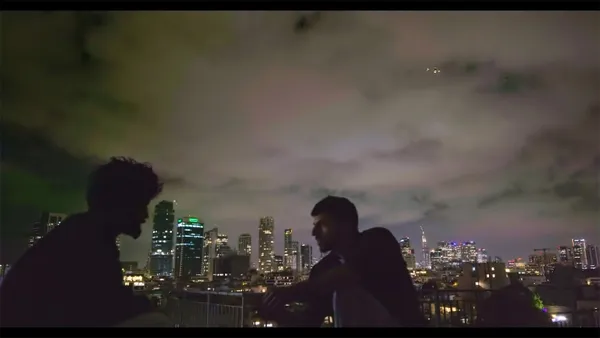

High on the rooftops of Tel Aviv in Israel, the normality is evident. Yuval Abraham and Rachel Szor’s cameras are there to record chilling testimony but they also gaze down upon countless lives in the neighbouring high rises. People glimpsed through windows enjoying a late supper, or watching TV after a day at the office alongside darkened windows, behind many of which, children will be sleeping dreaming of the next school day. Civilian lives, just like those of thousands who live in Gaza but who, unlike their Tel Aviv counterparts, could easily become “NAZA”. That is the military acronym for “nezek agavi”, the Hebrew term for “collateral damage” and used by the Israeli Defense Forces (IDF) to describe non-fighting citizens who are killed.
Like “collateral damage”, it is terminology that removes specificity. Gone are notions of men, women, children, the old and infirm, replaced by the clinical, indistinct and dehumanising four-letter label.
Abraham and Szor’s approach is systematic and sobering as they sit down with 24 IDF intelligence officers, whose silhouettes and voices have been digitally altered to preserve their anonymity. They are not the first to talk about genocide and the deliberate targeting of Palestinian civilians by the regime of Benjamin Netanyahu but the detail given, especially in terms of the attitude of IDF members towards Gazan citizens in the wake of the October 7 Hamas atrocity, is enough to turn your stomach.
It’s not just people who are deciding who to aim at, but artificial intelligence, put to work to analyse what goes in and out of the tens of thousands of phones they have under constant surveillance, detecting what it views as patterns and singling out those to eradicate. One operative notes that phones, of course, tend to be at home at night, making that the best time to attack a target, and not to worry about the 15% error rate or the fact four NAZA for every one Hamas fighter is considered acceptable (although, in fact a lot more often seems to happen with little more than a military shrug). “It made a lot of mistakes,” says one officer. Again, the language is telling. One AI’s ‘mistake’ is another person’s death.
Divided into sections, a segment dealing with much of this sort of targeting is labelled “Where’s daddy?” – a reference to the fact that children’s mobiles often help them to determine when the parent they want to kill is near. The child? NAZA.
The casual language choice used in general is almost impossible to fathom. “You feel a bit like God, because you see everything they are seeing,” says one, before charting how death is dished out. “It’s a bit like a video game,” says another. The sense of the whole of Gaza being like a sort of prison farm emerges, with buildings all catalogued, just waiting to be picked off, snipers choosing targets simply because they step away from an arbitrarily designated path. The directors also offer some historical backdrop, showing how this control of the populace by the state of Israel has grown down the years.
Surely there must be some sensation of guilt that has prompted these people to give testimony but it’s hard to tell from many of these interviews, which are conducted with a calm persistence by Abraham. The interviewees not only fall back on ideas of doing what they were told and “if I hadn’t been there someone else would have done it”, but often seem to be revelling in the memory. “It’s so insanely fun,” says one.
Beyond the indiscriminate killing – 73,000 dead, according to the film’s tally – is Netanyahu’s desire to legitimise what he is doing. That means targeting victims of his war crimes and attempting to discredit them in any way possible. Certainly his regime is at work where Abraham and Szor are concerned, with escalating threats to strip them of their citizenship following this film and their earlier Oscar-winning documentary No Other Land. NAZA – which premiered in Venice and has since played at San Sebastian and NYFF – will be released in the UK on October 16.
There is always a question of whether films like this are mostly preaching to a choir of those who are already engaged with the issue, with many of the current attacks aimed at this film and the filmmakers already coming from those that have not seen it. Given that it will be available for free, globally, on The Guardian website in November, everyone will have an opportunity to form an informed rather than kneejerk opinion. Compelling and devastating in its detail, it is an essential watch.
Reviewed on: 01 Oct 2026