




 |
| Liz Here Now |
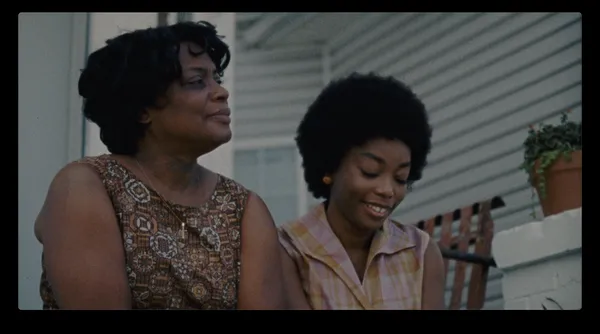
Adapted from the book by Todd Connor, Sterling Macer Jr’s Liz Here Now is an intense and deftly crafted film which you may well hear about this coming awards season. It stars Aunjanue Ellis-Taylor as the titular domestic worker, whose duties in the home of the influential Conner family include minding children Todd and Chrissy. When she realises that the children are being abused, and that their mother, Jane (Rachelle Lefevre), may have a serious psychiatric illness, Liz, herself a mother, struggles to overcome barriers of class and race and gender in order to come to their defence. The book is itself an adaptation of the author’s real life experiences, written in part as a tribute to the woman he credits with saving his life. The film recently premièred at the Chicago International Film Festival, and I was grateful for the opportunity to speak with Sterling, who is clearly passionate about it.
“A couple of years ago, the writer of Seven Pounds with Will Smith, Grant Nieporte, his production company was looking for a director that they felt could handle this material,” he tells me. “The project rolled around to me, and they asked me to pitch a concept and be very frank with them about what I thought based on the book, and apparently they liked what I had to say.”
Did he work from the book or with the actual people involved in the story?
“A little bit of both, actually. Obviously, the book is the source material, so I was tasked with looking at what was an initial draft of the script that was brought to me, asking me to put my two cents into it and see if I could tailor it to a vision that I felt very comfortable in telling. That meant, of course, going back to as much of the original sources as possible. Fortunately, the writer of the book is Todd Connor, so we spent some time in Oakland touring the various areas, his family history and getting to know each other and him really conveying to me his sense of Liz and what she meant in his life. It really helped with an eye towards world building and tone setting.
Aunjanue Ellis-Taylor is amazing in that role. Was she already on board?
“No,” he says. “That was an interesting conversation. She was at the very top of the list for me as an actor that I'd like to work with, but really kind of a pipe dream, it seemed like at the time. Fortunately she had a very good relationship with our casting director, Kim Hardin, and we set up a series of phone conversations. Aunjanue is a very sharp, insightful person that sees the whole of the narrative in a way that is incredibly impressive, and you have to have some answers or some thoughts. There was a couple of times in the conversation I was like, ‘Oh boy, I don't think I'm going to be able to get her on board,’ but she was very gracious, and I think we had a very good rapport. It helped that I'm an actor as well, so I can understand where she's going.”
His acting experience comes across strongly, I note, because the film is centred on the way the characters develop. I was interested in the character of Jane, because she is in many ways the most difficult one to get right. Sometimes she’s sympathetic, but she can just snap into an aggressive, dangerous state.
“That is a bull’s-eye, that observation,” he says. “This obviously is no disrespect to Aunjanue, who's amazing in her performance. Liz’s emotional trajectory is very clear. Jane's is much more” – he pauses, thinking for a moment. “She doesn't lead with all the colours of Jane, you know? So you have to mine those extra dimensions of her, and Rochelle and I were very aware of that going into it. We had to expand on Jane's palette, as it were, and add dimensionality to her, and I think you see that in a couple of scenes that are. In some of the most terrifying moments you see these brief periods of lucidity and self awareness that Jane doesn't typically walk around with, almost as if her head bobs above the water for a brief period and then all of a sudden she's back under.”
There's a wonderful scene where she's sitting in front of the mirror. There's a lot going on there, just from a technical point of view, getting it to work with all of the reflections, but the character stands out because because she had Liz have a real conversation and connect for a moment as human beings.
“Yes, and that is probably the high point of that bobbing above the water. That's where we see Jane. There's a real human desire in her to overcome what's going on, and it's a real familial kind of connection that the two mothers have. If you listen to the score closely, it's somewhat of Liz's family theme that comes in because there's an inclusive thing that she's giving Jane at that moment. And it's a moment where you just want Jane to get it. At the same time, at the front end of that scene, we're hinting at the fragmentation that is within her.”
Talking about Liz's family, there's a scene where Troy, her son, is explaining to Liz how to make a business proposal, and she's doing his tie. We see their interconnectedness, how they depend on one another, which seems to be something that's missing in Jane's family. It's a really effective way to make that contrast, I venture, rather than just relying on one family seeming happy and the other family seeming sad.
He’s glad I picked up on that, he says. “We very much wanted to paint a full picture, not just give the basic happy/sad thing. They’re a family who know how to relate to each other despite below middle class circumstances. A family whose love is expressed not just in broad attitudes but in the little things.”
Going back to technical things, I noticed that at the party for Frank's birthday, while Liz is walking around preparing to try speaking her mind, the camera seems to be at her height all the time, looking upwards at the white men. It adds to our sense of her vulnerability.
“Yes, that's exactly right. Myself and the cinematographer, Kyle [McConaghy], we had very specific rules about the different places in which we were shooting. Generally speaking, in the Connor house we always wanted to be slightly low. One, because it conveys the kids’ eye view. It just suggests that even when we're not aware of it. And two, it is that power dynamic that you observe, so it works especially well for Liz. If you notice, when we do go to a higher angle, it's a little bit higher than normal, just to give a bit of downward pressure so that you get that sense of that pressure on Liz.”
There's an incident at the end of the party which I won't mention because it would be a spoiler, but in that instant, where Frank's embarrassed, Jane is briefly in control, and she's higher up than him.
“Yeah,” he says. “I would say that visual is born out of it being wholly and fully her moment, her time to shine.”
It brings out something about Frank as a character. He's been living with a difficult situation for a long time, and obviously he's capable of doing harm as well, but he seems in many ways like an abused character who's trying to cope with a situation where he's out of his depth.
“Ryan [Wesley Gilreath], who plays Frank, is a very sensitive actor who very much wants to bring the full dimension of a character. In the hands of lesser actors, all of these roles could have been very two dimensional, but Ryan found that aspect of Frank that is – or that at least seems to us – quite sincere. Or Frank is a very good actor, one of the two. I think it adds to the complexity and keeps us, the filmmakers, a bit ahead of the audience in relation to Frank and how he fits into all of this.”
We also see something of the civil rights struggle going on at the time, putting the story in context. I tell him that I’m interested in the way he depicted the Black Panthers, because I know that there's not a lot of understanding, even today in the US, about all the ways they fitted into communities and provided services, alongside the political dimension.
“That's exactly right. And at that time in 1967, the Panthers were somewhat of a nascent organisation. The verdict on them hadn't been delivered, and even the Black community was really just getting to know, ‘Okay, what are they going to be about?’ And as you see very early on in the film, there's somewhat controversy within the Black community about the Panthers, and it’s generally split along generational lines.
“It’s a tricky thing because you can't really tell a story about late 1960s Oakland in the Black community and not somewhat delve into the Panthers, but you have to be careful because the Black Panthers and the subject matter thereof have such a gravitational pull. As soon as you bring them up, it's like we want to dive into that world, but the film's not about that. But they're central to the world building of the film and the tension ratchet, if you will, that comes about and comes to bear on Liz.”
We have to understand that power dynamic to see why Liz is unable to do about the things in the situation she's in, I observe. But there's a parallel there between Liz's growing political consciousness and the way that she has to come into her power to help the children. We hear her language change subtly over the course of the film. The way that she refers to herself changes.
“That's something that was very important to me,” he says. It was a conversation that Aunjanue and I had about Liz. From my vantage, it seemed that one of the keys for her diving into this was realising that Liz is initially something of an innocent in a social, political worldview kind of way. As she moves through this, her language changes as she takes us and herself through – I mean, probably calling it an awakening is an overstatement, but a new awareness is certainly, I think, appropriate. And once Aunjanue latched onto that, I think, she found a way into Liz.”
Finally, we discuss how Aunjanue worked with the child actors.
“It was amazing. As I mentioned before, I'm an actor. I speak actors’ languages. I understand how to get performance. But those kids!” He looks wistful for a moment. “There were a couple of points where I was going, ‘Oh my gosh, if I could’ – because they are so free. You would think that based on the intensity of the subject matter, we’d have to walk on eggshells here. They were completely unaffected. So much so that keeping them focused on what we were doing became the biggest challenge, because they just wanted to play.
“Aunjanue and Rochelle, but Aunjanue, because of the nature of her work with the kids, especially, was so good at helping to keep them focused, knowing that I was dealing with so many other things. And it made my job in directing them so much easier. With Brady [Wagner], we always said ‘Okay, Brady, what are the rules?’ We set some rules about not playing, and he liked working that way. As a child actor – and, you know, this may change over time – he's very free and able to just jump in and out almost without seeing that happen.”
Aniela Zeig, he says, is very different.
“She's very much a pro. She's in the box. She's very focused. But there's an age difference there, too. Yeah, it was a joy working with them. The first day was the sprinkler scene, them running from the sprinkler, and so I was sitting there and I ran through the sprinkler. They were following me through the sprinkler and jumping around. I was wore out that first day, just trying to keep up.” He laughs. “Working with those kids was especially fun. I mean, some scenes are more challenging than others because they're so intense, and the crew was a little concerned about how do we handle these really intense scenes with the kids. More concerned than the kids were. But it was very fun working with the kids. It reminded us how to play.”