




 |
| Ana, En Passant |
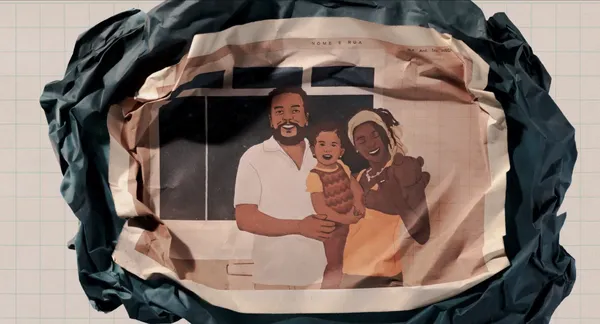
Brazilian director Fernanda Salgado's beguiling, animated feature Ana, En Passant, fuses together 2D hand-drawn animation, rotoscopy, collage and stop-motion with real-life footage. A treat for the senses, the story revolves around Ana, who leaves her native homeland of Brazil and travels to Paris after the death of her grandmother. It's a trip that becomes a journey of self discovery for Ana as she learns about her family's heritage.
Ana, En Passant is Salgado's feature début. She previously co-directed the quirky short film Tormenta, about an apartment in a rainy city and the self-reflections of a man searching for love.
In conversation with Eye For Film, Salgado discussed approaching narrative by way of documentary, the influence of Jan Švankmajer, the need to ground fantasy in reality, rejecting an open-ended resolution, and more.
 |
| Fernanda Salgado |
The following has been edited for clarity.
Paul Risker: How would you describe your relationship to cinema?
Fernanda Salgado: It is a little bit interwoven, but in terms of the personal relationship to cinema, I really love storytelling. I love fiction films and documentaries (well some of them, it depends). It's really funny because in my studio, I'm always proposing fiction or animation films, and then I have a partner who really loves documentaries. So, we do both — one at a time. It complements how we work and think about our projects.
In regard to the professional side, I did my undergrad in social communications in Brazil, at a public university. I had several professors with different ways of thinking about, working with and discussing cinema. There were some that worked with visual and video art, others with documentaries or animation, and others who worked in a very classical Hollywood way.
So, I feel like my relationship with cinema is very much a mashup of all of these references and inspirations, insofar that I sometimes really love cheesy films, like superhero films, not all of them nowadays, but I do enjoy them. And I really love musicals — I get that from my mom. And classical films by Billy Wilder and [Alfred] Hitchcock, and also really weird experimental and crazy alternative films.
Getting to have all of these inspirations and references, informs what I like to watch and what I like to show students of mine. For instance. I have a daughter who's nine, and we love going to the cinema and watching blockbusters but also going to film festivals and watching really weird animations and different ways of telling stories for kids. So, I have a very eclectic relationship with cinema and storytelling.
PR: We are all on our unique journey with cinema, which I like to compare to a type of voyage. At times, it's like being in a boat on the ocean, letting the wind in the sails take you to unexpected places.
FS: Your relationship to films, and what you're gonna watch, will change with time because recently I've been focusing very much on watching animation. I really love watching kids' films as well, and so, when I go to film festivals, I'll look for the kids' programme. There was one festival that I went to where I watched several programs of short films. And the one that I liked the most, which was better integrated, was the one for kids. So, it's interesting how your interest ebbs and flows and there's space for everything.
PR: As someone that has taught film, do you feel a responsibility when introducing students to films?
FS: Yes, and what I like most about being a professor, which was my experience when I taught a documentary class, is you'll have seen all or several of the classic documentary films, so let's watch some different stuff. I loved having the opportunity to open up these kids' perspectives on what a documentary can be and what it can do — how you can work with it and how you can bend it.
So, I loved showing different stuff. These were still those classic films, but they were just a little outside the classic path. This allows the students to think differently when making their own films and encourages them to search for different, even weirder types of films to experience. It's about opening up worldviews about what cinema can be, which is one of the most interesting things about being a professor, because there are so many different types of films out there.
PR: Reflecting on your appreciation for different types of films and given that Ana, En Passant is a mix of animation styles, is the film your spiritual echo?
FS: While you're making the film you're not thinking about that but looking back on the process and the path that I took, having so many references and sources of inspiration did lead to a very eclectic film. And some of the references were documentaries. In some ways, I feel I approached the making of this fiction film as a documentary in regard to my relationship with the camera or the actress. So, yes, all of that informs the process of making the film and the aesthetic choices, for sure, and even maybe the tone and the rhythm of the film. Every little step, every reference, every influence led me to make this specific film in this way.
PR: The film is layered with detail in a way that will reward the curious audience who are willing to seek out repeat viewings.
FS: While we were making the film, I was explaining to the team what each of the different sequences were doing and what the references were. And so, there are many scenes and sequences, dialogue, sound and colours that are filled with intentions to create layers of significance. So, yes, if you were to sit and review the film, and try to go into all the little decisions for each scene, you'd find more layers because how it was built was very layered. And of course, there are things that may be only for me or the team, right? Not everything, because there's also a cultural context, but every little thing has been discussed and has several layers of meaning.
PR: You cannot watch the film through a purely narrative lens because it's almost like a stream of consciousness, or a type of long form poem. And repeat viewings are unlikely to be motivated by the narrative. Instead, it's the inner emotional worlds of its characters.
FS: I can see your point about the stream of consciousness for sure, because of the narrative and the flow. And I never felt like it was a classical type of narrative. There's no big conflict, right? There isn't any form of external opposition — it's so much of her internal movement. And for Alice, there is a sense that her conflict is very much internalised in own her body and is tied to her relationship with her own body. So, it's very physical in that way, but at the same time, there is not this opposing force that is external to them that they need to conquer — unless you think of social constructs, and colonialism and imperialism. But that's a very general context of the opposing force. The journey that we're telling in this story is so much about the internal flow of them moving through the world, picking up pieces of memories and unveiling the city. I don't know that it's very consequential, but it is internalised and something is moved inside of them. And that is the most important thing.
So, you're absolutely correct that the need for repeat viewings is not necessarily in terms of narrative, because the narrative is pretty straightforward. Instead, it's about how they're processing things, how they and the animation are moving so that we can go with them on this interior journey.
PR: The conflict is internalised and is about the struggle with one's own identity. You are asking the audience to enter the internal lives of the characters and to look at the film through a metaphorical lens, because it's lacking a traditional hero's journey arc. Instead, it's more psychologically driven, and any resolution is going to be emotional.
FS: Yes, and I wanted the resolution to be open-ended. So, I feel Ana, in solving her main problem, opens herself up to new possibilities. She actually solves something internally that we don't even see happen in the last scene. It happened a little before, so there is this feeling of a resolution that is very internalised. And then we have the resolution with Alice that is metaphorical and physical. She's finally at peace with her body again and is able to exist in this new form. Then we have the epilogue in which we have the grandmother again, and I'm always very emotional about that part of the film. I love how it ends mid-sentence, in the mid-movement of the birds, because it doesn't really end. It's pointing towards the continuity of these relationships, this story, and the movement of their lives. So, it requires opening ourselves up to move inside the feelings and sensations of the characters and just being open about not having definite resolutions.
And I didn't feel like I needed to explain anything; I didn't want to explain. It was never a question of why are they doubles? I love this openness.
PR: The concept of the double is present throughout cinema, and as compelling a narrative device as it is, it's a fitting way to view ourselves as individuals and humankind more broadly.
FS: I love the philosophical implications of this fantastic concept. And I really love how the fantastic, as absurd or wondrous as it can be, reflects our real world, the questions we have, and how we move through the world. So, I love this tension in the conversation between the real and the fantastic and how they're reflecting us and our world.
The Czech animator Jan Švankmajer was a reference while we were making the film — I loved Alice. There's this abundance of materials; this texture that's always there because of the very tactile use of several animation techniques. And I love how he shows us that in order to do the fantastic, you have to ground it in reality. It's an idea at the heart of Ana, En Passant, because the animation is woven into the acting of the characters, their movements and gestures. And the tactility of all the other materials also grounds the film in reality, so when the fantastical event of the double popping up happens, it feels different.
So, we're grounding the film in reality and playing with deconstructing or destroying it and making you see the construct of the film the whole time. Those were the parameters I wanted to experiment with — playing with reality while being very fantastical, and working with animation that might be thought of as something unreal. In a way, we're trying to upend everything. And how restless the character is, and how internally she feels displaced is externalised in the rotoscope animation techniques.