





Eye For Film >> Movies >> Begotten (1989) Film Review


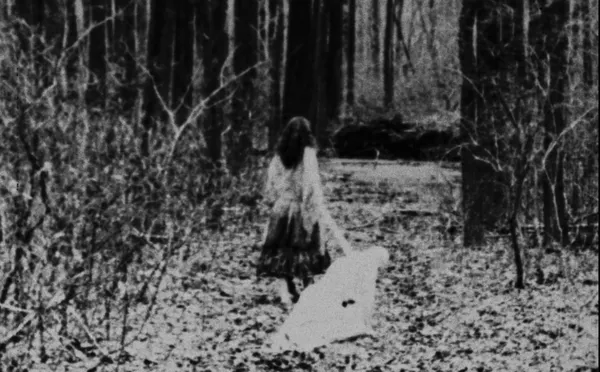

Recently restored and screened as part of Beyond Fest, E Elias Merhige’s uncanny Begotten is one of those films that some people experience as sublime art and others can’t get to grips with at all. Either way, it’s worth seeing if you have a serious interest in film. Merhige makes some intriguing choices, and there really is nothing else like it.
It’s a work inspired by footage taken in the aftermath of the atomic blast in Hiroshima. Opening with a prolonged sequence in which a masked man – perhaps representing a god – cuts out his own internal organs, it has, shall we say, a notably pessimistic view of life. Rendered in black and white, and further obscured by Merhige’s unique processing techniques, the gore won’t necessarily disturb you on a visceral level; this makes room for contemplation and a different type of discomfort. As we progress through the film, a woman emerges from the corpse, sexually excites it, impregnates herself and gives birth to an adult man. We follow these two characters through a work of bare rocks, rough grassland and leafless trees until each of them reaches an unfortunate end, with a final twist suggesting, to grim effect, that this whole process is cyclical.
Conceived as a dance piece, the film retains some of that quality in the movement of its characters and the operatic style of the costumes. There is no dialogue and the ideas behind some of the characters are only disclosed in the end credits, so viewers can come to their own conclusions before, perhaps, reinterpreting what they have seen in light of Merhige’s ideas.
Openness to interpretation is an important part of the central concept. The film itself was initially overexposed to reduce the amount of information it carried, then fed frame by frame through a home made optical printer, heavily filtered and rephotographed. As a consequence there are virtually no midtones left: it is black and white in the truest sense. In the forest scenes, the trees taper upwards into invisibility, as if their tops are too high up to see. Elsewhere, dark clouds hover overhead, backlit by the sun to striking effect. As the sun moves upward, there is a roaring sound like a powerful intake of breath, followed by a peal of thunder. Throughout, natural sounds like this are interwoven with an ambient soundtrack whose frequent looping suggests smaller cycles within the grand one on display.
Nature is not everything we see here. That brutal initial act takes place in the corner of a building exposed to the sky, implying a ruined, post-apocalyptic world. Elsewhere we see large concrete tubes lying on the ground. The comparative delicacy of the central figures and the savagery of the others they encounter, whose sexual violence and cannibalistic butchery sometimes seem like parts of the same ritual, is suggestive of HG Wells’ morlocks and eloi peopling a broken future.
A genuinely intriguing experiment, Begotten takes more time to unfurl than is really justified by what it has to say, despite the multiple ways in which that might be interpreted. Its philosophical contributions are potent if not really new. Its technical achievement is laden with potential, and indeed it has influenced other films since – notably Shadow Of The Vampire – but for filmmakers, there is much more here still to be explored.
Reviewed on: 25 Oct 2026


Director: E Elias Merhige
Writer: E Elias Merhige, Tom Gunning
Starring: Brian Salzberg, Donna Dempsey, Stephen Charles Barry, James Gandia, Garfield White, Arthur Streeter
Year: 1989
Runtime: 78 minutes
Country: US
Search database: