





Eye For Film >> Movies >> How To Listen To Fountains (2025) Film Review
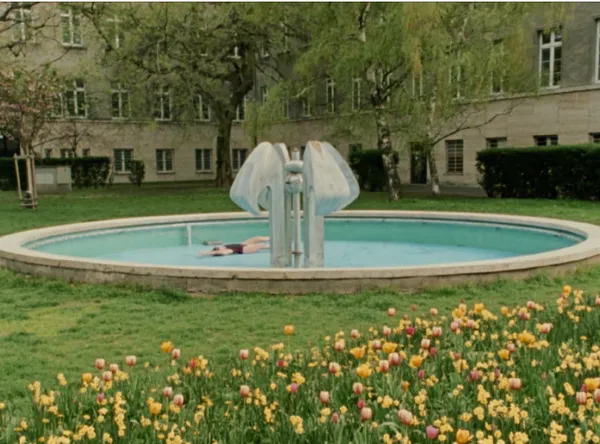

What if fountains could talk? Slovak director Eva Sajanová can definitely hear them. Her roughly 10-minute How To Listen To Fountains invites viewers to experience public spaces from a new angle by listening to them. With its playful, witty visuals and sounds, it takes us on a tour of Slovakian capital Bratislava’s forgotten fountains, where objects are the main characters and tell their own stories.
As political regimes change and economic systems rapidly shift, public spaces, especially in urban areas, change dramatically. When these changes are discussed, attention usually falls on parks, sidewalks, and recreational areas. People might defend famous statues and historical monuments, but in many Eastern European countries, fountains are completely neglected. As you walk around, you pass monumental structures that have been left disused and without water. This documentary turns its attention to them, treating them as one of the most vulnerable parts of public space, at risk of disappearing entirely amid privatisation.
Fountains might not generate much money. Maybe some of them collect coins from people who throw them in for luck. They themselves are barely lucky, though. Bright adverts promising huge shopping malls or new buildings seem to target these very spaces. Still, they serve specific purposes: they cool the surrounding area, provide drinking water, and create dramatic effects through decorative art. But fountains without water look sad, if not downright angry.
In this documentary, we rarely see humans as the main actors. When they do appear, it is mostly to serve the fountains. Like a doctor, a young woman places a stethoscope against a fountain, and we begin to hear it beating like a heart. The camera goes even further, giving us a chance to examine the fountain’s underground workings, where workers prepare the pipes and systems needed to make it work. To bring it to life. The whole documentary becomes an anatomy lesson.
Speaking of anatomy, some of the fountains shown in the film have female forms. And even those that are not explicitly statues of women, still somehow resemble female bodies when shown in close-up detail, from top to bottom. Like pistols made of stone or metal. Much like women in patriarchal societies, these protagonists’ needs are often overlooked too. At the beginning, the fountains are silent and dry. They seem able to share their needs and worries only with one another. Yet by the end, these monumental bodies, reach their climax with the fountains start flowing again. Sajanová believes in happy endings, and it would be hard for a viewer not to follow her.
Modern urban space is full of noise, but most of it is mechanical: the clatter of construction work, cars honking, trains rumbling. It’s almost impossible to hear birds chirping, tree leaves rustling, or water splashing. Anything related to natural living. The sounds of children playing on or around a fountain, or people drinking water from one on a hot day, are becoming increasingly rare. Instead, many fountains are dead silent. But not under Sajanová’s gaze: once the stethoscope touches a fountain, the film becomes not just a visual journey, but more of an auditory experience. We hear different voices of the fountains, which begin to sound like the voice of a frustrated public space. And the voice is a woman’s.
Reviewed on: 23 Oct 2026


Read more How To Listen To Fountains reviews:
| Nina Khutsishvili |   |
Director: Eva Sajanová
Writer: Eva Sajanová
Starring: Silvia Sviteková
Year: 2025
Runtime: 11 minutes
Country: Slovakia
Festivals:
Search database: