





Eye For Film >> Movies >> Fatherland (2026) Film Review

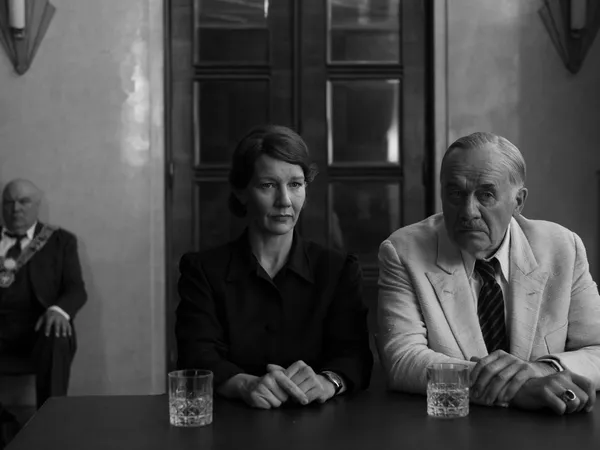

Paweł Pawlikowski, who won Best Director at Cannes, has reached a new artistic stratum with his profoundly moving and sagacious Fatherland, the highlight of the 64th New York Film Festival and Poland’s Oscar submission for Best International Film, starring the phenomenal Hanns Zischler as Thomas Mann and the always astounding Sandra Hüller as his daughter, Erika.
The story is that of a trip in 1949, the first return for the exiled Nobel Prize-winning novelist after 16 years to a Germany which was at the time already deep in the process of being split into two parts, divided by the Allied Forces harboring conflicting agendas. The Germany Mann left in 1933 is no longer and to find out what the fatherland has become is partly the reason for this journey. Germany, East and West (as well as the rest of the world) are celebrating the bicentennial of Johann Wolfgang von Goethe’s birth and Mann is invited to speak and accept two Goethe Prizes, one in Frankfurt am Main, where the literary genius was born, and one in Weimar, where he spent most of his adult life and served in various public offices.

In reality Mann was accompanied by his wife Katia, a fact that Pawlikowski changes, thus highlighting the father-daughter dynamics, as well as giving Erika, a multi-talented writer, actress, race car driver and BBC war correspondent who attended the Nuremberg Trials, a voice.
Fatherland, begins with neither Thomas, nor Erika, but with Klaus Mann (an immensely impressive August Diehl), on the phone with his favourite sister. Palm trees sway outside in marvellous black and white. The cinematography is again by Lukasz Zal (who also worked with Pawlikowski on Ida and Cold War and shot Jonathan Glazer’s masterful The Zone Of Interest). Seagulls are screeching, which could be coming from either side of the phone line, as Klaus is in a hotel room in Cannes and Erika at the modernist Pacific Palisades Villa in California that the Manns built in 1941, and from whence Thomas Mann broadcast his famous monthly anti-Nazi speeches, countering German propaganda.
None of this biographical information is spelled out to the viewers of Fatherland, instead Pawlikowski makes us feel and see it, and invites us to think for ourselves. Due to the great artistic finesse and actorly prowess we understand. Klaus is in a deep crisis, emotionally, intellectually. Klaus was the author of Mephisto, based on the actor Gustaf Gründgens, Erika’s former husband and his ex-lover, and worked for the US Military Intelligence Service, trained in psychological warfare and counter-intelligence. He is not going to join his father and sister on their trip, despite Erika’s pleading.
“Which side are you on? Stalin or Mickey Mouse?” The world is split in two and Klaus doesn’t believe in anything any more. “Erika, do you still believe in anything?” He asks on the phone and suggests that maybe they should all kill themselves, like Toller and Zweig, and that their father should go first. His deeply felt despair and anger about the state of the world also seems to be what motivates the upcoming trip. Klaus will never set foot again in Germany. “A language created to lie,” is how he puts it, whereas his father will soon speak about the German language as his only true and lasting abode in his two almost identical Goethe speeches.
The camera follows a scooter through the ruins of a post-war city, then switches and places us inside the black Buick, driven by Erika (who had competed in early automotive rallies in the 1930s), next to her father as they arrive at the Metropol Hotel in Frankfurt. The cinema across the street shows the fictitious movie “Das Flüstern des Schicksals”, a cheeky comment on the “whispering of fate” that is happening here.
A US official named Arthur Quint (David Menkin) will take care of their security, and Erika hands him the threatening letters that have already arrived for them at the hotel, calling Mann a traitor to his country and warning that they were “coming for him”. At the press conference, where the multi-lingual Erika functions as her father’s translator, the questions range from the meaning of the award, to his leaving Germany, to Cold War preferences. Why does he accept the Goethe prize both in the West and soon in Weimar? Since language and literature know no zones, he sees no conflict there. His “home” now is in California, but “Heimat” is a much more difficult question.
Thomas Mann doesn’t travel light. “You have more stuff than the Dietrich” says Erika as she unpacks his suitcases. She not only drives, translates, puts together his wardrobe, she also edits her father’s speeches and listens to him practice. The way Zischler and Hüller play their relationship is so wonderfully real and subtle and appropriately opaque for all us non-Mann family members, that it at times brought tears to my eyes. We are watching thinking human beings who have something to say, who try to express to others what is important. That goes for all four of them, the characters and the actors portraying them.
During the Frankfurt speech at the Paulskirche, there is a moment where Erika from the audience looks up to the cathedral’s upper gallery balcony. Hüller’s face suddenly resembles that of a saint, filled with love. It isn’t the power of her father’s words, though, but the fact that she sees her brother Klaus, or rather his phantom, up near the rafters. Klaus had committed suicide. It isn’t the last time that he shall haunt the film, the way beloved dead ones tend to do.
Pawlikowski has always been a master of atmosphere, but never have the scenes been such vivid jewels and so fervently interconnected with history at large. Each seemingly small encounter, thanks to the superb supporting cast, enhances the film and can also serve as a rabbit hole for those who want to explore further the wide-reaching net the Manns have woven.
There is journalist Betty Knox, played by Anna Madeley (Mrs. Hall in All Creatures Great & Small) with sparkle and drive, who greets her old friend in Frankfurt. Knox was an American dancer, who became a war correspondent for the London Evening Standard and reported from the Nuremberg Trials together with Erika, with whom she was romantically involved. Theo and Enno Trebs (Christian Petzold’s formidable Miroirs No. 3) as Wolfgang and Wieland Wagner, Richard’s grandsons, talk about reviving the Bayreuth Festival, giving Thomas Mann a chance to express how he feels about their mother’s Nazi collaboration. Zischler is marvelously stone faced, listening to the brothers’ honey-sweet praise, only to verbally lash out as he walks away from them at the reception. Winifred Wagner, their mother, ran the festival from 1930-1944 and was a close friend to Hitler.
“Musik, Musik, Musik” a song made popular in 1939 by actress Marika Rökk, an operetta performer famous for her tap dancing and Hungarian accent, who was chosen by Goebbels to become the German film industry’s alternative to Hollywood musical stars such as Ginger Rogers or Eleanor Powell, is Pawlikowski’s excellent choice for the evening entertainment in the West (the song is also performed with an accent, resembling that of Rökk).
“Erilein” greets Gustaf Gründgens (Joachim Meyerhoff) his ex-wife at the same reception in the hotel bar. Obviously he hadn’t forgiven Klaus for Mephisto, in which he, thinly disguised, makes a deal with the devil. “Göring befriended me!” Gründgens insists. “I stayed in Germany because I’m an actor” he explains before insulting Erika’s many talents, presumably not for the first time. The slap he receives for that is just as heartfelt as her father’s comment to the Wagner boys was. Her explanation that that was her ex-husband also allows the mention of WH Auden, her current husband since 1935, a marriage of convenience, which granted her British citizenship and thus protected her from prosecution by the Nazis.
The discrepancy between the West and East is stark and everything from the makeup to costume and production design works together beautifully to make us feel the different ideological winds blowing.
Before their early departure to Weimar and after the arrival of the horrible personal news, Erika hears and reacts (“Fascists!” “Murderers!”) to drunken men downstairs on the street sing a popular military marching song that dates back to the late 19th century. Its terrifying sounding lyrics speak of a most beautiful Polish village girl who refuses to kiss the German grenadier, and once she does, ends up as a water corpse. Do not associate with the occupiers is merely one of the song’s warnings. Sung by a group of drunken men it becomes something else.
While father and daughter are on their way on the badly paved roads to the East (staying that way for decades to come), the radio plays another perfectly selected song (an area where Emmanuel Marre is lacking with A Man Of His Time and its anachronistic musical shortsightedness). The Comedian Harmonist hit “Irgendwo auf der Welt” longs for a “Somewhere in the world”, where there is a little bit of true happiness to be found. The Comedian Harmonists were a vocal group that performed until 1934, when three of the six men had to leave Germany because they were Jewish, of Jewish descent, or married to a Jewish woman. The song’s yearning lyrics and its background capture the emotional state, the exhaustion and pain and the nevertheless.
Border crossing, gifting a cigar, an impromptu pick up at an almost empty inn, where the waitress (Fritzi Haberlandt of Babylon Berlin) can offer them only chicory coffee or sea buckthorn juice – the Eastern Zone is a different world entirely. They are welcomed by Johannes R Becher (David Striesow who plays Hermann Göring in Babylon Berlin) to accompany him to meet Colonel Tiulpanov (Daniel Wagner) and the first of several choir performances. Children singing now, later a never-ending military choir – this is a far cry from the entertainment in the West.
Is Thomas Mann seen as a “bourgeois relic?” Tiulpanov quotes Mephistopheles from Goethe’s Faust who, when asked about his identity says he is “ ein Teil von jener Kraft, /Die stets das Böse will und stets das Gute schafft“ ("I am part of that power which eternally wills evil and eternally works good”). Contradictions abound and opposites cannot live one without the other, as Mann knows and speaks about in his lectures.
Buchenwald is now used by the Soviets to house political prisoners, according to a man who alarms the visitors, before he is dragged away by security officers. Big, tall cold corridors and wooden doors. For a few moments we are kidnapped into Thomas Mann’s dream. When he speaks of Goethe, he speaks of the open gaze, the open eyes for contradiction, the irony of the gaze. A visit to Goethe’s house includes his death mask, his hand in plaster, his rather dainty shoes. Photographs are being taken, Erika wants to leave. At the endless garden reception Thomas Mann looks bored, exhausted. He finds his daughter in her room on the bed.
They talk about the family catastrophe that has befallen them and everything else that matters in the now. It is an enviable scene of closeness and shows a deep bond of understanding between father and daughter, as they sit in their dressing gowns, sipping Armenian brandy, a gift from Tiulpanov and presumably “Stalin’s favourite drink” that he served to Churchill at Yalta.
On the drive back, followed by a military car, AFN playing the Tiger Rag indicates that the West isn’t far. As they pass by a church in ruins, a glance is enough, without a word, Erika turns back and the two of them inspect what remains of the building. Two men, high up are at work tuning the organ. The Manns sit and listen and we hear Bach, Klaus Mann’s favorite composer. The expression on Hanns Zischler’s face in the final shot of the film remains etched in my mind with its sheer colossal emotional power. The most perfect ending imaginable.
Reviewed on: 04 Oct 2026


Director: Pawel Pawlikowski
Writer: Pawel Pawlikowski
Starring: Sandra Hüller, Hanns Zischler, August Diehl, Anna Madeley, Devid Striesow, David Menkin, Joachim Meyerhoff, Enno Trebs, Theo Trebs, Waldemar Kobus, Daniel Wagner, Fritzi Haberlandt, Milan Peschel, Joanna Kulig, Christophe Falconnet
Year: 2026
Runtime: 82 minutes
Country: Poland, Germany, Italy, France
Search database:
