





Eye For Film >> Movies >> How To Listen To Fountains (2025) Film Review

We all show our love towards the cities we live in differently. Eva Sajanová writes her love letter to the Slovakian capital Bratislava with her short about fountains. How To Listen To Fountains invites the viewer into a childlike state of wonder, with inanimate objects coming to life. First, we see a broken piece of tile emerge from a yellow landscape of sand that looks like a construction site. The tile moves in stop-motion. The simple rule is clear. In this film every object has a soul.
Sajanová documents real life images of Bratislava’s fountains of many sorts and aligns them with real recordings of the water flowing, spouting, rushing. The noise of the city often overshadows the delicate sounds of gurgles and trickles of the water but here we hear them loud and clear. Each of their sounds is unique, which makes them come alive. But they are struggling. Most of them are dry. It gives them a melancholic look. Gerard Richter's abstract paintings come to mind, seeing the layers of dark green and bluish sediment built up over the years. Dry fountains with the city’s lifeless landscapes breathe emptiness. Yet this sadness is overpowered by the curiosity and joy of a camera that moves around them, gets up close, and even goes underground, to their roots. All this time we hear them loudly. This creates excitement about what these fountains have to say.
Their noise is dragged out from within; you can hear tiny drops of water flashing inside the pipes hidden under the ground. This extreme closeness makes you feel that the fountains are whispering to you, as if sharing a secret. It is the actual sound of the underground pipes, with its raw, repetitive noises, that is hypnotising and sometimes recalls experimental electronic music. We see the images of construction work, while the sound of water instructs you to listen to the fountains. It helps you understand they are in danger.
The surrounding billboards make ominous promises: ‘’We are creating a place friendly for pedestrians, cyclists and drivers’’, “Look, here will be a new space for gatherings”. The promise is big, but the threat is bigger. The sound of water rushing is changed with the noises of drill. A construction worker’s glove is moving up with stop-motion. Privatisation for the sake of profit continues, which reads as a fountain’s death sentence.
With the economic system that rules post-Soviet countries like Slovakia, developers and investors are the ones who decide the fate of the city. They will take as many public spaces as they want. With public spaces in danger, the quality of life is in danger, just as the right to look at the beautiful pieces of art in the streets. So, this eerie sound of water rushing through the pipes starts to read as a stubborn, revolutionary murmur; a way of protecting itself from a strong and blind industrial force that cannot see its beauty.
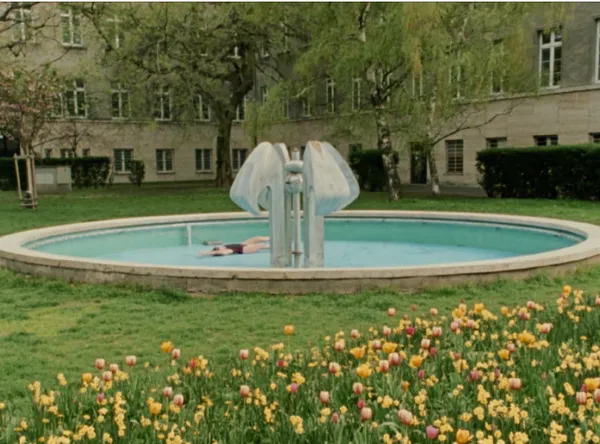
There is this one beautiful surreal scene in the film. A girl decides to swim in an empty fountain. It looks awkward and sad without water. She looks like a fish on land, waiting for her death. This image reads like a metaphor. Just as swimming requires water, a city needs its public spaces for a comfortable living. This is why we need to listen to these fountains and defend them passionately. When we hear the noises of liberated water coming from many different fountains of Bratislava, it leaves us with hope. If we stay as loud as these noises of streaming water, saving the beauty of our cities seems possible.
Reviewed on: 23 Oct 2026


Read more How To Listen To Fountains reviews:
| Temuka Zoidze |   |
Director: Eva Sajanová
Writer: Eva Sajanová
Starring: Silvia Sviteková
Year: 2025
Runtime: 11 minutes
Country: Slovakia
Festivals:
Search database: