





Eye For Film >> Movies >> I Am Going To Miss You (2026) Film Review


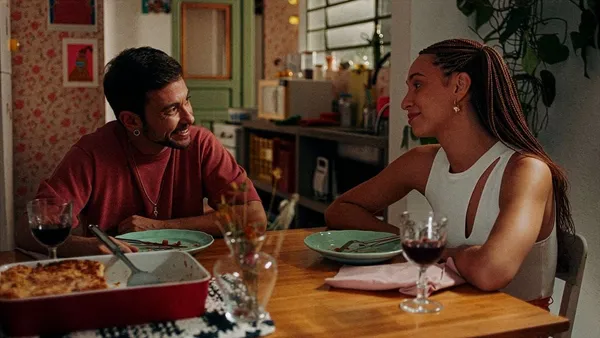

Often it’s when relationships are coming apart that we learn to value them most. When we meet Caio (Gabriel Lodi) and Amanda (Alice Marcone), they have been together for seven years. She’s about to go on a work trip to New York City. He’s about to move to Rio. They sit with their backs against a mattress in their stripped-down flat. To all intents and purposes, it’s over, but they still don’t really want to let go.
Daniel Ribeiro’s gentle yet resonant romantic drama, screened at Newfest and the Scottish Queer International Film Festival, delves back into the past to see how the two of them found themselves here. We first meet them when they’re busy moving into the same flat, but learn that they’ve been dating since high school. Each already has a different vision of how the relationship is going to develop, though they won’t fully understand that until much later.
They are both trans, and that might be some of what has brought them together – a certain shared understanding, a sense of a safe space – but it is a largely incidental factor in the narrative which is refreshing. Contrary to the impression that cinema’s recent fascination may give, trans people lead lives much like everyone else’s: not everything is about transition. Beyond their relationship, the most important thing in Caio’s life is his love of radio. Though he makes his living in the bakery owned by his mum, he also spends time working at the local radio station, volunteering for everything he can, and after some years of this, his talent is finally being recognised: there’s talk of him getting his own show.
Amanda, meanwhile, is an office worker, very career-focused and ambitious in a more conventional way. It’s through work that she meets the conventionally handsome João (Luca Scarpelli), and something begins to develop between them. Despite refusing to let it get physical, she feels guilty, and for a while this makes her crave comfort and reassurance, propelling her back in the direction of her ‘little penguin’. But can she shake it off for good? And does she really want to? “We don’t always feel what we want,” she explains, doing her best to be honest even when the temptation is to be kind and let the damage get worse.
Both leads approach their roles with patience and sensitivity, exploring every nuance of their characters. Ribeiro finds something beautiful in fragility and rawness, turning a soulful gaze upon tragedy in the distinctive tradition of Portuguese-speakers, and it’s no coincidence that the film plays out on a fado track. It’s a tradition that makes room for celebration of love regardless of its capacity to endure, and for that other kind of love between partners like this which may well last forever regardless of how events play out. The result is a sweetly melancholy film which doesn’t slip down as easily as Hollywood romances but will leave you with a deeper sense of satisfaction.
Reviewed on: 21 Oct 2026



Director: Daniel Ribeiro
Writer: Alice Marcone, Daniel Ribeiro
Starring: Alice Marcone, Gabriel Lodi, Luca Scarpelli
Year: 2026
Runtime: 87 minutes
Country: Brazil
Search database: