




 |
| Amber Paul in The Drive |
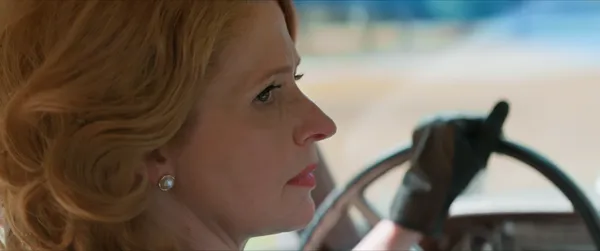
One of the most impressive contenders in this year’s battle for a short film Oscar nomination, David Arrow’s The Drive is a slice of life centred on a potent moment in US history. It sees an upper middle class white woman (played by David’s wife, Amber Paul) collecting a group of young girls from school, dropping two of them off and the noticing, as she is taking the other two home for a sleepover, that she is being followed by a black Cadillac. Between this, a moment of listening to the radio, and the strange ways that other drivers are behaving, she gradually becomes aware of what has happened, but is determined to protect the children from it for as long as possible.
“I read a fascinating book about the day on which it takes place: November 22, 1963,” says David when we meet. “I call in the film a footnote to history, because it's a piece of that day. Not, I think, in any way hugely dramatic to the overall events, but unique and very personal. Part of the story of that day, and very key to that family, what was going on. And I found it fascinating. I thought it was worth sharing. Particularly knowing that I had an actress who would be able to convey the journey, which was so often in silence.” He looks across at Amber and grins, and she beams happily. “I thought it was a great opportunity to make a film that was just unique,” he continues. “And the challenge, of course, of doing something in a period was also something that intrigued me.”
With hardly any dialogue, Amber has to convey her character’s emotional journey almost entirely through her face and body language. I ask about the internal process behind that.
“I did first a lot of research on the period to understand the role of women and this particular woman during that time,” she says. “The way that David and I work, I work very hard on the script in preparation, and then I always let that preparation go so I'm living in the moment. So as were filming, I'd ask David ‘Where am I in the arc of the story?’ I created an arc for myself, and I think that for her it just unfolds, literally, moment by moment. She hears something and she says ‘Oh, my goodness, I must protect the children. I must protect the children.’ And then each piece as it unfolds, she...” She trails off. “Because no one knew. There was only radio at that time that was really working. It's such a blessing to work in a time frame with no cell phones, no car phones and stuff. So as it unfolds in the story, it unfolds for me as an actress.”
There's a moment when she hears on the radio “Three shots have been fired,” and she just instantly turns it off. We don't know how much she's really processed that as a piece of information, because it's the kind of thing that parents do instinctively, to to protect children.
“Exactly. And, you know, little bits of information are given out – the strength of David's filmmaking is that he lets it slowly unfold, and then there's a turn where you finally, as an audience, realise, which is actually at the end. But no matter what, I had to protect those little girls from hearing that. At first, she doesn't really know what’s happening, and then she starts to clue in that something has happened.”
“Yeah, yeah,” says David. “In a way, it was a slow unravelling for the whole country. I mean, they didn't know. News reports were coming out of Dallas. They didn't know really what was going on. In the same way that we have almost instant information now, there was so much confusion. But Amber's and the character's instinct to protect the children, I also felt was very universal, and although this was an extraordinary time and an extraordinary circumstance, it was very appropriate in what a mom and a caring person would want to do under any circumstances, even with the added burden of knowing who actually is in your back seat.”
The film is a mosaic of small details, very carefully identified and assembled.
“It's actually thanks to our incredible crew,” says Amber, “because this set was unique in that we had every single person working towards this goal of integrity, of telling, because it's a true story from beginning to end. And getting every single detail right, from the buttons on my outfit, which were vintage, to the gloves, which were vintage, getting every single detail right came down to them. Everyone worked so hard to make sure that we got it right because we're telling such an important story in American history. And it's also down to David at the helm, so he can talk a bit about that.”
“It was carefully constructed,” he says. “A lot of it was in the moment, based on what vehicles we had, but it was always designed that the opening would have a credit sequence driving through DC, so that we could see where we were, and cutting to the gloves, which tell us what period we're in, and the console of the car, the push button of a radio, as opposed to the digital world that we live in now. That was very much to create the world of the time that we're in, and there's little subtle things that people wouldn't really catch, but the very first building that she passes by on the drive there is the National Archives. It's my little hint of saying, ‘This is a true story.’
“We shot in D.C. and there was a flag that was coming untethered from its pole, and we caught that and I thought ‘Well, that was great, because the world is about to untether.’ So a lot of it was very designed or taken advantage of when we saw the opportunities at the put-together in the edit. But it was also done in collaboration. Amber and I have a wonderful way of working on what's going to show, what's going to tell her story.
“I really rely on actors in general, but particularly on Amber, [so I can] say, you know, ‘What are you doing? What's your feeling? And how can I then support that in the filmmaking? I have my ideas, but I want to embrace your ideas.’ Because it's such a collaborative art and the more you can take advantage of those collaborations, I think the better outcomes you have and the more surprises await you.”
“Yeah,” says Amber, “because my preparation – because I obviously wasn't alive at that time – I listened to the music she would have listened to. I read the most popular book for. women on the New York Times reading list. I studied everything that was happening right up into that moment because we're following something that goes moment by moment in that day. So I did a lot of those kind of things to ground me, and thinking, how does a woman of that station carry herself in 1963? Because we move very differently now. So I did all of that thinking and what it kept me was grounded in 1963. And I let all of that go, and then it was just experiencing it as it happened.
“I'm so lucky in that my husband writes incredible scripts for me, but we also love working together, so no one knows me better. And to have that person as your director...” She smiles contentedly. “He knows exactly what word or phrase to use, and how to ask me to do a certain thing on set. I'm very lucky.”
It’s one thing to talk about women in the period, but with this particular woman, although she's limited in what she has access to because of her sex, she's also very privileged in certain ways. We see that from her clothes and her hair and the way that she carries herself. When she is stopped and goes to talk to the man in the other car, it's clear that she's being accorded a degree of respect and authority herself as well.
“Yes. It's an interesting dichotomy because she represents every person that day in 1963, the everyday person, and yet she is in a unique position because her daughter's best friend is Caroline Kennedy. It was such an exciting day, so she probably got a little more dressed up than usual to do the carpool because she's taking the girls to tea at Lord and Taylor and then home for Caroline's very first sleepover. And I always think about that, the excitement of that and how excited her daughter is, and then that little girl's loss.”
“How many lives were shattered that day?” David wonders.
“But hers in particular. We lost our president, and she lost her father at age six, in a time when she should have had so much fun at a sleepover. There is a privilege to the role, to the character, but at the same time, she's every person whose heart was ripped out that day.”
I suggest that even without the bigger events, the loss of the sleepover is traumatic, because it’s a huge moment in life at that age and the girls were probably looking forward to it for weeks.
“Yeah,” says Amber, instantly on the same page. “And there was so much excitement, which David wrote into the script. But I always think of, you know, in other events in our history, like 9/ 11, everyone remembers where they were that day – worldwide, actually, for that experience, and how everyone came together. But we didn't have any information as it was unfolding. And when we do screenings, I have people come up to me who were alive that day when JFK was assassinated, and they tell me where they were. They have an exact memory. And they say, ‘I'd never seen my mother cry in public,’ and they cry when they tell me because, they say, ‘I haven't thought of this in years.’
“On the other end of the story, young people come to me and say ‘I'm curious about him. I want to know more,’ and they pull out their phones. So it has an impact on both ends of the age spectrum, I guess.”
Do they think it has a particular resonance now as well? People had a lot of hope in that moment with Kennedy, and they really thought that American society was changing for the better. Now most people are feeling dissatisfied with the political process, whichever side they're on. Do people look back to that moment and think that's when something critical went wrong?
“It's a great question,” says David. “I don't know how many people look backwards, but I know that historians often use that event as a sort of sense of the loss of innocence. I certainly resonated with that in the sense that children were part of this for our story, because what better represents innocence than children? So it is that loss of innocence. And I think there's a lot of events. There was Vietnam for the US of course, and Watergate was a huge issue for how the public looked at politics. But it's true. I think the one thing that did happen in this event is that there were no party affiliations. There was national grief.
Kennedy was facing a lot of [criticism], you know – there was a sign in Dallas: ‘Wanted, dead or alive,’ but as seriously as it might have have been taken, it evaporated in the national coming together. Amber brought up 9/11. What kind of national events bring people together? It's certainly not our current situation with the Middle East. Very few things bring us together.”
“Yes,” says Amber. “And when we have those experiences as a nation, the barriers between us fall away. It doesn't matter who you are affiliated with politically or where you come from, or your background or your choice of religion. You're just American in that moment. The level of care that people showed for each other then, and also after 911, was extraordinary. It did not matter because we’d all just come through this thing together.”
“But I think your question is a really interesting one,” says David. “Is that possible now? I don't know. Hopefully we won't be faced with the kind of tragedy that would put that question to test.”
It’s not quite on the same scale, but they might have a big moment in their own lives if this does get an Oscar nomination. How do they feel about being in that race?
“I think, you know, we've been in the business for a while, and of course, it's everyone's dream to even have that phrase be associated with you,” says David, making a visible effort to keep himself from getting overwhelmed. “It's an incredible honour and really a tribute to, well, first of all Amber, my muse, who really is the emotional backbone of the story. But it really is. I mean, I feel very proud as a filmmaker, but what I'm really proud of is that we did it together, that our group, our team, we had a really good time making the film. Amber said she had inklings of how good it would be. I was just worried about getting the next shot, but, you know, we couldn't be more thrilled.”
“When I was in the car driving and were doing it, I said ‘This is something really special and unusual,” adds Amber. “In terms of the potential Oscar nomination, I would be thrilled. The Short Film, Live Action category is often the underdogs of the entertainment industry. It's often not the household name, but small teams that have come together to create these extraordinary stories. I'm glad that they have those categories, and I feel very lucky to even be in this moment of qualifying for that potential.”
I note that personally I think that we often see the best work in the short categories because the politics isn't there in the same way that it is with lot of the bigger ones. Different audiences see the films at each stage, and that really brings out talent.
“That's the bonus,” Amber says. “Because of this, so many more people will see the film.”
David nods. “At the end of the day, we make these things – everyone does – we make them to be seen, and so hopefully this opportunity allows the film to be seen by more eyes and experience a bit of history that they may not have known about. Now we've increased their knowledge and hopefully given them a little bit of a metaphor, but a ride that they won't forget.”