 |
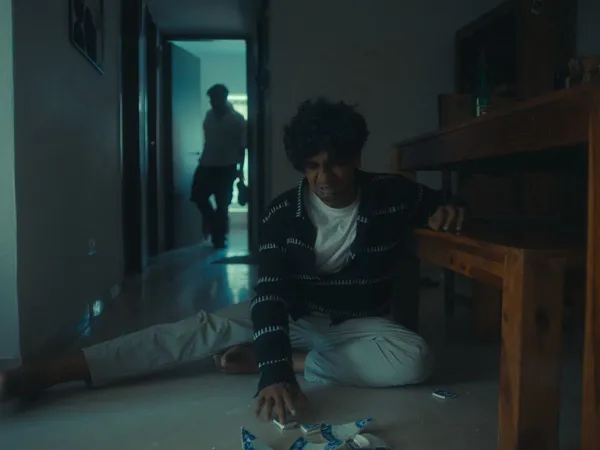
| Abhinav Jha in Chaar Diwaari |
The only Indian selection at this year’s Fantasia International Film Festival, and a deserving award winner, short film Chaar Diwaari is a beautifully realised, high concept thriller which will stick in viewers’ minds. Producer Shivek Gupta was delighted to have the opportunity to promote it there, and although director Syed Shadan was unfortunately not able to attend due to visa delays, he joined us online to discuss it.
“I've been attending the festival for the last week and it is incredible, says Shivek. “I keep telling Shadan it is the greatest crowd a filmmaker can ask for and just such an incredible experience in its totality. “
He’s been enjoying some of the other films screening, he tells me, like Japanese comedy Break Free, Dutch comedy After School and Japanese festival favourite Beasts Clutching At Straws, which latter he cannot praise enough. This also led to a bit of a revelation.
“When I was seeing these kind of films, I realised it's such a big honour for our film to be in the same festival. I've also had a chance to chat with so many other filmmakers. I met the writer of After School at the networking event just to get to know more about his writing process, because I truly feel that comedy is such a hard genre to do. It is a genre that is dying all over the world. And for them to have made a comedy that was not only out loud funny, but very gripping and heartfelt and you cared about the characters, it was just so amazing.
“Fantasia has opened a lot of doors for us. It is such a massive opportunity to just have your film screen here because now, if we want, we can come back to Frontiers next year with a feature pitch. I can't wait for our screening because I don't think we would have ever received such a reception. They are so encouraging to all the filmmakers. The crowd just loves you and they cheer for you. You're almost like rock stars for the day.”
Shadan is keen to tell me how the film developed.
“We are both from India, we are both childhood friends and we love films,” says Shadan. “I am currently working in the Indian film industry. I write. I've written a show for Netflix India. I'm doing a bunch of other things for Netflix India and Amazon Prime India. But since I'm writing here, I always have been directing and I love direction a lot, and Shivek and I have always worked creatively extremely well. So this is our second film together, and the idea was something that came to me when there was this stretch of time that I was living in this two bedroom flat in Mumbai and my flatmates were a way.
“Since, you know, writing is such an isolated exercise, I just sank into it and days started blending into nights, and I'd go stretches without seeing another person. Then I started thinking maybe I’ve built walls inside of my own head and my existence has shrunk down to the space between the four walls that I live between. So that's when the idea for the film first came to me, when I started thinking ‘What if the walls actually started closing in?’ And what if the house itself was doing the things to me that my mind already was? That then of course translated into the film.
“Chaar Diwaari is about a man who moves into this too-good-to be-true Mumbai apartment, and some of the rare things that happen to him are that it's in his budget, it's spacious, there are good views out of the window. In a city that's starved of good housing or even decent housing, he gets it in his budget. It's just so too-good-to-be-true that he asks his broker, you know, ‘What's wrong? What's the catch? Sure, just tell me.’ And the broker tells him ‘It's all good. Just start living here and you'll see.’ And as days progress, there's some odd things happening. And that's when this guy realises that maybe the walls are closing in on him, literally.”
I ask Shivek what he thought when he first heard this idea. Did it seem to him that it was something that could realistically be filmed on a budget they could raise?
“This is mine and Shadan's second film together, but we've been working creatively together for a while,” he says. “We've also made some ads, some podcasts. I really badly wanted to make another film and I think when the idea first came to him, the first thing in his mind was that it needs to be a one location film so that we can actually execute it on a small budget – which actually did help us plan this, even though it does seem very ambitious. The art directors did such an amazing job because they were building all the walls on set, so it was almost like experiencing movie magic, as they say.
“We used to forget what the actual size of the house was so many times because the walls that were built were so well made. So once everything came together, it wasn't that big of a challenge. It was beautiful. And I think post production took the most time, because we were done with the shoot in three days and then it took like six months to get the final thing out. So yeah, I think it was more ambitious once he had written it, but once the whole project started coming together, it just seemed easier and was one of the most wonderful shooting experiences of my life, for sure.”
It seemed like it was planned out so that they could minimize the amount of wall moving that you had to do, I observe.
“I don't think, when we were shooting, we were sure of what would the jumps be like. How small do we make the walls so that it registers in the audience's mind? Those decisions were all made in the edit, that we needed to do big jumps so that people know that the walls are getting smaller inside instead of just being very subtle about it. It was a lot of fun. I actually want to give a shout out to the owner of this house who absolutely did not care what we did with it. She was just the sweetest person. She was really nice. And all because of her, we could make this movie, actually.”
How did they approach weaving in other events to distract the audience before the protagonist realised what the problem was?
“I think one of the bigger challenges for us was the fact that since we wanted the walls moving in to kick in later in the film – it’s almost ten minutes before we actually see it happening –we wanted the audience to keep thinking ‘What is it actually that's going to happen with this person?’” says Shadan. “Because the first scene ends on such a vague note that there's a ghost in the house, and then the broker just casually misdirects him and says ‘There’s this seepage in the house. That's the ghost that I'm talking about.’ But that leaves the audience with a question. Okay, there's something definitely wrong. And in that moment, when that vase falls and then there's a photo frame and then there's a bunch of other things, you start thinking ‘Okay, is this some kind of a poltergeist situation? What is it actually?’ So we wanted to not direct the audience's attention to something specifically. I think what we wanted was just to give them enough to keep questioning what they're seeing, just so that they're engaging with the film.
“Once we actually play our trick, you know, what to expect from this film from that point onwards. So we just wanted to get the audience to engage with the film for those first six, seven minutes, and then it's a roller coaster from there. “
Something that stood out to me early on that didn't fit with what was being said by the broker was a child's toy sitting on the set of drawers at the back. This was a happy accident, he explains.
“We were shooting in a house that was owned by a family and they had little girls, but they were not in the city at the moment. Their grandmother was there. And then there was this house that actually people were living in, so when we started shooting, people had left their things midway. So there were toys scattered all over, there were some clothes here and there. It was kind of the experience that we wanted our protagonist to have, that he has walked in on a house that has someone already. It feels like somebody was there just a minute ago, before him.
“So we also entered a similar house, so we actually didn't have to do a lot of things. We just made sure that the camera captures most of these things and we imply those things. And again, the reason why I think the protagonist never questions all of this is because he's just so bewildered by the fact that he's getting this house, because it's unreal to get that in a city like Mumbai, and especially on his budget.”
The protagonist is constantly bothered by people who are phoning him or coming to visit. Was that about creating a different kind of claustrophobia?
“One hundred percent,” he say. “I think there's an underlying tone in the film about how you also build walls inside of your own head by not letting people in. Which is why whenever in the film he's trying to point out to people that the house is getting smaller, nobody else seems to see the same thing. It's because of the fact that he's also not welcoming people inside and to let them see the things from his point of view. It's only in the end, when he finally has this person to tell everything to – and yet, you know what happens.”
“Yeah,” says Shivek. “Also, none of the horror happens in front of any of the other people that visit him, be it his cook, be it his boss, even at the party. So right before the party begins, you see that the house is literally shrinked in size. But before all the guests are entering, it just goes back to its normal size, almost like it's playing a game with our protagonist. That was very intentional, just to create even that feeling of confusion in the audience's mind. Is it actually happening or is he actually hallucinating even though it is so real?
“The audience has seen the house literally shrink down, but still they have that sense of confusion if it's all for real, or is the protagonist actually just losing his mind? That was very deliberate, so that none of the horror happens in front of any of the other people, even in the climax. Till then, the house is completely okay, and people just thought that the protagonist lost his mind and he just started punching the walls out of nowhere.”
I was interested in the way that he treats his housekeeper when she comes around. He's blaming things on her because he can't think of another way to explain things, but he is punching down by blaming things on her because she has less power than he does, whilst he has less power than the broker who's put him in that position.
“I would think in the angle of the housekeeper, you could argue that even she is a little guilty,” he says. “She kind of knew what was happening with the other tenants, but she never questioned it. She never raised that point. Hence when Abhinav was doubting her intentions, of course she doesn't know what's happening, but she also knows that this house is not normal. But she never felt the need [to say anything] because she was just there to do her job and leave. She never felt that the protagonist needs to know that a person comes in this house and two weeks later there is a new tenant.”
“It's a classist behaviour, you know,” says Shadan, “but it's interesting because that's the only logical explanation that this person could also think of. It is definitely punching down on the maid, and it's the easiest way that he can make sense of the situation that he's in. But again, as Shivek said, I think we have put in some little clues there to hint at the fact that maybe the maid knows about this, because when she enters, she says that she'll take her salary in advance.
“There's this slide thing that we did with the maid was that when she enters, she knows what button is for the fan and all of that. So she's been there before. She knows what's going to happen with this person, but to her, this is her job. Her job is not to freak the other person out, which is why she keeps gaslighting this person, saying she doesn't know what he's talking about. But when you're watching the film, we think about the fact that, okay, maybe this guy is losing his mind. We never actually question that. What if she's in on it? So that's something that we try to do.”
We talk about casting.
“Abhinav Jha, who is our protagonist, has been a part of a bunch of great Indian indie films, some of the best to have come out in the past ten years or so,” says Shadan. “Shivek and I were at a film festival where we were seeing his film together. A film called Pokhar Ke Dunu Paar, which is called On Either Side Of The Pond in English. We were just awestruck by his performance in the film. And that film has restrained filmography in the sense that it's shot from a distance and actors get time to perform. There's no cuts. It's a great meditative film. And I wanted an actor and I had personally struggled with this before, that a lot of times, in my experience, actors didn't know what to do with their body when they didn't have particular actions.
“Here I was with Shivek seeing Abhinav carrying himself so well, it felt like I was looking at a real person. And then again, he is the perfect corporate guy in Mumbai. This person that we imagine him as. I wanted for this person to feel like this is one of us, and he does that well with his full body, which is something that really stuck out to me.”
“How we actually ended up casting was Shadan just dropped him a random message on Instagram and that's what got the ball rolling,” says Shivek. “I would just say that because this is just a one actor film, if our actor was weak, it wouldn't resonate with the audience at all. It would go nowhere. And once the script was written down, I thought casting was going to be our biggest challenge. Because who do we trust enough with this? Because Abhinav is literally there in every frame. And to carry a film for every frame, even though it's a short film, it's a very hard and challenging job. And because Abhinav was a seasoned actor in terms of that he's done credible things before.
“Even the way he surrendered to the role, even the way he was behaving on set, it was just amazing. I think we got lucky with the casting, with how easy it was. Just a random DM helped us. And I think he just fit the bill perfectly. As he said, we wanted him to look like a normal, everyday Mumbai person. We did not want an actor with a certain sort of physical presence. So he fit the bill completely. I think we've been very lucky with this film that the people that we wanted to collaborate with, we just have, we've been able to get them all. So fingers crossed. I hope this remains with us forever.”
He’s delighted that Fantasia let them put the result in front of an international audience.
“I was telling this to Shadan yesterday, that we will always look back at Fantasia and be like, they were the ones who kind of gave us some sort of credibility, some kind of recognition for our film, and life post-Fantasia will be different to what it is right now.”
“The allure of Fantasia is such that nobody wants to pass on an opportunity to be associated with it in any way or form,” says Shadan. “I think it's a great shame that I couldn't go there because of the imaginary walls between countries that we have. I would have loved to. But I'm glad that Shivek is there because he's a true champion of the film, and he's a true champion of whatever I have ever done in my life. So I am so happy that he's there and I hope that the audience likes the film as much as we liked making it.”