 |
| The Name Of The Rose |
1986 hit movie The Name Of The Rose is enjoying a comeback at the moment, with a major new Blu-ray and 4K release. Pretty much as soon as news of this broke, I managed to obtain a number for director Jean-Jacques Annaud, having been told that he was keen to speak, but he proved difficult to get hold of nonetheless. Although he’s 82 now, he has never slowed down. When I finally managed to catch him, he was just off the phone after discussing a new project aimed at helping young filmmakers, which remains one of his passions.
Where to begin when talking about a project as expansive as this? As a lover of the book with which it all began, I ask him when it was that it first captivated him, and how he persuaded Umberto Eco to let him take on the process of adaptation.
“What happened is I read it while I was promoting the movie Quest For Fire,” he says. “I was in the Caribbean, in some island, Haiti or Guadeloupe, and I read a small article in Le Monde, the French newspaper, that there was a curious, strange book that interested the Italian critics to a strange excitement. When I read that it was set in a monastery in the 14th Century, and it was a murder mystery in the quest of a book by Aristotle...” He trails off as if he still has to catch his breath when thinking about it. “I learned Greek for eight years, and Aristotle's book, La Poetique – ‘The Poetic’ – is one of my favourite books because it's the best screenplay lesson you can have in your life.
“I am totally atheist, but I love monasteries and churches because I love the architecture, I love the silence. I love the fact that it's a sacred meeting place. So I remember calling my agent and saying ‘Can you get me a copy? I understand the book is going to be published in France.’ When my partner in screenplay read it, he called me back. He said, ‘Come back quickly,’ because he knew that there was something that I would love. And when I read it, I was, I remember, on page 70, and I called my agent back and I said ‘Please check if the rights are available.’
“And then he called me, on page 150 or something like that, and said ‘No, don't read it, because the rights are already been bought.’ But then on page 250, I'm calling him back and saying ‘Okay, please check who has the right.’ And he calls me on page 350. He says ‘It's the Italian television, Rai Television.’ I said ‘Get me a meeting.’ I said ‘Do they have a director?’ He said ‘No.’ So I said ‘Alright, get me a meeting with someone in charge.’ And I was almost finishing the book when I got a call and ‘Yes, you have a meeting, like tomorrow.’ I jumped in a plane.
“I met the chairman of Rai, and I said jokingly, when he opened the door, I said ‘Sir, who is the director of The Name Of The Rose?’ He said ‘Well, you know, it's a difficult book. We don't know yet.’ I said ‘Don't look, don't look. I am the director of The Name Of The Rose.. And of course I joked, but I joked seriously. And he said ‘Well, you should meet Umberto Eco.’ And I did. I called him from a telephone booth. I was near my country place. I got a meeting like three days after because he was going through Paris, and I met him at his hotel near Gare Montparnasse at 6 o' clock in the morning.
“He was a man of great humour. I said to him ‘You see, you will not find many directors in the world that have read, in Greek, Poetic Number One. And I have been passionate with monasteries since my childhood.’ Then I asked him a few questions. It was very funny because he couldn't answer those questions because, you know, when you write, you don't have to write [about] are the Franciscan barefoot, or do they have beef? What's the colour of the pigs?’ When I was driving him to the airport, I was joking and talking to him. I said ‘Do you know, were the Franciscan wearing sandals?’
“We did sort of become friends, that first meeting, and then – to make it short for you – we became a part of the family, you know? I loved his country place in Monte Cerrignone in the South of Italy. We would go there, my wife and I, and sometimes with my screenplay writer, we would go there at least every month, but sometimes almost every week. Also, Umberto spoke very good French. He loved using French, so conversation was generally in French. Even today I still have a very warm relationship with that family.
“I was in Alessandria two weeks ago to commemorate, unfortunately, his death. And I was with his wife, Renate. His son was one of my third assistants on the set when I shot The Name Of The Rose. I mean, it's absolutely above a usual relationship with a writer. I admire the man very much. I love his way. He was what we call in French a bon vivant. He was a guy who loved pastas in good restaurants, and he loved his wine and he loved everything that can be loved. So he was, at the same time a very impressive man. He had an incredible culture.
“You know, right now, very often, I'm asked about artificial intelligence. Well, it was natural intelligence, because Umberto had a memory that was absolutely fabulous, and he had a mind that could connect the information that was in his head. He didn't have to use a computer to know what are steam engines or butterflies or the sexuality of palm trees. I was quiet – what can I say? And I loved his attitude towards what is an adaptation. I always told him, I said ‘If we want a decent movie, I will have to betray you.’ And he said ‘Please, go ahead.’
“I remember one day were visiting at six o' clock in the morning in a castle that inspired him nearby. We woke up at 5:00 in the morning. It was a misty day, and while we were contemplating that ruin, Umberto said to me ‘Oh, by the way, if you want to do a musical, go ahead, I'm interested.’ I remember him telling me, he said, ‘You know, if some idiots tell you that the film is not the book, answer those stupid people that I gave permission to a friend of mine who is a sculptor – he made a sculpture, he wanted to call it The Name Of The Rose. You know what I said? “Yes, but it's not the book, it's a sculpture.”’ So, you know, that made me so happy and relaxed and at the same time as I love the book and I love the man. I wanted to make the best possible movie.
“Like my distributors in the US, when I told him that I picked Sean Connery after one year of search around the world, he went mad in a friendly way. It was a catastrophe for him. And then when he saw the movie, he said something that touched me a lot. He said ‘The thing that was the best was what I feared the most. Connery is sensational.’ So. And we, you know, we never got apart. I mean, my wife and I saw him at least every three months. We had dinners together for pleasure. Umberto offered me many of his books to adapt, but I was either busy or there were also TV series that approached me for it.
“I said ‘How could I redo with other actors something that I did with people that I adore? I cannot, you know? Once, and then it's done.’ But by the way, I had the worst reviews of my life in Italy, where we ended up making a triumph. And you know, when I go to Italy, I have free lunch in any restaurant. After, I remember they didn't tell me how bad were the reviews. We had a private plane with Sean Connery to go to Vienna, and I asked the press people around me. I said ‘How is it you don't tell me, how is the press?’ One guy said ‘Well, there is one review. It's not bad.’
“The engine was already started when they banged at the small door of the private plane and put on a pile of newspapers. I went through them. They were only between horrible and terrible reviews. Because it was not the book. And I remember saying, ‘You know, the way not to betray a book is to fill the pages. One after the other, you fill the pages. If you want to make a movie, it's another. A movie is another thing. You don't need 16 hours to read it. You see it in two hours. Either you’re moved or you're not. You're interested in the character or you're not.’
“We have to be inspired by a book. This is why I call it a palimpsest, because I want to say that it wasn't not the original. It was a film inspired by a book. So, you know, a palimpsest is an old manuscript that has been scrapped and erased, but you still see the old lines. And Umberto said to me ‘You did a mistake here. You should not have said it's a palimpsest. You should have said ‘It's on a palimpsest.’ What it means is there is the remains of the book, but it's not exactly the book.
“I must say, the only thing Umberto resented – in a very nice way – he didn't want to read the screenplay, but he knew that I gave a part for this woman of the young peasants, way more. Because he ended his book saying that – as a matter of fact, you know, it's in retrospect. It's the old man, the character of Adso, the novice, who is an old monk and remembers.
“As a matter of fact, Umberto wanted to end the movie with La Nef Des Fous [‘The Ship Of Fools]. It's a painting. Anyway, he wanted it and I said ‘Umberto, this is an intellectual thing, it's not an emotional thing. We never establish this painting and therefore it won't work.’ And he was sad because he said ‘You know, the girl, I'm not very interested by this character.’ I said ‘Well, listen, when you have a first time, and when the old man says that the only thing he remembers after all this reading of his life is this encounter in the smelly kitchen of a monastery, well, you know, between film and literature there is a major difference. We talk to the instinct first, while literature talks to the brain and the brain goes down to the bowels.’ When you visualise what the writer is describing, we do the visualising first and the understanding of the depth of the story comes later. So it's an inverted approach.”
Something that really interests me about the film, I say, is that the book is very dense with its philosophical and theological ideas, and the average viewer isn't going to know all that, yet he did a great job of incorporating many of them without distracting from the story. How did he achieve that?
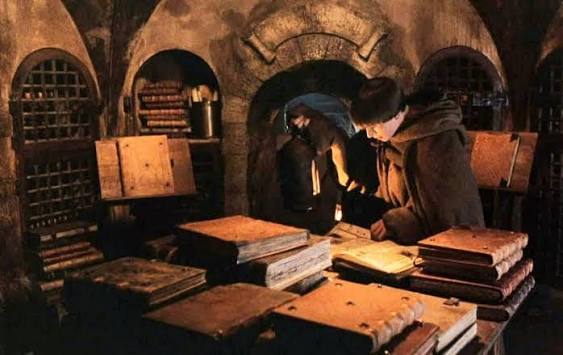
“Well, you know, I remember that everybody considered that I will never be able to make it, that no one will be able to make it – including Umberto. But I remember putting the book on the corner of my desk and I was pointing at the book saying ‘I will get you.’ It took me a year and 17 versions of the screenplay. I exhausted four different writers because it was very complicated to mix a murder mystery story with a theological story and with a historical story. So I managed to have the best Medieval specialists in costume, food, religion of course. I had to immerse myself in the period, in theological problems that I had no idea [about] when I started reading the book.
“I still have it in my office. In order to be myself immersed in that world. The whole unit and the actors look at the director. Does he know what he's talking about, or is he just an idiot who is well paid and flies first class? No, you really have to be the beating heart of your movie. And yes, it took me a terrible long time with my first usual partner, my writing partner. We did nine versions and then I was not satisfied and he said ‘I can't do it anymore.’
“Then I went to my other writer, who was Gérard Brach, who was working a lot with international directors. He did four, and I was still not satisfied. So I had another guy for one version, and then Jane Birkin’s brother for the last version. And then I did it myself because I was not satisfied. You know, it takes a long time to understand the situation of the 14th Century, why there was so much poverty among the Serfs. Why is it the Benedictines had such wealth? How does it resonate to the world today? And the world today is no different from the world when I shot the movie. So, you know, all that had to be managed into something that was capturing a contemporary audience. And there's always the problem with a movie set in the past, that you have to describe the past with the sensitivity of today. That's the complexity of it.”
How does feel about The Name Of The Rose now, compared to the rest of the work that he’s done at this stage in his career?
“I'm very – how can I say – deeply happy inside. Because it's not only this movie that has been renovated is. It's a movie that was seen everywhere in the world recently. I showed a movie in China. I have another movie in China. When I shot the first movie in China, I didn't realise that most of the guys in my unit had seen the movie, and that is very reassuring.
“I have many friends who are very good directors, [who] were directors for hire. Therefore, okay, they had a screenplay that was not too bad, and they had good meals with important actors, and then the movie is forgotten. I felt that what was important is that a movie should have a long life.
“I lived in Los Angeles for 10 years and at the end of my 10 years, I was a bit tired, because I was every day in dinners with wonderful people. But we were not discussing about important things. What was important was how much the movie did on Friday. And frankly, if your career is based on the first day of a movie that is going to disappear – maybe it makes a lot of money – it's fine. This is for Mr Trump. Make a lot of money disappear and be forgotten. I decided to go the other option and called first some movie that I would be not ashamed of in 30 years, in 40 years. So, yes, it's very pleasant.
“You know, this week I'm going to be renovating my first movie [Black And White In Colour]. It's not my initiative, it's the initiative of financiers. I decided to put quite a lot of money in my very first movie. Fortunately, I got the Academy Award for this for Foreign Language Film. But this is more luck than reality. It also gave me the impression that it was more important to try to convey your own thoughts instead of being loaned by a banker who has no film culture and wants to see strong returns on the first week. So this is the way I functioned since the beginning. Probably, I must say, probably because similarly to Ridley Scott or to Alan Parker, when we were babies, we were very much in demand for commercial. So, you know, I was selling a product. And then I said to myself, ‘No, what I have to sell is my heart.’
“It's different. You know, they were very successful, and I'm still a very good friend of Ridley and I was a good friend of Alan Parker. All those guys who did commercial were in good faith when we did the best commercial that we were able to do. But ultimately we knew that we had to not sell butter or milk or cheese or underwear or shampoo. That we had to sell something else, which was our truth. And this is how Alan Parker really decided to change their life.”