




 |
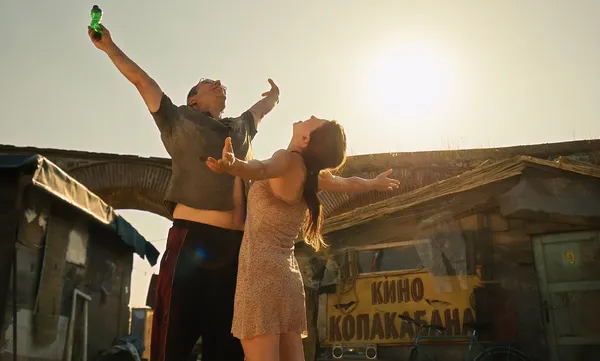
| Sara Klimoska and Filip Trajkovic as Malina and Viktor in Sister Brother Manhole Cover, which Milcho Manchevski says 'is funny, but it's talking about serious issues, especially about wealth inequality, which I think is going to blow up, and it is the source of so many of our contemporary issues, even when it's not so obvious' |
The reason why both films have followed hot on the heels of one another is very specific – Manchevski was “blacklisted” by the Macedonian Film Agency after he turned whistleblower about corruption there. His accusations eventually went on to be upheld by Macedonia’s Anti-Corruption Commission.
The director, who won Venice’s Golden Lion for his debut Before The Rain, says: “Working on one offset my working on the other and hopefully gave me a better perspective on what the other film felt like, and hopefully they complement each other. Ultimately, they're both serious. Manhole Cover is funny, but it's talking about serious issues, especially about wealth inequality, which I think is going to blow up, and it is the source of so many of our contemporary issues, even when it's not so obvious. It's going to be the global warming of tomorrow, I think.”
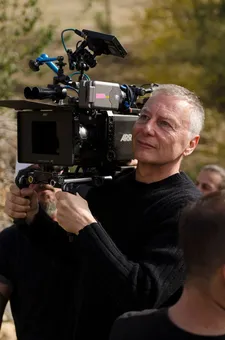 |
| Milcho Manchevski with his camera. On becoming a whistleblower he says: 'I have no regrets about this, nor anything else I've done in life' |
“I guess I was, I was, I was more eager to go into production and maybe more enthusiastic about the project and about the world that we are portraying. Had the film not been held back by several years, I don't know whether it would have been as energetic as it is in the end because we were all revving up our engines and waiting.”
He adds: “Hopefully, in the end, I won two court cases against the agency and the government changed the leadership of the agency and I do hope that in the end, there's going to be accountability, but that's a separate story.”
Manchevski says he has “no regrets” about becoming a whistleblower. He adds: “We have a saying in Macedonia that means, ‘Whatever bad things happen, it's for a good reason’. So I’m trying to look at the positive side.
“I have no regrets about this, nor anything else I've done in life. What was it John Lennon said? ‘Life is what happens when you’re busy making other plans’. Or, experience is what you get when you didn't get what you wanted.”
The film unfolds against to very different backdrops. On the one hand, there’s the down-at-heel slum where the siblings live and, on the other, is the opulent home occupied by the doctor and his blind mother. Explaining how he found the locations the filmmaker says: “We wanted to work on location and we searched for locations that had the ‘smell’, the authenticity of the place. The entire film is shot in Skopje and the surrounding areas. So the scrapyard is a real scrapyard, the illegal dump is a real illegal dump that we had to sanitise so that we could work there – especially the actors. We had to fend off the dogs.
“The former mayor very kindly let us shoot in his opulent house and we didn't have to change that much because what you see there is what was there – we brought in the bust, we brought in the piano. The slum was the only part that we constructed ourselves because we didn't want to work in a real slum. We didn't want to walk in and affect the community and people's lives, but it was built to to feel and to look like the real slums around Skopje, which are mostly inhabited by the Roma population. We also liked the idea of constructing the slum around an ancient aqueduct to have yet another layer of contrast.”
The contrast between the haves and have nots is part of the basis of the film, but it’s also a celebration of unconventional families and those families that we make for ourselves as opposed to the ones we’re given.
Manchevski says: “I myself and most of the people I know live in unconventional families and it doesn’t mean that we don't love our partners or our families any more than if we lived in the Fifties American suburbia.
“It wasn’t something that I necessarily set out to do – I seldom start with the message or or the theme of the film – I start with a character or smell or a plot twist and then play with them the way a child would play and let the story take me. I'm just a medium for the characters and for the story. In the process, you slowly become more disciplined and more focused and the themes and the so-called messages bubble up to the surface.
“So the theme of creating your family out of the people you love or out of the people you just happen to encounter became a subject, even though it wasn't there at the beginning. The same way the issue of poverty and fairness in society was not necessarily something I started with, but as you work, you realise that this is central.”
In this case, the start of the film originated from improvising with his partner. “So, if you want to do a story about a couple, but they’re not a romantic couple, they’re a brother and sister. What do they do? Something outlandish like steal busts for a living… and if you’re doing that, what might happen? Well, you may drop a bust on your foot, and then if your foot is broken, you go to a doctor, but what if the doctor is corrupt. So it was just playing with a story that combined the social reality of Macedonia today, which I believe is universal, with an absurd take on that reality. And finding characters that are complicated, characters that you love and who love each other, but most of what they do is something you wouldn't approve of. If you create this kind of a cauldron, a lot of fun things come out.”
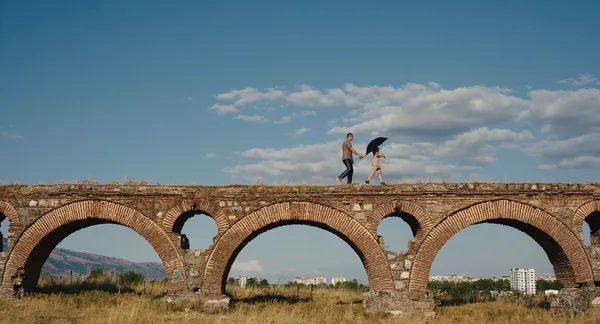 |
| Sister Brother Manhole Cover. Milcho Manchevski: 'We liked the idea of constructing the slum around an ancient aqueduct to have yet another layer of contrast' |
He adds: “We all love Viktor but we have to be careful that in portraying him, we don’t screw up. So, Filip Trajkovic, who plays Viktor, and myself did a lot of research. He actually volunteered with the group who work with people who have issues similar to those Victor has in the film. He became very close with them and they came to the shoot and we’re inviting them to the premiere. The idea was not to treat people who have issues like Viktor as different. We’re all human beings with our issues and feelings and and and strivings and hurts, and it’s great when we’re different. In the famous words of Rodney King, “Can we all get along?”
Finding someone for the part is something that Manchevski relishes, noting its “one of my favourite parts of the job”.
Explaining his process, after discussing candidates with a casting director, he says: “In the first round, we always ask him to read from the classics. Usually the “Out, damned spot” monologue [from Shakespeare’s Macbeth]. Then in the next round, we ask them to read from the actual script, and eventually we narrow it down, and it’s a lot of fun.”
Once the cast is settled, he says: “We do three weeks of rehearsals, usually table reading, where we're just loose. We read the words, we stick to the words, but then we can do whatever you want at that point. We tried to rehearse on location, especially in the house and the illegal dump to get a sense of the place and what we can do so that by the time we shoot we can improvise and we can change things, but we try to keep that to the rehearsals. So, when we're shooting, we ideally know what we’re doing, so you move fast and can make it on a smallish budget.”
It’s been a busy year, but given the fact projects have been held back for Manchevski, does that mean that he has been busily working on future films while the court case played out?
“That would have been the rational thing to do,” he says with a laugh, “Unfortunately, I spent a lot of the time with lawyers and smoking on my balcony.”
He adds: “But I do have a film I want to do now and I’m hoping to get it off the ground next year. It’s an idea I’ve had forever. Usually it’s like I latch on to an idea and I don’t let go until it’s released but this next one, called Homecoming, is different in that way. I’ve had this idea forever and I approached it from different angles and I was always a little hesitant to do it. Now it’s opened itself up for me and it cracked open by asking me to go very simple in terms of emotion and in terms of narrative. Maybe I needed to get a little older before doing it because it's about forgiving yourself and it's about dealing with regrets. It's a story about a guy who comes home to die. But it's not sad.”