





Eye For Film >> Movies >> Everest: The Other Side (2026) Film Review


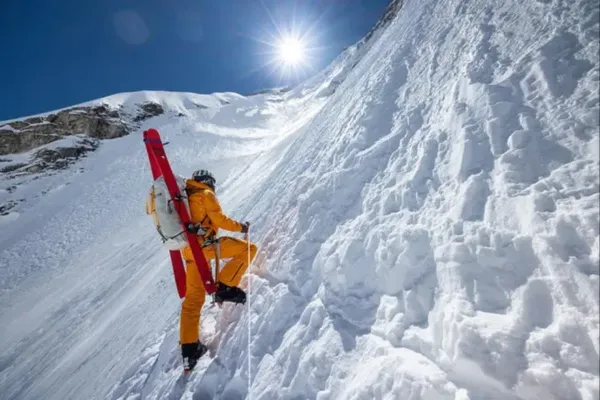

In the documentary Everest: The Other Side, the late American ski mountaineer Hilaree Nelson's words about the rawness of survival, and how the connection forged within that is not found anywhere else slice through our consciousness. That's not to say we understand the drive behind these words. Instead, it's that the disconnect reaches deep into our soul, and stirs a combination of fear, awe and bewilderment. The ambition Nelson shares with her partner, ski mountaineer Jim Morrison, to be the first to climb and ski down the north face of Everest, is so daring, it's a dream reserved for the few.
Elizabeth Chai Vasarhelyi and Jimmy Chin's latest documentary, adds new personalities to their expanding filmic thread about human endurance. Their work has looked upward, from Meru, about three elite climbers taking on the challenge of the infamous Himalayan mountain, to their Oscar-winning documentary Free Solo, which chronicles Alex Honnold's quest to climb El Capitan, a 914-meter granite rock formation in California's Yosemite National Park, solo, without a rope. Meanwhile, their narrative drama Nyad told the real-life story of 60-year-old American athlete Diana Nyad's attempt to swim the 110 miles of open ocean between Cuba and Florida. Love+War tells the story of Pulitzer Prize-winning American photographer Linsey Addario, who for the last 25 years has been in different theatres of war, documenting the human story behind the violence.
Everest: The Other Side documents the attempts to tame the north side of the mountain, located inside the Chinese border, by mountaineers who view it as the more difficult route compared to Nepal's south side. There's an interesting exchange where a mountaineer who successfully summited the mountain comments that previous generations would never have dreamt of skiing down the north side. It's a moment that not only puts the film in context but the enterprise of human endurance that continues to raise the terrifying real-life stakes.
Given the film reaches the crescendo of death-defying drama, it's ironic there are lulls that pull us in and out of the film. While there are undeniably parts built for the big screen spectacle, which are juxtaposed with an emotional weight, the film's rudimentary form is the enemy within. There are patches where the 113-minute run time feels a bit of a stretch. However, out of this minor criticism emerges the film's strength – it quickly drags you back into its drama, be it the reality of Morrison's determination to confront the mountain that killed his partner and successfully complete their shared dream, or the heartfelt human moments where we encounter characters familiar with death and loss.
This is punctuated in a charged scene when Vasarhelyi asks her husband Chin, who joins Morrison's team, how many friends have sat at their table who are now dead? Together, they run through the list of names, emphasising Vasarhelyi's relief when she thought her own husband had put Everest behind him. It's a poignant exchange, as we feel the anxiety hidden behind her composure.
How the audience experiences the film, which screened at London Film Festival, will be dependent on their familiarity with the real-life events. Do we come to it with the belief in human endurance, and the inevitable triumph in spite of the danger? Or are we aware of a fateful fall when climbing the north side? These people are modern-day heroes on a quest for immortality. Instead, of glory in battle against other men, like the ancient heroes, their names are etched into history by their feats of endurance. But their quests are not expressions of ego, rather the need to push oneself to the extremes and find that "rawness" Nelson speaks about.
Cinema's power lies not only in the ability to entertain or even thrill us with its spectacle – it's to make us think. Everest: The Other Side is about the fragility of dreams, specifically Jim Morrison's case, a man all too familiar with death and loss. Years before watching Nelson fall to her death, his wife and two young children died in a freak aviation crash. What's remarkable about Everest: The Other Side is that we simply don't register the searing urgency for Morrison and his team to face Everest and exert their will upon it until the final moments of triumph or failure hit. Opposite the emotional outpouring onscreen, we ourselves feel a cascade of emotions from within, amid which is a recognition for these characters who refuse to be intimidated by death and loss. Instead, they stare humankind’s greatest fear in the eye with a respectful yet unbreakable spirit.
Reviewed on: 14 Oct 2026