





Eye For Film >> Movies >> Klara And The Sun (2026) Film Review



Unlike cinema, where we are shown what everything looks and sounds like, the magic of literature is the way the prose frees our minds to imagine more independently. British-Japanese novelist Kazuo Ishiguro's writing has always struck me as being special. It is effortlessly detailed, and it evokes a feeling similar to the jolt the warmth of the sun on your skin gives. Regardless of the job Kiwi director Taika Waititi and his co-writer Dahvi Waller have done in adapting Ishiguro's eighth novel, the 2021 dystopian science-fiction story Klara And The Sun, I'm struck by the regret of not having, as yet, encountered the story in its literary form.
When we're introduced to Klara (Jenny Ortega), a solar-powered B1 model robot companion, or what is more delicately referred to as an "Artificial Friend", we learn that if she isn't chosen by a family, she'll become obsolete and will be sent back to the factory, where she'll be broken up and used to manufacture newer models.

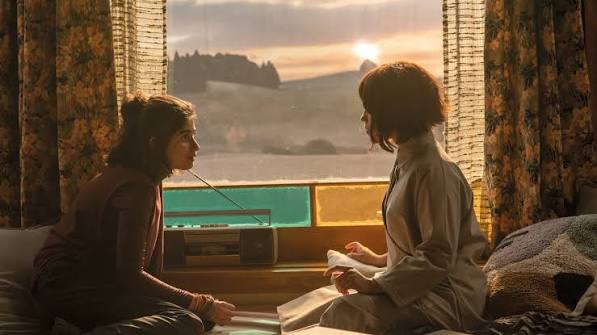
Facing competition from the newer Bluetooth-ready B3 models stocked by the Fancy Friends store across the street, Klara and her outdated AFs, Rosa (Molly Curnow) and Rex (Harry Greenwood) are given the prime real estate of the storefront window for three days. AFs are forbidden from interacting with passers-by, but when a young girl named Josie (Mia Tharia) spots Klara, the AF breaks the rules and forges a connection by mimicking Josie's animated hand gestures. This all but brief interaction is enough for Josie to be adamant that Klara is the AF she must have, in spite of her mother's (Amy Adams) protests. After all, the B1s are discontinued and there are more up-to-date models across the street.
Rarely does a character jump off the screen in the way Klara does. Ortega is luminous in the role. Her wide and expressive eyes are warm and inviting, while her face is alive with a joyful exuberance. She's the picture of the excitable inner child, who is blinded by a certain naïve innocence. When we first meet Klara in The Friend Store, Rex warns her that her quirky behaviour, including standing on one leg, will deter families from choosing her. For me, Klara's quirks only add to her magnetic appeal. She is a spiritual companion for anyone of us who has wanted to feel like they belong, wanted a friend or wanted to be loved. And so, there's nothing more we want than to tag along with Klara on her adventure, even if it's one that will be touched by the pain of lives lived.
In Waititi's hands, Klara's adventure rolls on by with a fantasy-like energy, and as such, there's always a feeling it's a dream we could awake from at any moment.
Klara And The Sun relies on the physicality of the actors. Natasha Lyonne, who plays the store manager, is a fine example of this, the essence of whose character comes through her gravely voice. Steve Buscemi, is a perfect choice as Capaldi; his voice and deliberately emphasised physicality have a certain cadence that complements the world building. If there's a noticeable texture to Lyonne's performance, then Amy Adams crafts a restrained performance. She hits her cues, knowing when to offer an ominous threat or even humour into proceedings and when to pull on the heartstrings. It's a performance that can easily be lost in the visual dynamism, but her eyes and facial expressions allow her to play the character with tempered restraint. And yet, she doesn't compromise her presence, meaning that, even in melodramatic moments, she remains grounded.
It's easy to criticise Klara And The Sun for not digging down deeper into its AI subject matter. Waititi's intention, however, is to craft an emotionally-driven story that is more content to lean into a melodramatic or twee sensibility than be intellectually thought-provoking. I cannot weigh in on how this honours the source material, other than to observe the film adaptation is riddled with a paradox. It's strange that a story as emotional and heartfelt as Klara And The Sun, and which entertains the themes of life and love, family and friendship, death and grief, struggles to immerse us in its drama for much of the running time. Then, something happens that sparks feelings of sadness and regret.
The narrative arcs are satisfying, even if they'll be a little too saccharine for some tastes. And there's an energetic spirit throughout. However, something is missing in the execution that doesn't allow Klara and the characters to bring these broad sweeping themes and ideas to life. The fault lies in the story being so dependent on its destination that it doesn't focus enough on the journey. Instead, the twists and turns need to be guarded, and so, every scene is in service of the ending rather than the characters living in the moment.
In spite of these shortcomings, Waititi pulls together moments that reach down deep and touch one's soul. One of the most captivating reflections is on impermanence and how we end up with only our memories of the life we've lived or how we choose to remember. In the case of Klara, who narrates the story, the question we're left to ask is whether she's a reliable narrator? But then, what we should ask ourselves is, does it really matter? Truth is important, but sometimes it's nice to lose ourselves in ambiguity and not needing to know for sure.
Reviewed on: 27 Oct 2026



Director: Taika Waititi
Writer: Dahvi Waller, Taika Waititi, based on the book by Kazuo Ishiguro
Starring: Jenna Ortega, Mia Tharia, Amy Adams, Natasha Lyonne, Aran Murphy, Rachel House, Steve Buscemi, Davida McKenzie, Harry Greenwood, Anastasiia Aksiuta
Year: 2026
Runtime: 116 minutes
BBFC: 
Country: New Zealand, UK, US
Search database: