





Eye For Film >> Movies >> Dice-Ching-O-Mat (2026) Film Review


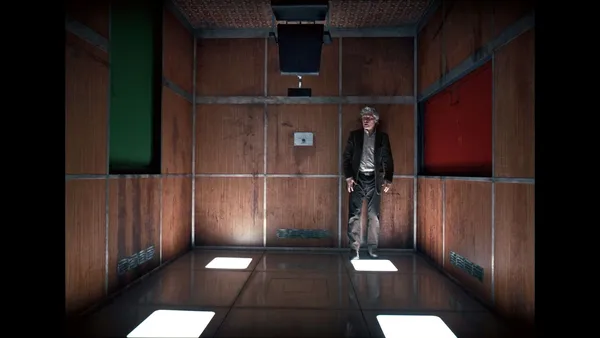

The biological and the artificial come together to overload your synapses in Kristijonas Vildziunas’s new feature. A poem generated by a rogue AI model quickly gives way to a refreshingly analogue (and smiley) sentient machine installed within a dingy elevator. There, a lost man gets three attempts to save his family. The task? Travel to the past and find the green door. Luckily, the elevator doubles as a time machine, operated with a set of dice and the Zhou- period Chinese oracle text I Ching.
Dainius Gavenonis plays a sinologist Vilis with the kind of charmless charisma possible only for a man who has spent the last few decades with little interaction outside of academia. He gets a chance to relive his past through multiple simulated realities – by preventing a family member’s death, or spending more time with his children, savouring the last moments of their childhood. If he performs well enough for the algorithm, the simulation might just become his next reality.

The Lithuanian filmmaker proposes a bold take on sci-fi stylisation. His elevator contraption blends the uncanny childishness of a sentient machine and a high-brow conceptual punch. Its inner workings combine the cultural legacy of divination with robotics and human intervention: instructions for the time vehicle are generated by rolling the dice, and inserting them into a slot. One of the central questions asked is whether Vilis has any control over the machine, or is just a flesh proxy necessary for its operation?
Dice-Ching-O-Mat does little to utilise the genre fully. Science fiction acts mostly as a prosthetic, reduced to a stylised metaphor of psychological limitations. Almost every conventional element is demoted to a decoration, save maybe for the techno-orientalism that’s inherent to the story. If we were to remove the machine – no matter how fun its approach to cellular automata and Videodrome-like blending of reality is – the story would remain the same. Even worse, the scientific fantasy often distracts from Vilis’s struggle, the audience more concerned with figuring out what is happening than the character’s inner world.
Scale is another problem. The high-concept framing brings unnecessary gravitas to an otherwise grounded and intimate story. Monochromatic dice and their binary judgements dictate entire lives, impossible spaces spin endlessly, hinting at some profound realisation that never comes, replaced with a significantly more humble diagnosis. Dealing with the passage of time and embracing the future’s uncertainty are moving thematic threads that get drowned out by the machinery’s omnipresent whirring.
Vilis’ journey is that of learning how to let go and overcome the constraints of his own cognitive wiring. Vildziunas manages to capture this with a precise understanding, but lacks the same accuracy when it comes to using sci-fi’s toolset to tell a compelling story. A genre for him is but a plaything. Once the fun of deconstructing conventions is over, it can be simply discarded with little regard for the meaning hidden within.
Reviewed on: 16 Oct 2026



Director: Kristijonas Vildžiūnas
Writer: Kristijonas Vildžiūnas
Starring: Dainius Gavenonis, Adelė Šuminskaitė, Vilma Raubaitė, Maksimas Semionovas, Vaidilė Juozaitytė
Year: 2026
Runtime: 88 minutes
Country: Lithuania, Latvia, Estonia
Festivals:
Search database: