





Eye For Film >> Movies >> No Fairy Dust (2026) Film Review



Fourteen years after Clip (2012) won her a Tiger Award at Rotterdam International Film Festival, Maja Miloš returns with a sophomore feature that keeps much of the same rawness of her debut. What has changed in the meantime? No Fairy Dust (2026) premiered at this year's Sarajevo Film Festival, later winning Best Actress for its star, Jovana Stojiljković, at the Niš Film Festival – an edition organised entirely by actors in protest against the political turmoil in Serbia.
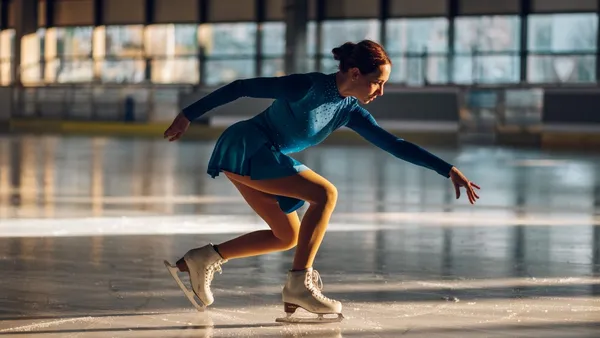
Marija (Jovana Stojiljković) has been a figure skater since early childhood, with small successes over the years and a couple of trophies to show for it. Since the sport demands investment her working-class family could never afford, she never reached the status commanded by her talent and grit. On top of that, she lost her mother in adolescence, leaving Marija with her father Dragan (Ljubomir Bandović), a truck driver always on the road.
After returning from the practice one day, Marija catches Dragan as he is making love to Suzana (Nataša Ninković), a woman he picked up on the road and grew close to after years of being a widower. Soon after Suzana, and two of her loud and foul-mouthed daughters will move in with them, taking up much of the space. As if that wasn’t enough, when a tragedy strikes, their already precarious situation will take a turn for the worse, forcing Dragan to take on a heavier workload and fewer paying jobs, keeping him away from home for an extended period of time and leaving Marija in the clutches of Suzana and her two daughters. Since Dragan had to go into debt to get a new truck for the job, Suzana puts pressure on Marija to carry the burden of bringing in more money into the household, essentially pushing Marija into prostitution while shaming her for doing so in the process.
When Clip came out, it mainly drew attention for its raw depiction of adolescent sex and violence, and it went underappreciated just how ahead of its time it was in tackling the subject of adolescents filming themselves, and the ways in which video-mediation of everyday life plays into young, developing minds, serving at once as a means of communication and of alienation. What got lost was that when every way of communicating fails, violence becomes the only way to express or receive love. This last point is crucial, because it's exactly where No Fairy Dust follows up.
This year has been defined by a contemplative turn toward the depiction of sex work, most notably in the final season of Euphoria and the AppleTV’s adaptation of Margo’s Got Money Troubles. These works frame (online) sex work as a desperate pursuit of class mobility in a society where traditional paths to advancement have vanished. While in the past the very use of female bodies by the industry was clearly exploitative, here the creators are incentivised to use their own bodies as the means of production, essentially reinforcing the logic of exploitation on themselves.
Even though Maja Miloš’s sophomore feature doesn’t depict these modern forms of sexwork, the essential contradiction – of your very body being the means of cutting your way in society while the same system incentivises self-exploitation – is at the very core of No Fairy Dust. As a figure skater, Marija has devoted her entire existence to the act of performance, but once the plot kicks in, this same principle which has been the core of her identity becomes the source of her self-destruction.
If it wasn’t clear from the initial set-up, the film is a soft retelling of the Cinderella story. However, in the centre of the traditional tale is a girl thrown into servitude under a stepmother scheming to marry her own two daughters into royalty. But, no matter the attempts to make that happen, it was the fated love at first sight that determined the outcome. Whether Cinderella is under the magical spell until the stroke of midnight, or just another housemaid, if the proverbial shoe fits, no amount of meddling can override a love that was fated from the start. While all the elements are present in No Fairy Dust, the deviations from the fairy tale are… telling.
Marija, almost as in, the "Virgin Mary”, has a certain aura of pureness around her, and although she may not be the loudest, nor promiscuous in any way – something the surrounding “turbo-folk” culture very much demands and rewards – she still enchants most of the people who happen to meet her, even if she clearly doesn’t fit the milieu. In that sense, “the evil stepmother” can’t take anything away from Marija. She isn’t really trying to prevent the fairy-tale marriage, nor is she plotting to advance her daughters to “Cinderella's” detriment. Here, the stepmother (played with conniving menace by Ninković) is looking to push both of her two daughters into the underbelly of low culture and various types of precarious work, turning malign only once that world accepts Marija instead of her two daughters.
Where the original fairy tale draws a stark divide between the royal class and everyone outside it, here low culture becomes the ultimate leveller, permeating society top to bottom. This is already visible in Clip, where the divide between the protagonist and her upper-middle-class crush is ultimately dissolved in the shared allure and excess of turbo-folk nightlife. In that sense, it’s not the stepmother facilitating anything but the actual structure of society that makes the explicit objectification of women a societal norm. When all is levelled, there is no moment of Marija having to be discovered by managing to fit into the shape of a princess by stepping into the shoe. Recognition is immediate. The only thing standing in the way is Marija and Luka’s lack of language to express their feelings, making the “language” of sex and violence the ultimate expression of love.
While those differences between the traditional Cinderella, or even its postmodern reinterpretations like last year’s The Ugly Stepsister, account for much of the film's commentary, they also reveal some of its storytelling blunders. By turning focus towards the exploration of sex and violence as the ultimate language of love, the film skips important beats that render the conflict incomplete. While it’s stated that the stepmother is pushing Marija into the workforce so they can pay off the debt, it’s merely implied or suggested that she pushed her into the world of prostitution. This makes for an interesting conflict, where participating in the turbo-folk libidinal economy is expected and rewarded by the same authoritative figures that will later punish Marija once she submits herself to the radical endpoint of that world. However, this conflict can’t come to fruition because much of their in-house dynamics of Marija working to support the household is simply skipped in the time ellipses. Furthermore, this undermines the very contemporary urgency the story could have had in the international context as well.
However, the most problems manifest themselves in the actual production. The jumps from scenes in the style of Romanian New Wave to stylised oneiric dream sequences are so sharp that the overall result feels jarring in a way that undermines both stylistic choices. On top of that, certain sequences are shot with poor care regarding the mise-en-scène and at slightly raised ISO, resulting in improvised grainy image in places where that shouldn’t have been the issue. These structural, editorial and production issues ultimately render all the contemplation and praise slightly backhanded, undermining the otherwise brave effort on the part of Maja Miloš, and even more so, the bravery of Jovana Stojiljković, backed by her main co-stars, Anđela Jovanović and Marko Grabež.
All three have established themselves on the Serbian scene as standout actors, even so, never have we seen them like this (and no, not because of the nude scenes, of which there are many, each more radical than the last). Jovanović’s energy is hectically contagious in the role of the promiscuous best friend with the heart of gold, while Grabež, playing the beautiful and wealthy programmer, convincingly plays against the type and manages to draw laughs and sympathy from a character that could’ve otherwise alienated audiences.
However, the only true standout here is Jovana Stojiljković, whose inclusion was the subject of criticism owing to her being well past the age of the main character she is playing (Marija in the movie is 19, while Stojiljković was closer to 30 at the time of filming). On the other hand, given that the film is about the expression of love through sex and violence where language fails, meaning that much of the chemistry lives in the looks and subtle gestures, it calls for a more mature performer in complete control, and here Stojiljković shines, delivering the beating heart of the entire film.
Reviewed on: 16 Oct 2026