 |
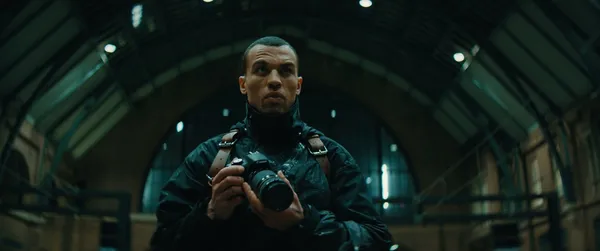
| Dudley O'Shaughnessy in Rain Catcher, who Michele Fiascaris says 'inspired the development of the character in the feature' |
Italian-born director Fiascaris graduated from the London Film Academy and has had a successful career directing content for everyone from Netflix to the BBC as well as working on short films.
Catching up with him to chat about the film after its premiere, he says that it was always his ambition to make the feature but that the short film, which he saw as a stepping stone to the bigger picture.
He says the short’s success “was a kind of a confirmation, a reassurance that it could work and it really gave us the momentum, gave the project the reputation to move on because of the festival run that it had, but also because of the distribution deals that we got with HBO and with Disney+”.
He admits scaling it up was a challenge.
“Yes, because short is a different thing,” he explains “With a short you need a concept and it's almost like a joke with a punchline, so it's like you tell a little story and then there's a punchline and then it’s over and everybody goes home. But with the feature, you need to stay there for two hours, so it doesn't work the same way. So we had to change the finale. The short had a different finale that is a bit more, let's say conceptual and maybe a bit less character-based and a bit more abstract.
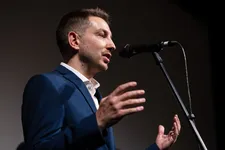 |
| Michele Fiascaris in Karlovy Vary Photo: Courtesy of Film Servis Festival Karlovy Vary |
This style of clandestine street photography is something that has been in the news quite a lot of late, with the latest generation of wearable tech glasses frames bringing the debate back up the agenda, but the idea for this film predates the latest media storms and was, in fact, rooted in an online clip that Fiascaris and Polesel came across.
“It was a viral video, with a videographer filming a crowd from a long long distance with a zoom lens,” Fiascaris recalls. “Suddenly a guy within the crowd turns around and looks into the camera, but he's so far that you think he couldn't possibly have seen it. But he keeps staring, and he looks very angry, bothered by the fact that he's being filmed. You think he can’t possibly have realised he’s being filmed but then he starts walking towards the camera, and he must walk for five minutes, because that's how far away the camera is. And when he gets close to the videographer, the videographer packs up the camera and leaves, thinking that he's coming after him. But really, he was just going towards a monument that was right behind him in the same eye line. So it was just a misunderstanding.
“But the idea that a person who is being spied on doesn't realise he's being spied on and decides to take revenge, that was the inception.”
London’s Barbican is an essential element of the film, adding a lot of character, with its sharply brutalist geometric towers.
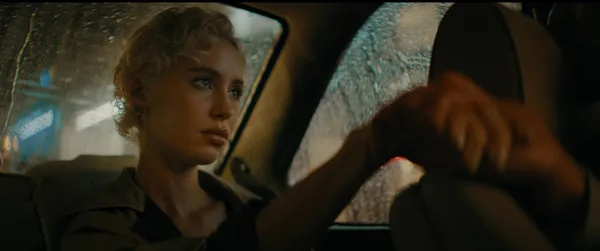 |
| Iris Law In Rain Catcher. Michele Fasciaris: 'We had a very specific idea of what kind of London we wanted to show' Photo: Yellow Pill Films, Featuristic Films |
“Also style-wise it is very consistent, this brutalist architecture is very good for shots. Everything is very symmetrical, and it really works within a frame. It's so geometric, and so monumental, that it is already kind of epic. Then, it's also labyrinthine, you can get lost in it. So, if we felt like it was really perfect.
“We were big fans of the Barbican itself. We actually met the surviving architect and we met the daughter of the lead architect of the company, Chamberlain, Powell and Bond. So we met the daughter of Mr Powell and another architect called Michael Frank Woods, who is the only surviving one. He's in his 80s now and he’s such a brilliant guy. He told us so much about how they designed it and we discovered so much about it. It's built with such detail and we are so in love with it.
“We tried to create a really specific world of the film, where the Barbican is the centre of it, but also we use other landmarks – King's Cross and, for example, we use some art deco that we have in London, like the Transport For London building in St James's Park, and we really like it, and it's going to be refurbished soon, so it was one of the last chances to use it and it is at the beginning of the film when Miles is about to go to the rooftop and he enters a building, that is the TFL building. We had a very specific idea of what kind of London we wanted to show.”
The crew had three different flats to shoot from in the estate to give themselves different view points and Fiascari says the local community were very supportive of the film. Much of Rain Catcher is shot after dark, so the filmmaker used winter to his advantage.
“We could only film exteriors up until 8pm, although we may have called an exception here and there. The thing is because we shot in November and December, at 3 30pm it was already kind of night. So it was really convenient because you always have this thing of when you’re shooting in the winter that you lose light so quickly. Instead, we would start the day at lunch, start shooting exteriors at about 3.30pm, and then, at about 8pm, we could go indoors. So we had a good five hours of night time outdoors.
“The main challenge was the cold, because the costumes are not that heavy, they're more like autumn/spring kinds of rain jackets, and it was getting really cold. So I felt bad for the actors. They had to power through. The rain was mainly with rain machines,and it still gets in your clothes and everything despite the rain gear. I think that was a bit challenging but it was fun as well. We had a good time at the Barbican. There's not many people at night so it was quite easy in a way.”
In terms of the central character, Fiascari wanted Miles to be ambiguous in terms of his morality.
“It makes him interesting,” he says, adding: “He’s got his own code. In a way, he’s Machiavellian, because he puts the ends before the means. That means when he wants to get a photo, he's gonna do whatever it takes. He can be courageous and brave at times but also, he's a bit self-centered, he’s a loner. He has borderline criminal behaviors, but he doesn't mean him to hurt anybody directly. But his photos can hurt people, because, of course, they may be exposing stuff his subjects don't want to share.”
The film also exposes the exploiting of art for commercial purposes, as a gallery see an opportunity to capitalise on his notoriety.
“The gallery are a bit like vultures. They don’t really care about Miles but once he says, ‘I have half a million followers’, they jump on board because they want to exploit that. So it's a bit of an exploitative chain, where he exploits people's privacy, and then the gallery exploits his following.”
And when it came to casting the lead, there was only one name in the frame.
“We had cast Dudley in the short film and we felt like he really, in a way, inspired the development of the character in the feature because we couldn't separate the two at one point once we saw him as Rain Catcher. He just fit in so well with the Barbican with the mysterious vibe that he has, this kind of aura and very peculiar look as well. So we developed the film with him in mind and took some traits that he brought to the character and developed them for the feature.”
Asked what he has learned from shooting his first feature, the director says being flexible and open to streamlining things is key.
“I think people think that they need to get a million shots to cover the same action from a million points of view, but sometimes simplifying it and making a decision like a clear, simple decision. First of all, it defines the style more clearly, because then it's a singular point of view that you're giving the audience. You're not giving a million points of view, otherwise it becomes a little bit like a reality show where you have cameras pointing everywhere and because you see everything at the same time, you’re not taking a position, you’re not taking an angle. So sometimes taking a bold decision is more effective than trying to do everything. So I think that's the one thing that I learned – make it simple, take a bold position and make a statement.” As for what’s next, we can expect more atmospheric filmmaking that taps into the current news agenda.
“We have a couple of ideas for features in the pipeline. One is a body thriller more than body horror, and it is about body modifications. I cannot reveal too much about it because it's still a rough idea, but has to do with a very radical surgery that can modify your body. You’re probably familiar with ‘looksmaxxing’ where people think they can just fix or max anything they’re not happy with. Where’s the limit to that? So this is an extreme case of that.