 |
| Corpus Photo: Fantasia International Film Festival |
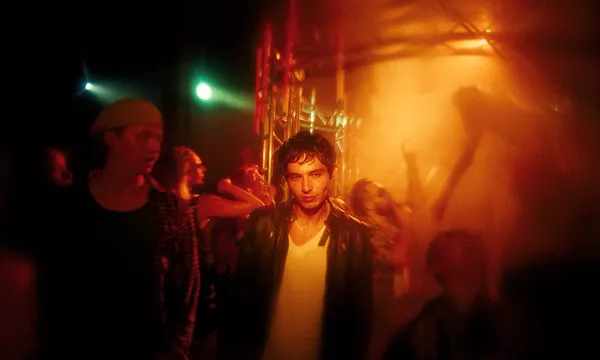
American director Corrin Evans' psychological horror Corpus, co-written by Lily Cowles, who also produces and stars, is set in the Summer of 1998, in New York City. The story revolves around small-time drug dealer and nightlife photographer Sayo (Jeff Wahlberg), burgeoning movie star Vince (Brodie Townsend), and the energetic and spirited Ross (Michael Vlamis). The trio of friends set off for a party upstate, hoping for a night of debauchery. Arriving at the remote manor, they soon find themselves ensnared by three mysterious women; Billie (Cowles), Wren (Nuha Jes Izman), and Cata (Ching Valdes-Aran). As the night unfolds, the women's terrifying agenda is revealed, offering a kind of debauchery beyond the men's expectations.
Corpus is Evans' feature directorial début. Her short films include Cousins, about two cousins reckoning with the romantic feelings they have for one another, and the comedy Joe Goes To Therapy, starring Cowles, in which a groom seeks out therapy to figure out his issues. Alongside directing, Evans has worked as an intimacy coordinator on Ti West's Maxxxine, Elijah Bynum's Magazine Dreams, and the episodic dramas Mayans M.C. and Yellowstone, among others.
Cowles has voiced the character of Helen Park in Call Of Duty: Mobile, Call Of Duty: Black Ops Cold War, and Call Of Duty: Black Ops 6. Her onscreen credits include the horror Antebellum, the drama Albany Road, and the episodic sci-fi series Roswell, New Mexico.
Wahlberg's previous credits include HBO's Euphoria, the true crime miniseries The Girl From Plainville, and Lords Of Anarchy. Vlamis recently starred in Sam Hayes' indie pool-hopping comedy Pools, and he has co-written, directed and starred in the psychological thriller Crossword, about grieving parents trying to cope with the loss of their daughter, where the daily puzzle becomes more than just a puzzle.
In conversation with Eye For Film, Evans, Cowles, Wahlberg, and Vlamis discussed how stories have a mind of their own, the good type of pain, offering an authentic representation of friendship, and those insane moments that will surprise audiences.
The following has been edited for clarity.
Paul Risker: What compelled you to want to tell this story and why now?
Corrin Evans: With a lot of things that I decide to move forward with or bring to life, whether it's a film or any other piece of artistic work, it's something that sleeve tugs me or catches a part of me and doesn't let go. It feels like another entity that is coming in and looking for an outlet. I have to surrender to it at a certain point, because it's in my mind.
I don't want to speak for you, Lily, but when we started writing the film, there was a moment where we were sitting in your house, and you and I just looked at each other, and I remember I started crying. We were reading through the script, and I said: "We have to make this." And you said: "We're gonna make it." There was an energy around it that felt like it was trying to come through on its own.
Lily Cowles: You'll have to ask the film why it wanted to be born — we really had very little to do with it. I love the relationship at the heart of this film, and it's something that I pulled so much from personally. I've had this experience, as I think a lot of people have, and so a lot of us can relate to this, or so, I hope. Although it's like the feeling of cotton balls being torn apart behind your rib cage, it hurts so good that it's like the feeling of being alive.
The film has so much that I love about it, but the relationship between Sayo and Vince at the heart of it, this yearning, I wanted that to come through. I wanted people to be able to see themselves and have the experience watching it where they're like, 'Oh, my God, I know that feeling.' And Jeff did such an amazing job as Sayo, holding that energy for us throughout the film. So, yes, that was part of the reason.
PR: We need to be talking through the implications of AI, which is growing at a rapid rate. Your point about stirring the audience's feelings reminds me of why we love films. While AI may be able to construct a story and replicate human beings, the reason we fell in love with film is the human element of another person or a collection of people sharing their creative expression. And why people will connect with Corpus is that human element.
CE: I surely hope so.
LC: For me personally, my life experiences come out of this body that I'm living in. The feeling that I was just describing is a feeling that happened in my body. It's not something that I could conspire to create. It's something that I lived through, was hurt by or sensually felt it. And I just don't know how a machine can come up with something like that. It can replicate, but I don't think machines will ever be able to capture what it's like to have a body where we experience this.
PR: Jeff and Michael, is there anything the audience might find surprising about the entry point you found into your characters, and how you perceived them?
Jeff Wahlberg: At his core, Sayo is an artist, and I come from art. I have never played a single sport in my life. My whole life I've painted and drawn, done sculptures and photography. I always say I'm the master of none, because I'd get bored of one thing and move on to the next before I could truly master anything.
In playing Sayo, all the prep for Corpus was art focused. It was about getting in touch with that little kid artist in me. I did a lot of painting, drawing, writing and poems and to answer your question, maybe that could be surprising. It seems kind of counterintuitive and floaty, but it just reminded me of that feeling of being alone and creating like Sayo is in his apartment, developing those photos and having a process that can be meditative.
Michael Vlamis: One of the biggest surprises when watching the film will be the subversion of tropes. People will be very surprised at how the movie ends and how each person has a different dynamic with one another. My character could be very broey, but he can also have a real moment with Sayo and with Vince. You see with the three of them how that works, and that's how every friendship circle is. You have your text group, and then you have your personal relationships with each person. Corrin and Lily did a really good job of showcasing the authenticity of that within the film.
And then, what will also surprise people are some of the insane scenes in this film.
PR: In a culture that has become increasingly adversarial, laying waste to nuance, does it fall to art to nurture nuanced conversations around specific themes and ideas?
CE: Life is so nuanced, and it's very odd to me the way that the culture has moved. And, yes, I do think art is that place, and film especially, because it's so hypnotic. You're taking on the point of view of a character when you watch a film, and you're getting to explore life, space, friendships, and love with them. So, it's a great place to explore nuance.
Personally, I am excited about the trend of indie film right now to do things that are more nuanced and explorative. I've seen so many amazing movies this year that are just leaving me feeling hopeful and excited about the future of film, especially in a culture, to your point that it has become very black and white and lacking in nuance, which is reflected in a lot of film and TV made on a larger scale.
LC: There's a longing for it, actually. I do think that it's like a pendulum swinging and while our attention spans have been shattered and fragmented, there's a real desire to connect with things that are deeper and more nuanced — things you have to pay attention to, and you're invited to lean into.
With this script we didn't want to hit people over the head where what's going on is obvious. We wanted to invite people in. And because people are longing for that, I hope they find it and enjoy it.
PR: Rewatching a film can help to peel the layers of the story and its characters. Corpus is one of those films that is likely well served by repeat viewings. It's a film to spend time thinking about, allowing it to creep under your skin and reveal itself.
CE: That was really important for me directorially. I was joking with Jeff about one line in the movie that he felt needed to be louder. I said, "No, that's for the rewatch." There are a lot of subtleties also in the production design. My production designer, Sadra [Therani], would ask, "Are you going to feature this?" Sometimes we would feature a prop or an item, and then other times, I'd say, "No, it's so good that we'll just skim past it because that gives something for people to lean into."
I like that there's not the space for every joke in Corpus and I did that on purpose. I didn't want to pause for the laugh. Instead, miss it and watch the film again, or at least that was my intention directorially. My approach was to allow things to just happen. My favourite movies are like that, and I can watch them a million times and still find something new.
MV: And when you watch it again, knowing what's coming, the dread is excruciating in certain scenes.
PR: Is filmmaking a transformative experience that changes you as a person?
JW: A million times, yes — I can't stress it enough. Corpus changed the way I approached the entire craft, just because after we wrapped, Corrin stayed in constant contact. A lot of days, I was a little bird sitting in the editing room, and, seeing the way it all came together, viscerally laid out to me how much this is an editor's medium and how as little as half a second can change a scene.
Thank you so much, Corrin, for being gracious about letting me just sit on your shoulder and whisper in your ear whenever I got the chance to. But, yes, it completely changed the way I approach everything in the best possible way.
MV: It reminded me how nice it is to make art with your friends, and also it reminded me of the kind of work that I want to be doing. I haven't been in a lot of films that are shot like this, and when you're photographed in the way that some of your favourite films are shot, that's really inspiring. And when you are happy with your work on a project like that, as I am pleased with this film across the board, it tells you that you do belong in this medium, in this type of film, and you can do this.
So much of our industry is, "What have you done? Oh, that's what you do, right?" This will showcase several of us in a new light, and it'll get people thinking about what's actually possible coming from us. So, it definitely changed the trajectory of what's going to be next for me.
LC: Corpus made me into a producer. I'd never produced anything on this level before, and I'd never written a screenplay. And it was an incredible year. It was a year of being thrown into the fire and I came out a different person. The greatest gift was for six to eight months, I couldn't second guess myself — man, I miss those days. I couldn't afford to. I just had to be: "Yeah, we're good. We're going forward." That will change a person. I also got a lot stronger and built a bunch of muscle. You can't see them [now], but you saw them on screen.
CE: It was amazing, and also Lily's hair was really long, and she cut it for the role. So, yes, there was a physical transformation, too.
I'll try not to fucking cry talking about this, but I probably will. They all know I fucking cry all the fucking time — I process all of my feelings through tears, which is great because it just happens quickly, you know?
Corpus gave me a space to do all of the things I was afraid I shouldn't do. I was always in trouble as a kid for being too bossy, intense or whatever it was. And when you're a director, everybody's looking at you and begging you to do that. So, it's like shadow work/shadow integration.
All the qualities I'm afraid are what's bad about me in my personal life, my intensity, my desire to communicate a lot (and clearly) and be communicated with, on set, those are the best qualities that I could ever have. And so, going into the movie, I was thinking: 'Oh, how am I going to do? It's my first feature." I was so scared of all these things and then those qualities that I struggle with on a day-to-day basis were demanded of me. I finally had a place to channel that, for weeks on end, that unlike on shorter projects, are only weeklong. Instead, I got to do this for months.
Corpus premières in the Cheval Noir Competition at the 30th Fantasia International Film Festival on 26 July.