




 |
| Attack On Paradise Photo: Fantasia International Film Festival |
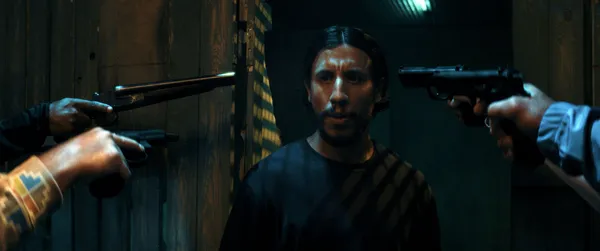
Just out of prison, Suleyman (Saïd Boumazoughe) wants to return home to the Paradise apartment block to take care of his chronically ill mother, but things have changed since he went away. The building is now run by violence criminals, and he happens to have arrived on the same day that a police raid is taking place. Now he will have to fight his way through there, one floor at a time.
This is Attack On Paradise, and when I meet Saïd, who is in Montreal for its screening at Fantasia, I ask if I’m correct in thinking that it was originally his idea, which he developed for director Bob Colaers.
“Yes, that's how it went,” says Saïd. “I initially started during the Coronavirus pandemic. I always say when there is less opportunity, you have to create opportunity. And I came also from a background where I was casted as the drug dealer, the terrorist, also for small parts and didn't have a chance. So I created my story, a little bit inspired by my youth, because I grew up in suburb. I grew up in a social building with drug dealers, with bad people. I went to the producers who I was working with. They believed in the idea and then they told me to choose a director and that became Bob when he planned his vision for it. So I created it but Bob directed it and also came also in with his ideas, his vision. I knew Bob already from a previous production, so for me, it was an obvious decision to work with him.”
“We worked together on my first ever job in the film, when I was a production assistant,” says Bob, who is also in attendance. “It was at the same production house where we made Paradise, so it's a cool circle.”
I mention that I like the way the film blends action with social commentary.
“Yeah,” says Bob. “When I got the screenplay, I also got Saïd's motivation letter, and I was reading there that he grew up without heroic figures that shared the same background. That really struck me because I grew up surrounded by heroes. I believe it's important that young people can identify with a hero because heroes shape some childhoods. That made us feel more strongly than ever that we had to make this movie. That's why Saïd wanted to make it.
Saïd nods. “Yeah, that's the most important thing, what Bob said. But also for me it was choosing how to start, because I also could choose that he comes from the military, that he's like Rambo coming from his duty, or the son of a rich immigrant, like Batman. But I really chose to start from the prison, to start from a mistake, because I wanted to mislead the audience. To start from the cliché, how society looks at us, like somebody came from the prison, very violent. Then during the story, you see him unveiling himself and trying to see what's wrong in his core. That's his inner battle.
“That's a battle that every child has in these suburbs, to choose the good things or choose the bad things. If you're stuck in a situation where only bad things happen, how can you see the light if you're living in the dark? And that's why we also named it Paradise. Because in our culture the mother is very important. We say the key of paradise lies beneath the feet of your mother, and every gangster has, in a certain way, respect for his mother. You can see how Tony Montana in Scarface respects his mother.
“It's a common thing in urban warfare, to empathise with the mother, and her strength is the core of this movie. Everything stands or falls with her. It's not about Suleyman kicking the ass of everybody. It's the mother. Will she survive it or not? Because she's going to die soon. So then everything starts with the mother. Also, in Arabic, we say ‘mother, mother, and then the father.’ So the mother is two times important than the father. So for me, it was like starting with the cliché, but breaking a taboo. To break the cliché, you have to start from the cliché.”
“Yeah,” says Bob. “And also underneath that thick layer of action and fighting, this film is actually a film about hope.”
“Let's start everything with hope,” says Saïd. “Yeah. So we started with jail. So. And also, we have real ex-convicts playing in the movie. We had the opportunity to shoot in jail. We didn’t want to romanticise the jail, to romanticise gangsters. No, we're trying, like Bob said, to romanticise hope, a second chance. How badly can your day start, really? How unlucky can you get the day you get free? How much bad luck can you have, and how far can you go without losing yourself?”
“We talked a lot about the movie and the screenplay,” says Bob. “We wanted to make this movie for the young people who are struggling and who sometimes feel abandoned by society. We hope that they see a hero in Suleyman and leave the cinema with the feeling that they never should give up.”
The fighting is often used as a medium for storytelling.
“Yeah, yeah,” says Bob. “We wanted to make a big action movie with a lot of fights. We actually decided to not always use weapons because, like in Dredd, there are a lot of shootings, and we wanted to create a visual style where not only the camera style is different for every floor and the colour is different every floor, but we also wanted to do other kinds of fighting so that it's not always the same, so it's not boring.”
We talk about the teamwork involved in creating those scenes.
“The most beautiful thing about is we have our stunt coordinator, who is an awesome guy that works in the same building as me, and he's risked his life for other project,” says Saïd. “This was the first time that we introduced him as head stunt choreographer. He's a Belgian Moroccan guy, born and raised in Belgium. So for me it's like we broke a tradition. Like Bob said, we didn't choose average actors or your average director.
“When we chose Suleyman, we didn't want to make him like a ninja. He's just a common guy. It's not like he’s a divine superhero, you know? It's not God-given [skill]. He's just a guy who knows how to fight. He has a background in kickboxing. But also, the mother said to the prince of the gangsters, ‘You don't know my son.’ That's the mysteriousness that we were trying to get because we didn't want to explain where he's coming from, like in Karate Kid. We tried to be like every kid that's grown up in a suburb and knows how to fight. If you grow up in the streets, you know how to fight.
“We don't want to highlight violence. We just want to highlight talents. Because also those guys that are in the fight sequences were guys that I trained with in the fight clubs. When I get my opportunity, I said ‘Listen, I'm going to make my own movie and I will all give you opportunities.’ And that's why I went to those guys with Bob, and Bob said to me ‘Let's rock and roll.’ That's my luck that I have with Bob, that he trusted me also with those guys.”
“Another answer to your question is that we had a lot of stuntmen, but most of the actors with the talking parts, they didn't have any experience with fighting,” says Bob. “So yeah, we sent them to the gym. We had not many preparation days with the stunt team, but we tried our best. Two fun facts. Clara, who played Jasmine, I think three months before the shoot started, she had an accident and she broke her arm. She had to play at 50% with her arm. And also Saïd, just before the shoot, wanted to do a real boxing match to experience how it feels and to take that experience with him to the shoot.”
We are almost out of time, so I explain that, regrettably, we’re going to have to wrap up.
“Okay,” says Saïd. “But I want to say one thing: that this production was made with people with a lot of passion. It's a low budget, so we didn't have the time to prepare ourselves. If we had the money to prepare for six months, it would be awesome.”