




 |
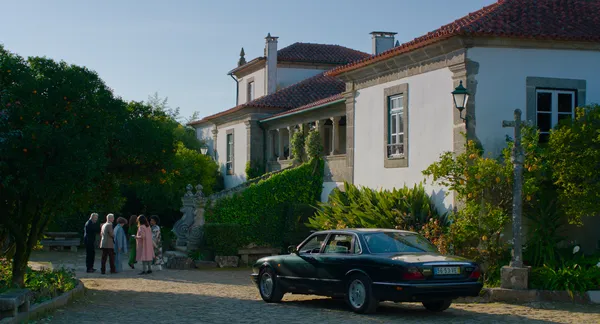
| The Portuguese House Photo: courtesy of AX1 Films |
In Spanish filmmaker Avelina Prat's gentle drama The Portuguese House, the life of Fernando, a geography professor, falls apart when his wife abruptly leaves him. She offers no explanation and so, Fernando takes an impromptu trip to Portugal. There he crosses paths with Manuel, a itinerant gardener. When Manuel dies suddenly, Fernando assumes his identity, taking the spontaneous decision to swap academia for gardening.
The Portuguese House is Prat's second feature. Her début, Vasil, told the story of an immigrant who meets up with four friends while he's in Spain, and over his two-month visit, he shares his perspective on life.
Speaking with Eye For Film, Prat compares architecture and cinema, discusses the creative process and the compassionate, open-minded ideas at the heart of her film.
The following has been edited for clarity.
Casper Borges: What are the roots to your passion for filmmaking?
Avelina Prat: I studied architecture and then I worked as an architect for a few years. So, for me, cinema was just something I loved, but it was something that other people, far from me did. I never imagined that I could do it myself. But then with time, and starting out with short films, I realised it shared many things in common with architecture. For example, it has the same process, like when you are doing the first drawings or thinking about the first ideas for a script. Everything you need for that to become either a building or a movie is very similar — all the people or the means or the money or the direction.
CB: It's an interesting comparison that I'd never really thought about. Talk to me about that transition and the challenges if going from shorts to a feature.
AP: I started out in cinema as a script supervisor in continuity. That was such a good schooling because you are next to the director and the camera all the time. It's the perfect spot to see how films are made, and so, that's how I was introduced to filmmaking. And after working on a few films, I thought, okay, maybe I can make a short film, and I loved shorts. It took me a few years, but then I decided that maybe I could do a feature film too. The most difficult thing was to find an idea and when I had that, everything came together.
CB: I was always told that you need to make sure you’ve got a list of ideas, so you can move swiftly from one project to the next. But as we’re saying, that’s not necessarily true because you need to know that you can take the idea and do something with it. When you’re taking advice it’s important to identify the good advice because a lot of it can be misleading.
AP: Yes, and there's a huge tendency to push you towards the things that are obvious, those clichés that everybody does. So you must be strong if you want to hold onto your vision and you have to believe in it.
So many things happened throughout this process and the hardest thing is that you have to keep the spirit of your original idea, even if you change things along the way.
CB: What was the genesis of the idea for The Portuguese House?
AP: I have always been interested in migration, of people living different lives and leaving everything behind and going somewhere else. I came across this article in a newspaper whose headline was: “My name is Angel Gonzalez and I declare I am not dead.” And it was shocking.
It was the story of a man from Spain who had migrated to Venezuela. 20 years later, he wanted to come back to Spain, but they wouldn't let him back into the country because he had officially been declared dead. And he didn't know what had happened.
He had a daughter that had stayed in Spain that had no news about him for 20 years. She had tried to find him, but with no success. And the Spanish law allows you to declare someone dead if a lot of time passes by and you cannot get hold of somebody. It was quite shocking and I thought about what could happen to make someone decide to leave everything behind and start a new life somewhere else. And I made up a story.
And in fact, if you pay attention, almost every character occupies a place or lives in a country that is not their native place of birth. That mirror game between the characters is interesting.
CB: Given the hot button issue of immigration, are there political intentions behind the film?
AP: It is not meant to be a social or political film directly, but of course, it explores the subject from another point of view. And there is some intention to show and a declaration there that another type of migration or another way to look at migrants is possible. So what the film proposes is a type of empathy in the way we look at each other—to get close and really look at them, because every one of them has a story. We must not forget that.
And that's what films are about too. I see films and I read books because I want to know about other points of view from people different than me. And I want to know what they think and how they see the world — that’s important.
CB: The protagonist finds himself swept up in an unintended adventure. He makes few choices at any point in the story. It brings up the subject of fate and chance.
AP: He didn't plan any of that. The only thing he plans is at the end when he realises the journey he has taken over all these years and where his home is, and then makes a choice. That’s the only time that he really does. But he's open to everything that comes his way and he doesn't say no to things. Instead, he tries things which is also a way of being in this world. You might not be proactive, but tell yourself: “I'm going to observe and accept what's coming and see what happens.”
CB: Beyond the main character, the cast are an unconventional lot who walk to the beat of their own drum.
AP: The most important thing for me is that these characters are all independent and they do not judge each other. So, each one has their own life and they interact with one another and respect each other. They never mess with one another’s lives, which is beautiful. To be a strong character and independent is important.
The Portuguese House is in UK cinemas now.