 |
| Magan's Fare |
The story of a cab driver who has to figure out what to do after a fragile older woman gets into the back of his car without asking, Magan’s Fare explores issues of social neglect, immigrant experience and personal obligation. Starring Barkhad Abdi and Alexis Rhee, it’s one of the short films to have qualified for the 2027 Oscar longlist, so I arranged to speak with writer Dana White and her co-director Christopher Knoblock as they travelled between film festivals.
“Chris and I were actually in the process of making some other films, and when the pandemic hit, it became really apparent to us that the government really wasn't looking out for older adults,” says Dana. “I remember we were watching TV one day and I heard them say, you know, ‘only older adults are dying of Covid,’ and I thought that was just horrific. Like, what the hell does that mean? It was so upsetting that it sort of started Chris and I thinking about themes in our work and the things that we wanted to focus on.
“Around that time, I started hearing about a subject called patient dumping, which is something that happens in the ‘States quite a bit, where people, and especially older adults with cognitive issues, those who don't have the resources, can sometimes be dumped from locations and from facilities to places that really aren't equipped to care for them, like boarding houses or hostels or bus stations and homeless shelters sometimes. So we started hearing about this, and then we decided we wanted to make some movies about it. And so we started out by making a film called Involuntary, which stars the actor Jack McGee, about an older man who has Alzheimer's, who's basically dumped from his facility to the homeless shelter.
“We were so taken by it and the research that we did, and were so overwhelmed by the subject, that we thought ‘Wow, we have to keep doing this. This can't be the last film we make about this.’ So while we were making Involuntary, we came up with the idea. Involuntary is a mix. It's from the point of view, a little bit, of this fractured mind that this man has, and it's from the audience's point of view.
“Then we thought it'd be really interesting to make a film about this subject, but from the moral quandary of the person who has to actually take this person somewhere. What does that mean to us as human beings? What is our responsibility to strangers around us? And so we came up with this idea and decided we wanted it to be a driver who has to actually take a woman from the place that she’s being dumped from to somewhere else. That's the quick summary. There was a lot of stuff in between, a lot of thinking, a lot of trying to figure things out. But that was the quick way.”
They’re interesting characters because they're both outsiders in a different way as well, both being immigrants (or possibly, in Magan’s case, the child of an immigrant). There's something that bonds them there, but also, they don't feel they fit in or have the support that they might otherwise have.
“Absolutely. I mean, it was so interesting because when we made the film, we really weren't initially thinking in those terms. That was the thing we absolutely wanted: we had to have him. We thought he was just absolutely the actor that had to play this. We started to adjust some of the script around his background and then we found Alexis Rhee, but we had already written the script by the time we got Alexis. So when we found Barkhad, we decided to really bring that into play. And, yeah, I think that's another theme in the story is.
“Chris and I really wanted that. Even one of the nurses is from Ireland, right? So everybody is from different places. We loved that idea of having people that were from different places and the bond that they would have, having been through really rough times in their respective countries before they came to the state. We thought that would be really interesting.”
“Part of the film’s intensity comes from its focus on just two people, but we also hear Barkhad talking on the phone with his wife and mother. Were those conversations able to be done live, or in post?”
“We did that in post, actually, which was kind of amazing,” she says. “But what we did do for our actresses was we had them listen. As they were talking, they were sort of listening to Barkhad speaking, to Magan speaking, so they were able to play off that, which was really helpful.
Both leads have had experience in some quite big productions. Were they both enthusiastic about coming on board?
“They were both so enthusiastic,” she says. “I mean, to give you a little backstory about Barkhad and us, when we came up with the idea and we decided that Barkhad had to be Magan, we wrote it specifically for him. We didn't know him, so we decided that we would write it around his mannerisms and the way he spoke and the rhythm of his body. We just watched everything. We knew his work really well, and so script was written with everything about him in mind. We had hoped that if we then got the script to him, that he would see that and feel that somehow. And I think it worked, which was amazing.
“When he heard from his agent that we had written it for him, he was like, ‘Wow, okay. I feel this.’ In interviews in the past, he said ‘You know, I actually felt how the film went and I was really excited about that.”
Something about the film that stood out to me was the quality of the audio work, particularly in scenes where there are different kinds of apparent silence.
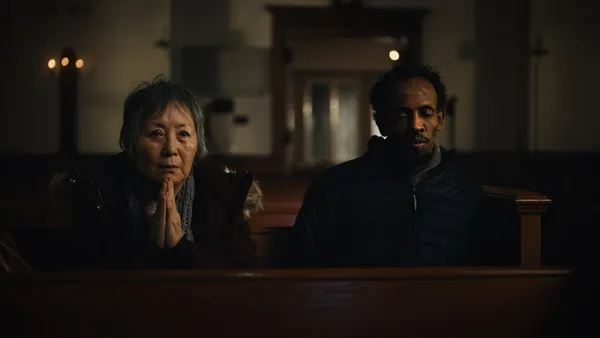
“I think that's a really wonderful observation,” says Chris, who has been sitting quietly, listening to his co-director. “In the church, we really wanted a sense of silence. It's not wholly silent. You hear certain sounds, but we do have that stillness. Basically, most of the film is handheld, but some scenes are strategically done with a very still camera, and we chose to do that for some of the church because we did want to really slow things down. When she goes to this place at the end and she's in a state of prayer, so to speak, we want to bring the audience into that sense of silence that she has.”
“It's such a quiet moment for her,” Dana says, “and I think for Magan as well, because this is the moment that he has to make a decision. We wanted there to be a sense of this was just them alone against the world in a way, in this space, while you can hear these little things of him knocking in the background and you can hear that the outside world is still there. But when he comes through that door and stands looking at her, it's like the rest of the world is not there and it's the two of them and it's the decision that he now has to make.”
“Yeah,” says Chris. “It amplifies the decision that he needs to make. It also amplifies the sense of the acts of compassion and empathy and where that comes from. That comes from the place of silence.”
It's a beautiful looking film, with crisp snow on the ground, but when choosing that kind of setting, one faces an extra challenge when it comes to continuity. I ask how long the shoot was and if they had any problems with that.
“That brings us to the most difficult aspect of the film,” says Chris, “which was that we filmed it in four days. It happened to be the four coldest days of the year, which was brutal for the crew and for the cast. But the great thing, as you mentioned, was that we didn't do have any comp work. We had, fortunately, snow on the ground all four days. We didn't have snow every day, but we did have snow on the ground which didn't go away.”
“But were really careful about that,” says Dana. “Like you said, you have to have this continuity. He's in the same general county you feel, though he's driving in different places.”
How do they feel about being Oscar-qualified now?
“We're so excited,” she says. “When we sort of started out, it was always our hope and our goal – you never know. But we really felt that we had a film that could actually have a chance. It's a long haul. There's a lot of wonderful films, and we're working really hard on our FYC campaign right now, and, you know, we'll see. We'll see what happens.”
“We started off with a bang,” says Chris. “We premièred at Raindance, where were nominated, and then things got quiet for a while. Then we won a couple of Oscar qualifying festivals, which put us into the game. So it's been a roller coaster.”
“Barkhad's amazing in it,” adds Dana. “It's just a really exciting journey for us, the whole experience. We're going to be at the Soho Film Festival, which we're super excited about. We just got back from Healdsburg, which is north of San Francisco, and we actually won the Grand Award there, so that was great. So, yeah, so we had a string of some really wonderful things happen on the festival circuit for us.”
They will find out if they’ve made it onto the Oscar shortlist on 15 December. Until then, they’re just glad that the film is reaching more people, and they hope that it will make people more aware of how some of the most vulnerable people in the US are treated.