 |
| Gimme Truth Photo: Fantastic Fest |
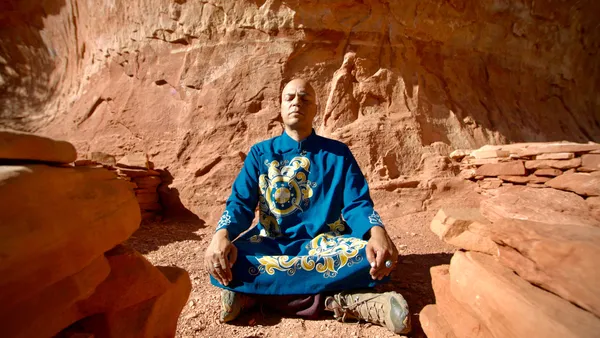
One of the joys of this year’s Fantastic Fest was Simon Ennis and Brad Abrahams’ documentary Gimme Truth, in which they explore a sample of the conspiracy theories currently at large in North America, from medical misconceptions to belief in visiting aliens. I've been on the Internet for 35 years, I tell them when we meet, and in the course of that time I really did think that I had seen it all. Then, when I saw the film, and its opening scenes in which a man discusses his conviction that mountains and caves are really the remnants of ancient cyclopean cities, well, that was a new one for me.
Simon laughs. “That was a new one for us too. That was actually the first conspiracy theory that we just found on our journey with this movie. And usually so far, in the Q&As, when people ask us what our favourite theory is in the movie or otherwise, that's the one that we both pick.”
Were there any others that took them by surprise?
“Yeah, actually,” says Brad. “The way we met Justin was, we were filming Arcturus Ra, the Starseed in our film, at a UFO disclosure conference in Las Vegas. At this point we’d been to a number of conferences like this. It's all usually the same kind of stuff. And then we turn to our right and we see this man, and he's just covered in this paraphernalia that's anti-extraterrestrial. We're like, ‘What's going on? What are you all about?’ He gives it this spiel that I've never really heard.
“I've heard a take that aliens could be nefarious, that maybe they're not all good, but never something striking on one side that's like, ‘Get them all out. We have to build a wall for the extraterrestrials.’ So that as such a well defined theory and subculture was new.”
I found that one really interesting because of the reactions to it, I say. It seemed that he was a problem for everybody at the conference. He was thrown out of because he was prompting people to think and question the other conspiracy theories that they heard.
“Yeah, exactly,” he says.
“Yeah, yeah,” says Simon. “I mean, you basically see us meeting him right on screen. We spoke to him for maybe 90 seconds before we got the camera going. So it's like you actually see us discovering a subject in real time in the movie. And Justin's a lovely guy. Then we went to the Bay Area, where he lives, and we spent some time with him. We're obviously big film buffs and his stop motion work and everything like that, you know, we could nerd out with him about old movies and sci-fi and other stuff too, so spending time with him was actually quite nice.”
How did they find the other people in the film? Were they generally nice people or did they come across as having problems that affected them in other ways?
“A good number of our subjects we met when we decided to go to these conferences,” says Brad. “Like I mentioned, that disclosure conference, and just being among the crowd, taking it all in. Anyone that seemed interesting, that seemed very multi dimensional for a documentary story, we would approach and try and talk to more. If they seemed like the right fit, then we would be like, ‘Hey, you know, we're making this film. We ourselves don't believe in theory X, Y and Z, but we're really interested in telling your story and figuring out how you got into it and what makes you tick.’ So that was for a good number of them.
“For Erica and Stephanie, they listened to a podcast that I'm on called the QAA Podcast, which is about conspiracy culture. It started charting the QAnon conspiracy, the history of that and how it unfolded, and then became a big tent conspiracy and truth seeking culture podcast. So they had listened to that and we put out a call for anyone who had gotten out of a radical belief.
“Stephanie had reached out first and said ‘You know, I've got my own story, but I think I can also connect you to this woman, Erica, whose story is even more compelling than mine.’ And then for Joachim, the meltologist that we talked about at the start here, were just following him on Instagram and he's very funny online. And so we just sent him a DM and he was like, ‘Yeah, that sounds interesting. Tell me a little more.’ Then we met him where he lives, out in Illinois.
“For Mikki, we'd seen him at the Conscious Life Expo and we didn't really talk to him there, but we filmed a little bit of his screening of the work in progress of Plandemic 3. Then we cold emailed and it took a couple years to get him to finally agree and be on camera.”
Simon nods. “Actually with him, we started the email by saying ‘We don't agree with you, but we're curious and we want to look at this from a very human and empathetic lens, a curious lens in a way, to maybe do something about bridging the division that's in culture right now. He did respond quite quickly and thanked us for our integrity. He said most people talk to him from the mainstream media, which we aren't.”
“We're independent filmmakers,” Brad notes.
“We're not HBO or CNN or something. [We won’t] dance around it or come in ways that he feels are duplicitous. We just came right out and said it. He really appreciated that. It still took quite a while, but that was our approach. We never tried to be undercover or present ourselves in any way other than the way we actually are.”
The aforementioned Arcturus Ra shows off his med beds in the film. Did some people participate because they thought they might be able to reach out and sell things, or get people involved in their conspiracies? Simon doesn’t think so.
“The closest, I would say – and it's absolutely not cynical – it's probably Justin, because he so deeply believes that the Allies of Humanity message that we have to stop this ET invasion is so necessary that he will talk to anyone about this. If anyone is interested, he will. If Ra sold a med bed from our movie, we never gave him an impression that was likely to happen.
“I think it's more just people want to feel heard and feel seen and people do like telling their stories, especially when you have active and interested and curious and empathetic listeners, which is very much how Brad and I operate. It's human connection and communication. People like being vulnerable and like being known.”
Some people in the film profess belief in multiple conspiracy theories, but how do others feel about sharing that space with others whose beliefs probably seem as bizarre to them as they do the average viewer?
“We haven't been able to show the film to any of our participants yet, so that is a question too,” says Brad. “We're very confident that when they see their story that they'll be like, ‘Yes, this is fair. This is as I told it, this is my story.’ But how will Justin feel being edited next to someone who is very pro extraterrestrial? How will Mikki Willis feel about being edited with some commentary by Jon Ronson? So that's a question mark.
“When were in the very early stages, we did show Mikki what we had filmed with Joachim and Arcturus. Those are very out there theories for him because that's not what he's interested in. He's interested in vaccines and other medical-related theories. But he was still, you know, ‘Okay, well, I see how you're telling these stories and that's not a red flag for me’. So if he didn't feel uncomfortable being next to someone who believes all extraterrestrials are bad, then it's very likely that the rest of our subjects won't.”
“We also basically told everybody who was in the movie ‘It's in flux. It's a moving target,’ adds Simon. “We did a lot of filming actually in Canada on a story that ended up not making the movie. When people would ask us ‘Oh, who else are you filming with?’ we would tell them. We're not doing anything that's supposed to be like a ‘gotcha!’ We're very clear about what we're doing all the time.
“You never know how your subjects will feel. I mean, it's a pretty charged thing just seeing yourself in a movie, so you never really know how it's going to work. But we're pretty optimistic. We don't make the movie for either our subjects or ourselves. It’s for an audience.”
I tell them I had been intending to ask if there were other things they had planned to include, and if they could talk about any of those.
“Yeah,” says Brad. “It's the Queen of Canada/Kingdom of Canada.”
I can’t help but smile. Reader, if you haven’t heard of this one, look it up. It’s quite something.
“Led by Romana Didulo,” Brad adds, leaving me wondering if there are other contenders for the Canadian crown whom I haven’t heard of. “We filmed so much there, went out a number of times to rural Saskatchewan, which is where the group had previously set up their headquarters in an abandoned high school in this tiny town of like 100 or something people, literally four hours away from any kind of city or civilisation. And we also filmed in Ontario for another subject for that. But sadly it's just too complex and too rich a story to have then put into an already complicated and packed documentary. To do it justice, it has to be its own feature or has to be its own miniseries.
“We filmed a couple other interviews for the film, and some other vérité moments that just didn't work. It wasn't fully fleshed out enough because we had to tick some boxes which was not just getting us a sit down interview with someone. We really had to understand what their life is like and how they're living and have them go about and do their thing. It has to be cinematic as well, and engaging for an audience. And some of them, that wasn't a part of their story. A lot of this is just people who post online or they read stuff online, and it just doesn't make for great cinema.”
“It’s the least cinematic thing in the world,” Simon agrees. “Yeah. And then there were a couple subjects, one of whom we were very, very close to, who's such a character. He was so charismatic, so strange, and doing something that was literally quite evil. He had said that through various supplements and stuff, he beat stage four cancer. And then what he was doing was if you have a terminal illness, you talk to him and he basically gets you to cash in your life insurance and give it to him, and pay for various wellness things. And it's people who are at the worst, most desperate situation, nearing the end of their lives, and he's taking them for all they’re worth and giving them totally false hope.
“He was also a very charming weirdo. We had met him at one of the conferences and Zoomed with him at least a dozen times, and we were literally about to buy tickets to Tennessee, where he lived. At the last second, he was like, ‘Well, you know, I was talking to my mother and my daughter’ – who he lived with – ‘and, you know, they were thinking, maybe it's not such a good idea.’ It was like, ‘Okay, we understand.’ I mean, basically, even if he was careful, he would be admitting that he was doing something pretty heinous.”
“It's too bad,” says Brad, “because he was going to play some show tunes for us on a grand piano.”
As we come towards the end of our time, I ask why they personally think that so much of this kind of belief system is out there at the moment.
“It's always been with us,” says Brad. “You know, questioning power, questioning those. in power who are likely pulling the strings in some fashion. The rise of social media and algorithms has amplified it, for sure, because depending on your bubble, you're usually only seeing from within that community, So it creates that echo chamber which it has been shown can make the imprint even further and wider. And then on top of that, were living in increasingly unstable times, increasingly chaotic times, and if conspiracy theorising is anything, it's trying to make sense of a very chaotic world and a world that seems to be against us, a world that seems to be very difficult for us and others.
“I totally understand that urge to do that. I do it myself. When a number of bad things happen to me, I'm like, ‘Why is this happening to me? There must be something else going on.’ And then you're like, ‘No, no, of course there isn't.’ But when you combine that with some kind of trauma that's happened earlier in life that leads you to a more ingrained distrust in authority, then that's sort of the recipe that will lead you – instead of just questioning something – that will spiral and grow and turn into a bizarre octopus of different theories that can lead you to darker and darker places.
“I think we're really in an epidemic of it right now. And to add to that, we have, in the United States at least, a president that amplifies a lot of these things. Even QAnon. President Trump himself probably doesn't even really know what it is, but on social media, in official White House accounts, they are using QAnon language and QAnon imagery, and that's only going to fuel the fire to a much more dangerous degree.”
“Yeah,” says Simon. “I would just add, because Brad didn't bring it up. I mean, obviously the chaos and discombobulation of the pandemic really ratcheted it up, as well as all the mainstream media places collapsing or breaking apart. It's pretty interesting. We get asked at Q&As a lot ‘Is there something that connects all of these people's stories, like, how they got into it?’ We were curious, too, and when we went out into the world and started talking to people, even people that aren't in the film, like, ‘How did you start believing this stuff?’ we thought that there were going to be all kinds of different reasons, you know, dozens of different reasons. And 98% of the time, the answer basically came down to trauma and YouTube.
“YouTube has gotten better now. They've kicked out a lot of the really cringey, harmful stuff. But that is what pilled almost everybody we talked to over the course of the four years of filming Gimme Truth.”