 |
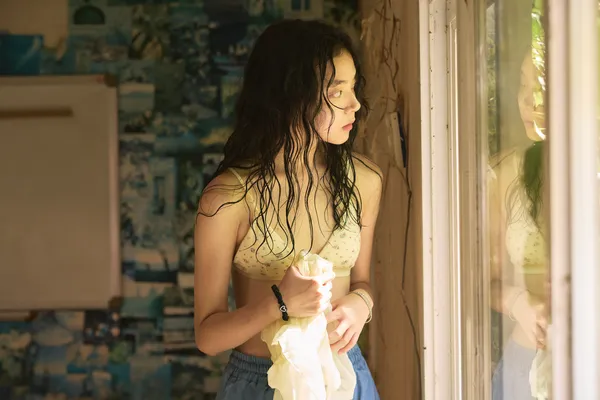
| Jin (Sim Su-bin) in The World Before. Yoon Dan-bi: 'People tend to easily forget the value of love, so I wanted to address that' Photo: Courtesy of San Sebastian Film Festival |
Your first film, Moving On, was a family-based drama and family is also an important part of this film. Why did you decide to return to that with this film?
I wanted to tell a story about family – something that feels timeless, the kind of classic narrative that can't simply be replaced by the digital world, something touching on the spiritual. People tend to easily forget the value of love, so I wanted to address that. I sought out a setting that felt "classic" – a house that was on the verge of disappearing – because I felt that perhaps our own sense of home might be facing a similar fate. I wanted to capture that kind of space.
Did you find yourself drawing on your own experience of adolescence for this?
The film isn’t telling my personal story. It’s more about wanting to tell a story in a more traditional way – something irreplaceable because everything is changing these days. I wanted to talk about the fundamentals, the things that truly matter – like love, or the value of love – in today’s world, things that people take for granted. It’s kind of cute but I didn’t want to dwell on the romance.
You show a lot of the changing viewpoint of the teenager, how Jin begins to inspect her body and think about how she looks and how her body is changing, why did you want to bring that to the fore?.
Before meeting the boy, the girl was more innocent, like her little sister, but what she wanted was changed, after the return of Dujae. Then when we see her looking in the mirror, I didn't want this to be just about the guy; rather, it's about exploring your own body. The changes of your body, but it is more about the internal change – the fact that she is in the midst of that process of change – that the film wanted to show. For the mirror scenes, I wanted the audience to feel a sense of unease because, of course, the image isn’t perfectly focused; it’s meant to evoke that strange, jarring sensation she would be experiencing.
As for the scene where Dujae is nervous – much like a young man might be – and keeps checking his own reflection... I wanted to portray that process of self-scrutiny. I also wanted to avoid the usual tropes of looking in a mirror, so we tried to film it in a slightly unconventional way – not just a standard shot, but something that felt a bit different.
Tell me about the casting of the film, especially the casting of the younger sister as well as the main actress as they have a lot of chemistry together. Did you rehearse with them a lot before the film was shot?
Some of the adults were, indeed, cast, but many of the other members of the cast are the real inhabitants of the island. The young girl really nailed the audition. We were looking for people who could express themselves well – someone with genuine charm when you meet them in person – rather than just someone who could flawlessly execute a scripted routine.
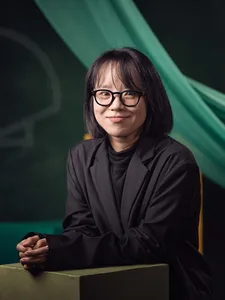 |
| Yoon Dan-bi in San Sebastian Photo: Courtesy of San Sebastian Film Festival/Marco Barada |
The smell on the T-shirt – men don’t get it. But, as a woman, I drew on the experience of catching a scent to feel the presence of a man you’ve known. The protagonist, Jin, does the same thing.
You also use food a lot, shared meals and items. How did you choose the mealtimes and what you wanted the characters to eat?
I like that they make meals because it makes me feel peaceful since people don’t usually fight when they eat and everyone is quite good humoured. I think eating together is part of our lives, so I would like it to look like a part of everyday life and part of the routine.
It’s less common now, but in older Korean movies, whenever characters were eating, the director would often try to avoid messy shots – like the table getting overturned – to keep things "safe". You know, keeping it controlled until the meal was over. Have you ever thought about that? And regarding the ramen shop next door... well, in a way, there was a conscious effort not to overdo it. Even though there was more to the story – like what the character of Dujae did in Seoul, what their future plans were, what kind of person they were, or if they truly loved the other person – I didn't want to cram too much in. I wanted to express the feeling of love without necessarily having the characters do something specific to show it.
Tell me about creating the character of Dujae. Does writing a male character present challenges for you as a female writer?
With this film I wanted to show the point of view of this girl, Jin. So we don’t know what Dujae will do in the future or what happened before he came to the island. I’ll leave the viewers to decide. I wanted the story to be more focused on her and for him to occupy the second plane. It’s unrequited love. Dujae doesn’t show what he wants so we all have to interrupt that.
Was it a challenge to shoot the water scenes?
It was easy with the actors because they swim very well and they are quite good friends. But what was difficult was the temperature of the water. It was sunny but the water temperature was very cold. But the actors meant we got the shots with no difficulty.
Some people say second films can be tricky because of the expectation after their first. How did you find making The World Before compared?
I’ve been thinking about my next project – the follow-up to The World Before. I couldn't quite pull off the "cold" or detached vibe I wanted last time, so I want to make sure I get it right this time. I know what I’m good at, but I’m torn between sticking to that or trying something entirely new. I really want to make a great film. I have a strong desire to move forward. I want to show you the next phase – after all, the gap between my first and second projects took longer than I expected, and I’m eager to create something new quickly.