





Eye For Film >> Movies >> Kim Novak’s Vertigo (2025) Film Review


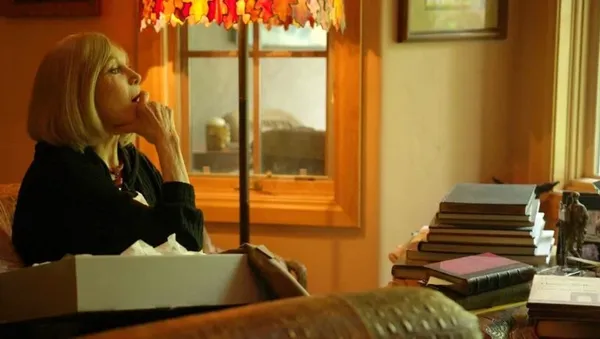

Kim Novak is sitting in her living room where they have been chatting for some time, going through pieces of memorabilia, when documentarian Alexandre O Philippe passes her a box. She knows instantly what is inside it. She hated it at the time, she says, but now she loves it. A particular grey suit. Famously, Alfred Hitchcock made her wear it even though she felt it was out of character. He expected her to follow instructions precisely, and he would never be satisfied because he wanted her to be someone else (Vera Miles, who had dropped out just before filming began). He never abused her, though, as he did other actresses, and she, who had never watched one of his films before, was delighted by his craft. Now, she says, the grey suit is a part of her.
We see clip from another film of hers, made a decade later: The Legend Of Lylah Clare. As she ascends a staircase, a man commands her “Stop! Now when you come down, you will not be Elsa Brinkman.” Echoes were everywhere over the course of her fragmentary acting career. There are hints of foreshadowing, too. That’s the thing about vertigo: it sends one spiralling, and a spiral, unlike a straight line, places elements of the present and the past side by side.
Reality and fiction are also close. Philippe shows her (and us) a photograph of him playing in his parents’ living room as a child. There, all around him, is the same wallpaper as in Ernie’s, the restaurant in Vertigo. This fascinated him when he first saw the film, and so inadvertently led to their meeting. At the time of making the documentary she was already in her nineties but didn’t look it, partly thanks to plastic surgery, a subject it politely left unaddressed. She was mocked when she first got it – not just for the way it looked, but for the idea of it. It seemed that a lot of people only felt comfortable when her appearance was being altered at the behest of someone other than herself.
“As soon as they have you under contract they want to change you, want to make you over,” she says here, reflecting on how, as a young Hollywood star, she saw her name up in lights and it wasn’t even her name. As fans flooded into cinemas around the world to watch her, she used to look in the mirror and wonder who she was.
She talks about her parents. The mother who, afraid she couldn’t cope with another mouth to feed, tried to abort her using knitting needles and, when that failed, tried to suffocate her with a pillow. She remembers fighting for breath. We can hear it in her voice now, a lifetime’s legacy of breathing problems. A father who disapproved of Hollywood and seemed to be disappointed in her. An extraordinary find by Philippe, on camera, suggests otherwise, and it is quite something to see.
Novak is one of those rare people who seem able to remember most of their lives in vivid detail, and although plenty has happened in hers that nobody would envy, it has never been dull. She talks about the wounded bird who fell in love with her, about the fires she survived (along with her original Vertigo script), about her closeness with Jimmy Stewart and how she fell in love with her unusual house by the sea. She talks about technique, about reacting rather than simply acting, about her admiration for Greta Garbo (“George, would you leave me alone?” she asks in a clip from Middle Of The Night) and the importance of being vulnerable, about the tragic loss of Philip Seymour Hoffman, overwhelmed because of that. About her own experience of being overwhelmed by characters, and why she had to leave Hollywood, to take refuge in her paintings.
Sitting in her attic for part of the film, she and Philippe are surrounded by her art. There is brief footage of her working at her easel, whilst she reflects on how being able to express herself in this way has helped her. Although Vertigo left her floundering, with pieces of Carlotta, Madeleine and Judy all permanently inside her, she also found it liberating because of the way it addressed what she was already going through. This film does something similar. At the start she’s uncertain what she will say, what she means - an expression which could be understood in more ways than one – but she clicks with Philippe, and there’s a wonderful openness about the film as she finds joy in being able to talk about everything with no fear anymore.
Cinema is all about watching and being watched. Though she perceives it as having been an erotic experience for Judy, she never liked the latter, herself. “I was a shining star but in the wrong galaxy, somehow,” she says. The documentary’s many clips let us see her shine, see the breadth of her talent, but also take in, again and again, the loneliness in her eyes. it has finally gone, and this is a chance to see her happy, at ease with herself, now that she finally knows who she is.
Reviewed on: 02 Oct 2026


Director: Alexandre O Philippe
Starring: Kim Novak, Alexandre O Philippe
Year: 2025
Runtime: 76 minutes
Country: US
Search database:
