





Eye For Film >> Movies >> Gimme Truth (2026) Film Review


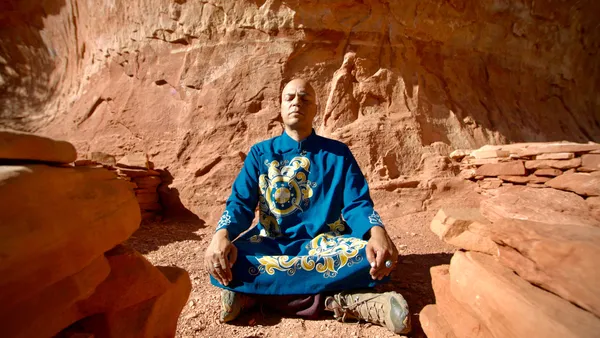

After a certain number of years on the internet (35 in this writer’s case), one begins to believe that one has seen it all where conspiracy theories are concerned, so it’s nice to encounter a documentary which still has some surprises in store. Recently screened at Fantastic Fest, Brad Abrahams and Simon Ennis’ film begins with a quote from Plato – or was it Laura Loomer? – whilst, appropriately enough, exploring a cave. The man in the cave discusses his immediate surroundings in what initially seems like an educated, poetic way, and then it gradually becomes apparent that when he talks about mountains as buildings, he’s not using metaphor – he actually believes that they are the remnants of an ancient civilisation. After all, he says, all the stuff about plate tectonics is obviously ridiculous – the sort of nonsense published by people who think the Earth is round.
Take a moment, and breathe. There is a lot more of this sort of thing to come.
From depressing but familiar claims that Covid was a ‘plandemic’ and never really dangerous; and that 9/11 was an inside job involving strategically placed bombs, with planes added to footage later using CGI; to the assertion that the pyramids are now-dormant reactors built to accumulate light, and Star Trek is a parallel reality mystically channelled by Gene Roddenberry, there is some spectacularly off-base thinking going on here. You may feel relatively relaxed about the old-fashioned ones, the stuff about ghosts and alien abductions, but then someone will pop up with a line like “Did they really ban lead paint because it was toxic, or because it blocked their signals?” and find yourself wondering if you’ve strayed into the Twilight Zone.
The real question, of course, is why? Why are there so many wild theories, and why are we experiencing a concentration of them at this particular moment in time? There is some to-camera theorising about that here. It’s a huge subject and, curiously enough, under-researched, so the film can be forgiven for not going into more depth. It is, overall, more of an ethnography, involving conspiracy theorists in the wild at a variety of events. It also gives five of them a chance to share their thoughts.
Alongside the cave man, there is Arcturus Ra, who describes himself as a Starseed and found his way into YouTube vlogging after failing as a rapper (his observations about the record industry are, ironically, not paranoid enough). Awed by the attention and income generating potential of the medium, he seems to have a Winston Zedmore-style ability to believe anything for pay, and he now sells ‘medbeds’ in a quest to get people into a higher vibratory state using bioresonance. As you do.
Some of the stories are more tragic. Filmmaker Mikki Willis reflects on how his brother died after falling for a conspiracy theory which persuaded him not to take his HIV medication, rather to let his body acclimate to AIDS – and yet he now promotes dubious medical ideas himself, and is preparing to direct Plandemic The Musical (sadly not the spoof it sounds like). We also meet an interesting individual who has bought wholesale into the idea that aliens routinely visit Earth, but who, unlike most people of that ilk, does not believe that they are benevolent. It’s fascinating to see the reaction of other conspiracists to this. The accuse him of giving out negative vibes, but it’s clear that the real problem is that his ideas inspire critical thinking, which could lead to people questioning other carefully cultivated and highly lucrative beliefs.
The other really intriguing case here is that of a woman who recalls listening to Alex Jones when she was 20, being persuaded that 9/11 was an inside job and proceeding from there to anti-vax conspiracies, MAGA and Q-anon. Unlike the others here, she found her way out of those looping belief systems, and what she has to say about the way she was treated afterwards is very telling. Fortunately she has found support since. Her reflections on how her thinking worked at the time when she was delusional are valuable, and although it’s difficult for her to cope now with the understanding of some of the things she did or failed to do under the influence, she is proof that it is possible to recover and reclaim one’s life.
Take-aways from all this will be varied. What’s interesting is that it would seems to have potential appeal for people who believe in some of these things, and seeing them alongside others, with that encouragement to question, might be a step towards healing. It also does a good job of carrying the general viewer from laughter to sympathy and concern – maintaining a healthy awareness of how ludicrous many of these ideas are, yet reminding us of the vulnerability of many believers, and of how difficult it can be for our brains, evolved to sport patterns, to escape such traps. Many begin with reasonable propositions – Drake’s equation, the untrustworthiness of politicians, the temptations of capitalism – and then incrementally build towards their wilder goals with an affect akin to slowly boiling lobsters.
Gimme Truth won’t answer all the big questions for you, but it’s an interesting – and sometimes highly entertaining – contribution to the discourse around our moment of civilisational restructuring. It may help you to understand where some people are coming from, even if you never, ever want to go there.
Reviewed on: 25 Sep 2026


