





Eye For Film >> Movies >> The Dark Gets In (2026) Film Review


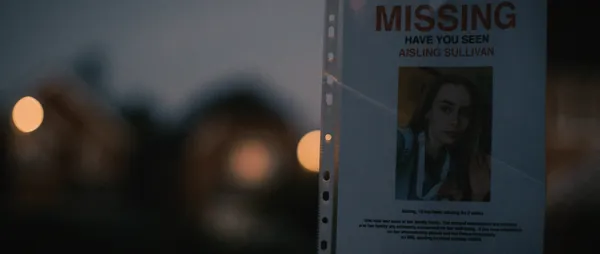

A missing teenage girl. A devastated family. A best friend, a teacher, assorted police officers sharing their thoughts on camera. You may think you’ve seen this before, but Sean Hogan’s reworking of the true crime documentary format takes us to a very different place. Whilst it’s not a new thing to use this for fiction – 2024’s Shelby Oaks springs to mind – Hogan’s film, by straying very close to some real stories prominent in the UK over the past few decades, attains a sharp edge which it uses to slice away conventional notions about what girls want and definitions of their sanity and social value.
The girl in this case is Aisling (Kezia Cotterrell), known as Ash, who lives in a spacious suburban home with parents Natasha (Charlotte Pyke) and Rory (Cameron Lewis), plus teenage brother Owen (Scott Burchell) who, we are told, has chosen not to take part in the documentary. Early on why learn about how sweet she was, a bit quiet but a natural performer who liked playing musical instruments and won praise from her drama teacher for her acting. She didn’t date anyone; she wanted to concentrate on her studies. She and her best friend , Samena, met when they were in year eight and became inseparable. All those superficial observations which serve to highlight the gaps in between. Then we hear how she went to bed early one night, feeling dizzy in the aftermath of a short illness, and simply wasn’t there the next morning.
There is a complicating factor in the story from the start. When she was 12, Nat’s best friend, Millie, was kidnapped and murdered. As a result, the family has always been security-conscious They not only have secure locks; they have cameras all over the house. Soon the police and parents alike are poring over these in search of something that will explain what happened. Rory can’t get over the fact that Ash’s phone was found beside her bed. What teenager would leave her phone behind? He struggles to acknowledge the most likely answer: one who wanted to disappear.
There are clues and there are twists. Secrets emerge over time. There is plenty of mystery for those who enjoy such things, and it’s well put together, but it’s only one aspect of a film which is really interested in what people choose not to consider and in how people allow themselves to be misdirected. This is, perhaps, a part of where the dark gets in. Nat goes to see a psychic – understandable, perhaps, given that nothing else seems to be helping. The psychic names a suspect, a teacher. Pretty soon the name is public knowledge and the teacher’s life is being turned upside down by obsessive members of the public who never knew Ash. Rory is angry and feels that Nat has been taken advantage of, but seems completely unaware of his own failures to behave rationally.
There is a very particular way in which the British media treats young female victims of crime, and it’s captured perfectly here, through the choices that the fictional documentary team have made and through the testimony of Ash’s friends and family. Although she was 15, Ash is described as if she were little more than an infant, utterly dependent on her parents, naturally full of love for them and, critically, incapable of experiencing sexual desire. As information begins to emerge about online activities which she kept secret fom those close to her, it is consistently overinterpreted to try to force her back into that mould. It’s not enough to suggest that she might have been vulnerable to exploitation by someone with much more experience than her. She has to be believed to have been completely ignorant of what was happening. By way of this approach, Hogan is able to create a situation in which the characters and the audience are receiving the same information but interpretating it very differently.
This is not a straightforward story of sexual violence, and viewers need not worry that it is going to be distressing in that way, though there are references to such things. By approaching the story from a different angle – and cleverly weaving it into a different tradition in a way that may leave you wanting to watch it again from the start to see what you’ve missed – Hogan is able to avoid turning Ash into a helpless sexualised object as such documentaries often do, and is further able to highlight the dangers of leaping to conclusions based on slender evidence (there are the usual statements from police officers advising that sort of caution, but these are routinely ignored). In this manner he gently eviscerates the true crime genre whilst delivering a clever genre thriller which ultimately shifts gears to deliver some real scares.
One of the highlights of BeyondFest 2026, and now lined up for Halloween Frightfest, this is well worth catching.
Reviewed on: 05 Oct 2026


Director: Sean Hogan
Writer: Sean Hogan
Starring: Charlotte Pyke, Cameron Lewis, Kezia Cotterrell, Scott Burchell
Year: 2026
Runtime: 91 minutes
Country: UK
Search database:
