 |
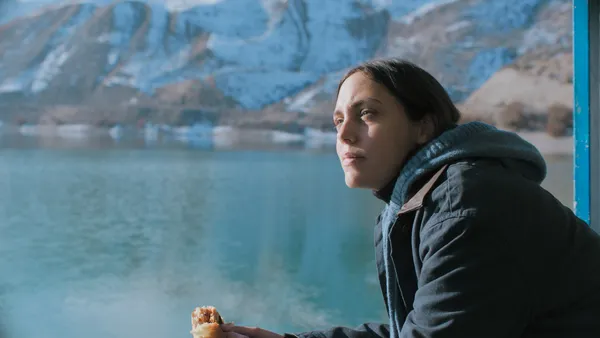
| Öykü Karayel as Elif in What Remains. Yeşim Ustaoğlu: 'I knew Öykü would be a good person to carry this very inner character who is very strong at the same time' Photo: Courtesy of San Sebastian Film Festival |
Tell me about the origins of the film.
Yesim Ustaoglu: It’s very simple. When I finished Clair Obscur, I had some other ideas but you know the world and my country are not passing through a very fancy time – there are little burdens, a little bit of suffocation, politically or in life. I was feeling I need to do something really honest about what I feel – suffocated in a way and that I need to find my own connection. And to do that, I just said to myself, “Get out. Go and see what is out there and be connected again.” I do this quite often. And I started to make my journey and to write about that. After my first journey, the pandemic arrived and it stopped me. It really made me think because all the world, including me, had to stop everything. The story marinated more and more and stayed with me.
Then as soon as I had again the chance [to write], I was much more connected with the story and the character. After the pandemic I was able to get out and drive and then I saw so many things. All these landscapes, not only the beauty, but dryness, emptiness, empty villages, I mean, and all the politics that makes people expel themselves from their own land, drone areas. I felt attached to the people and how they can be so strong at the same time as dealing with all these things. And I wrote about that.
You showcase the arts in What Remains, poetry and music and the idea of experimentation in art, through the two main characters
YU: Yes, because what we lose, especially in modern, fast-paced life, is our understanding, reading and writing, really our fifth sense – hearing, looking at the real connections. I wanted to make things [connected to that] sense by really looking at the moment, living in the moment and by hearing it too. When I started to think about it, the soundscape music came in on one side and the Elfi’s book, and the poetry came on the other side and then everything flowed.
How was shooting the film, because you shot this in four cities? Does that present logistical challenges?
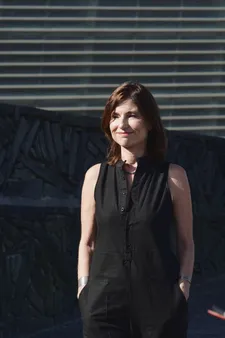 |
| Yeşim Ustaoğlu in San Sebastian Photo: Courtesy of San Sebastian Film Festival/Nora Jauregui |
Tell me about working with Ali Kayra Kul, who plays Selim, because children operate in a different way when they are on a set?
YU: He was, so cute and such a clever boy, and he really loved to work. We got so attached to each other. We were very careful about his programme, so he would work certain hours and then we would let him go home. But we were so attached to each other that when we said, “You’ve finished”, he didn’t want to leave. So I said, “OK, in springtime, you will be in the car”. He was so clever and understood the story very well.
Did you have much rehearsal time?
YU: With the main actors I had a very strong rehearsal period. With the kid, I helped him to understand in a more simple way, like a game. He read the whole script and his family. I had a connection with the family and the mother and his sister were there all the time. We were very careful.
Do you like to have rehearsal time with actors?
YU: I like it because you need to establish the character, the actors need to trust themselves. It's the establishment of the character, understanding the character, and then building the chemical energy together. Before the shoot, I talked with them so they understood the character more deeply and then there’s less rehearsal on the set.
How did you cast it because these are very demanding roles with the stars often on their own?
YU: It was really the most difficult question for me but I knew Öykü. A long time ago, we wanted to work together and I knew that she can express herself in a very deep way. After a couple of rehearsals I knew Öykü would be a good person to carry this very inner character who is very strong at the same time. Mehmet too [is someone I wanted to work with]. I really like his energy. He’s so natural and a good musician, a good bass player.
Why did you choose to make him an experimental musician?
Because I’m really interested in noise and silence and real hearing. For instance, I discovered John Cage and modern, atonal, electronic music at a very early age. It’s like John Cage says in the film as well. Noise doesn’t mean noise really. It’s hearing. When you really pay attention you can hear every single sound but in our very fast modern life we just don’t pay attention to anything. This was important for me because modern music teaches us to hear in a way.
Are you already working on future projects?
YU: I’m writing a bit now again. The treatment is ready. All my films are contemplative – less talk, more understanding. It’s about today, a very contemporary film. It’s too early to say what it’s about but again the female character is the main character and my focus.