 |
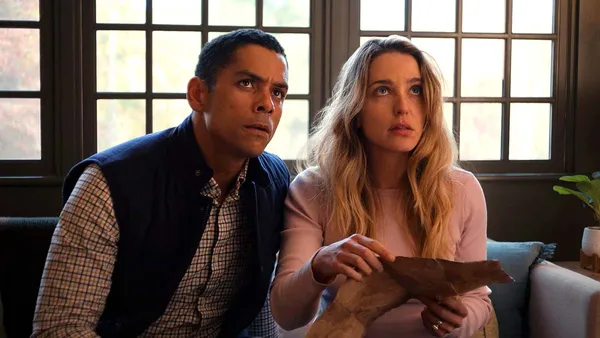
| Jessica Rothe and Charlie Barnett in Imposters |
American director Caleb Phillip's sophomore feature, the mystery thriller Imposters, revolves around Paul (Charlie Barnett) and Marie's (Jessica Rothe) disintegrating marriage. Things take an unexpected turn when, during a housewarming party, their infant son disappears. When a stranger visits and tells them a story about a cave that can return their son to them, it further divides the couple. Ignoring Paul's skepticism, Marie goes to the cave alone. When she returns, she's covered in blood with baby Theo in her arms.
Imposters is the first film produced by Broken Pig Productions, led by producers Thomas Bond and Sara Seligman. Bond has previously produced the fantastical horror short film Fishmonger, about an Irish fishmonger who can only save his mother's soul by entering into a pact with an ancient creature, and the late-night diner set drama Stardust, about a group of patrons forced to consider the consequences of their choices. He also produced Caleb Phillip's short film Play Me, which tells the story of a woman who awakes to find a man tied up on the backseat of her car, and a cassette recording with instructions about what to do next.
In conversation with Eye For Film, Bond discussed being struck by a lightning bolt while in the shower, embracing flawed and challenging characters, tying up all the loose ends while thematically offering no easy answers, and more.
The following has been edited for clarity.
Paul Risker: Was there a moment you can remember where you knew film would be a central part of your life?
Thomas Bond: I've been a huge film fan my entire life, but I do have a very specific memory from when I was nine years old. I grew up in Massachusetts, and one time we all went to Arizona on a work trip with my dad. I was in the shower in our hotel room, and I had the thought that I had to go to the hotel gift shop and get a notebook and start writing. It was specifically screenplays, because I had loved watching movies so much as a kid. So, I asked my mom, went down to the gift shop, and bought a notebook. Since that day, I thought I would be a screenwriter.
As a child, I would buy published versions of screenplays at the bookstore and read them constantly. I went to the New York Film Academy for a year when I was 21, where I met my current producing partner, Sara. We stayed together working in film for a long time. We wrote a feature together, which was great, and then, during the pandemic, I transitioned to producing when a friend needed some help making a short.
I found that I enjoyed that side of the filmmaking process. I really enjoyed the organising and collecting of teams, gear, permits, and insurance and all of the business side of things that a lot of filmmakers don't care to do themselves. I realised I had a knack for it, and it just blew up from there.
PR: I've not heard it described like that before — a flash of impulse.
TB: Like a lightning bolt moment literally 30 years ago. And I still feel like I have a sensory memory of that shower — just that urge. And I don't even remember if I wrote a story that night or if it was a specific thing. My memory of it is more a general idea of needing to go and become a writer, and specifically a screenwriter. And I've kept that interest my entire life, throughout my childhood and on into the film industry.
PR: And now you're on the logistical side of things?
TB: I feel the producing title is one that a lot of people don't really understand what it means or what a producer does. For me, it's very much the physical side of producing: hiring all the crew, auditioning the cast, getting the permits, handling the insurance, renting all the equipment, and doing the location scouting. My partner Sara and I do everything for our film. So, a lot of the jobs that you would normally see on an independent film, like a transportation department or an accountant, we take on all of those titles. It's all encompassing and anything on the logistics or business side of the film is what we take care of.
PR: Is there a clear definition of what a producer does or is it fluid?
TB: What's interesting at the independent level, so much of what a producer does depends on what you have the budget not to do. So, for us, and with our movie Imposters, we couldn't afford to have a bunch of different roles delineated for certain things that we needed to get done — we just did them all ourselves. And then, with the creative side of producing, which I love, how creatively involved I am with a particular story or the relationship I have with a certain director, varies from project to project. With Imposters, it was a very collaborative relationship with Caleb. He would bounce notes and ideas off me constantly. But it was very much his script, and we wanted to stay loyal to it. We granted him the freedom to exercise the vision that he wanted to put on the screen.
PR: To rewind a little, how did you first connect with Caleb and decide to take the reins and produce Imposters?
TB: Sara and I had just started our own production company, Broken Pig Productions, and we were looking for our first script to produce. Caleb Phillips is someone I knew as a gaffer, who I had worked with on a few shorts that I produced. He asked me to produce a short film that he had written called Play Me, which I did. When I was on set for that short, I could just tell he instinctively knew how to direct.
I think anyone can direct, but not everyone can direct well. There are certain inherent qualities you need as a director to be good at it, specifically where to put the camera. The most important thing for a director is, for every shot that they set up, they know where the camera should go. And Caleb instinctively knew, in my opinion, where to place the camera for every shot of that short.
So, when he sent me the feature script of Imposters, I read it, and it was similar to that shower I had as a kid. It immediately spoke to me — this was the story that Sara and I had been waiting to make under our company banner. I thought it was a tight, well written script and probably the hardest thing to do with a feature script is nail the ending. From the draft he sent me, I knew that he had an ending that was going to be incredibly satisfying to watch. And so, starting there, I knew we had something to work on.
I approached Caleb about letting us find the financing to make the movie, and thankfully he said yes. And now, here we are.
PR: There's the idea that there are three versions of a film: the film that is written, the film that is shot, and the film that is edited. Would you agree?
TB: I would say generally, yes, but specifically with Imposters, what was unique about that script and the filming of it was we changed very little from what was on the page. The real second version of the movie came in when we were editing the film. We realised certain things in one part of the movie needed to exist somewhere else or certain scenes needed to be split into different parts and spread throughout the movie. So, having that moment of discovery with our editor, Nick [Landa], it was really interesting for the three of us to find the pulse of the film.
For someone like Caleb, and for any first-time filmmaker, one thing that I can't recommend enough is to hire an editor. If you are a first-time director, do everything you can to avoid editing it yourself. You need that second pair of fresh eyes — someone who doesn't come to the movie with these preconceived notions of what they think it is based on the script. And you will find so many new avenues to tell the story in the best way possible.
PR: It's about needing distance at times, but I assume it's difficult to pause and step away when you're on a tight schedule. So, is this where that second person is invaluable?
TB: It's even more than just time pressure; sometimes it comes down to cost. The conversation at one point was that maybe Caleb would edit the film himself. Ultimately, we decided that it wasn't a good idea, not because he's not capable, but because we needed an additional creative mind to have their eyes on what we had shot to give us new ideas that we had never thought of.
It's tough when you're attached to a project for so long, like Caleb obviously was, as was I, Sara, and our other producer Joe [Bandelli], to come up with fresh ideas. When you're working on the same scenes over and over again for months, you build up a certain idea of what you think they need to be or what they should be. Sometimes you need that fresh brain of someone who has only been a part of the project for two weeks, to suggest doing something else. And it just opens up a whole new world for you.
PR: This speaks about the need to be willing to give up control because not every idea can be yours. For the director and the core filmmaking team, it's about filtering ideas to discover the best possible version of the film.
TB: 100% and I think that's something you have to find early on when you're figuring out the people who you're going to collaborate with. You need to understand that all of your individual egos don't matter. What's important is coming up with good ideas and solutions to decide on what will ultimately be in the finished version of the film. And whoever came up with it doesn't matter at all. We're not scoring points. We're trying to find the people who want what's best for the movie.
That can be a gamble if it's someone you've never worked with before, but you try to vet as much as you can beforehand. For example, if I thought Caleb was a control freak at the beginning of the process, I wouldn't have decided to make this movie with him. I decided to make this movie with him because I thought he was talented, he'd written a great script, and I thought that we could collaborate. And that collaboration, especially in filmmaking, is so important because nobody can do it by themselves. So, you need to find those people that are in it with you and are willing to put the needs of the film above their own needs or ego. And fortunately, we did.
We got incredibly lucky with the entire cast and crew. They truly blew away my expectations of what I thought the first film for our company would be like. I'm just so thrilled with how it turned out, and not just how it turned out, but what the experience was. Something that people overlook is the actual journey of making the thing. The movie's gonna be what it is, but that's a year to 18 months of your life, and you're never gonna get that time back. And so, you had better do whatever you can to make it enjoyable.
One of the things I'm proudest of as the film's producer is that I'm confident that everyone who worked on the movie had a really good time. I'm proud that I was able to facilitate that atmosphere.
PR: To shift onto the story itself, what were those strengths you needed to ensure were nurtured so the audience could connect with it?
TB: […] What Caleb did a great job with is the authenticity of the relationship between the husband and the wife. That parental relationship and marriage is incredibly complicated and flawed. He did not write easy people to root for, but he did write people that a viewer can relate to and see either themselves or their parents in. These flawed characters are sympathetic because they're incredibly human. So, he doesn't make it easy for you to care about their journey, but if you're willing to meet them on a human level, I think you'll be surprised at the depth that these two characters share.
The other thing Caleb is good at is plotting mystery puzzle-box type stories. We talk a lot about his love for Agatha Christie and murder mysteries. He has a good sense of pacing, in terms of where the pieces of the puzzle need to go throughout a story, not only to keep the audience entertained, but to close all those loops by the time the end credits roll.
So, you feel like you've watched something that's a little bit trippy, but by the time the movie's over, you don't feel like there are any major questions that he left unanswered. All the pieces of the puzzle make sense and there aren't any loose threads that leave you feeling like you didn't get your money's worth.
PR: It's all well and good having a puzzle-box narrative but if you haven't got a human story, then the film will lack heart.
TB: Any story starts with whoever your protagonist is. And it has to start there because that's what we all relate to. That's why you can anthropomorphise a milk carton and get people to care about it in a cartoon, because we see that human connection.
I want to give a shout-out to our actors Jessica Rothe and Charlie Barnett, because they did a phenomenal job of bringing these complicated characters to life. I feel they really responded to what was on the page and surprised us a lot with what they brought from the real world. They made a lot of choices that just elevated the depth of those characters. And I think it's a really fun story because a lot of these types of movies where you have a couple and something horrible happens to them, you normally start where they're in a blissful honeymoon phase: happy and so in love. Then, something gets taken from them that's traumatising, and it's about how do we get it back?
When you meet the couple in Imposters, their marriage is already on the rocks and, as parents, they're pretty unhappy. To then have them experience the worst nightmare for any parent when their child goes missing, and to see them fight to get them back, almost raises a question: why are they fighting so hard for this life that they weren't even that happy to begin with?
All of this opens up a lot of questions while you watch the film, specifically about what does it mean to be happy? What does it mean to be complacent versus fighting for something you think you deserve? Or what is it that you actually think you deserve? Do people really optimise what they think their life should be? Or do they just settle for things that are less than what they think they deserve? Maybe they delude themselves into thinking they don't deserve any better because of their own flaws? This movie is unique in the way it presents people who are difficult and flawed from the very beginning.
PR: The premise of the happiness trap is to ask are we ever happy if we are chasing the idea of happiness? In Imposters, the couple are forcing themselves to be happy, which means they are denying themselves what they desperately seek.
TB: Yes, and there's this idea of what's between your own private happiness and what you present to the world. You would look at this couple from the outside, without knowing them and think they are happy. They're newly married, they have a young, healthy baby boy, and they have a house that they own. By all accounts, they're living the American dream. And we even go into that early on in the movie. They throw a housewarming party and meet the neighbours, and they have to put on this act that they're this happy couple with this baby boy. But on the inside, they're crumbling. And at what point does one thing matter more than the other? What are you willing to make up, present to the world and pretend you're something you're not? How important is that versus your own internal sense of self-worth or happiness? There are a lot of interesting questions that don't have easy answers here.
PR: All of us are habitually performing for the rest of the world, right? Our lives are a stage for us to perform on.
TB: Yes, and if you go on Instagram, you'll find it everywhere.
PR: Returning to your earlier point about how there are no loose threads left unresolved, is the onus on you as filmmakers to play fair with the audience? Should you give them a chance to put the pieces into place on their own, even if they beat you to the punch?
TB: You don't necessarily need to explain every story, but as a filmmaker, you have an obligation to know what you're doing in a way that people can draw their own conclusions at the very least. Every ending of every film doesn't need to be black and white: it was this or it was that. But there needs to be enough in the story to allow people to theorise and come up with their own thoughts and ideas. If you don't at least have that, then you're not really doing the job of a storyteller because you're not giving the audience anything to chew on.
Our film ties up a lot of the open threads that we set up but, at the same time, you can interpret the ending in many different ways based on what you think the character's motivations are. So, as a filmmaker, as long as you do that part of the work to give the audience something to chew on, you've done your job. If you don't give them anything to think about, you're wasting their time, and why'd you even bother to make a movie?
The puzzle box is like a prop or a hook to engage with these characters, which I think every movie does. There are people who love comedies, people who love spy movies, and people who love slashers. This is a mystery thriller, and so, if you're a fan of those types of movies, you're probably going to enjoy it. And if you're not, there are certainly many other elements here that can grab you.
You always want to try to fit the story you're telling into an archetype model that is palatable to people. You want to present it in a way that generates some excitement because it's a hard sell to tell people: "Hey, watch this married couple fall apart." It's not fun to watch unless you're Ingmar Bergman making Scenes From A Marriage.
Genre is sometimes able to present the most interesting stories about people and humanity under the guise of something futuristic, horrible, or horrific. You can really understand a lot about people through a monster movie or an alien invasion film. I sometimes think that's the best way to tell stories about the human condition, and that's what we tried to do with Imposter.
Imposter had its English Premiere at the 2026 edition of London FrightFest.