 |
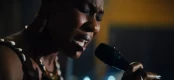
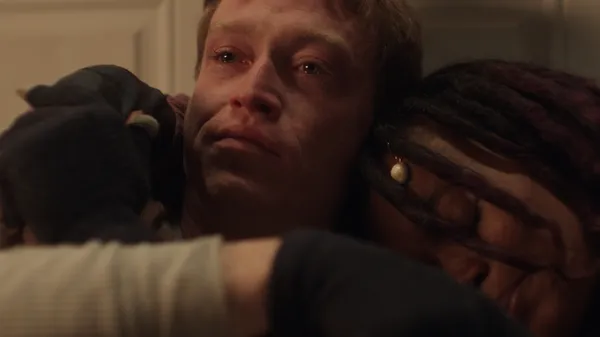
| Caleb Landry Jones and India Marie Cross in Down The Arm Of God. Landry Jones: 'Finding a way of making this film in the way it needed to be made meant going against most ways that people think about making films' Photo: ©EuropaCorp |
The film had its world premiere at Locarno Film Festival, where we caught up with Brunner, Landry Jones, Cross and some of the other cast members to talk about the unusual approach to the film.
Recalling how the project started, Brunner, who had previously worked with Landry Jones on To The Night, said: “I knew and Caleb knew because of collaborating together and becoming friends that we wanted to continue this creative relationship and to do something that is very important to us in a personal way, but also is socially feeding a resonance that we feel strongly about.
“So there were six different possible stories but we gravitated towards a true story about a pastor helping the homeless during a winter freeze because this story kind of represented a crossroads of how you decide in a situation like this. It’s kind of a paradox because if you're faced, as a congregation, with this problem in your backyard, you can understand from their point of view that maybe you don't want to endanger your kids. But if you see it from the perspective of the people who nearly freeze to death, there are moral facts.
“If a kid falls into a pool, you don’t think, ‘Should I take a sip of my beer.’ You should save the kid. With this contradiction, depending on which side you’re standing on, we wanted to generate something about these human complexities.
“We went into the encampments and we found the realities of people who were unhoused and on the fringes of society and invited them into a collaborative process, where it's really about authorship of their lived experience, but which is translated, through a long work of trust, into owning a character. So they are protected through a character. It’s not only themselves. It’s something that they can leave behind and look back on. It was very much an invitation of joining forces and generating trust together. It was a long journey to find the right place to do it, the right people to do it, to find money for it.”
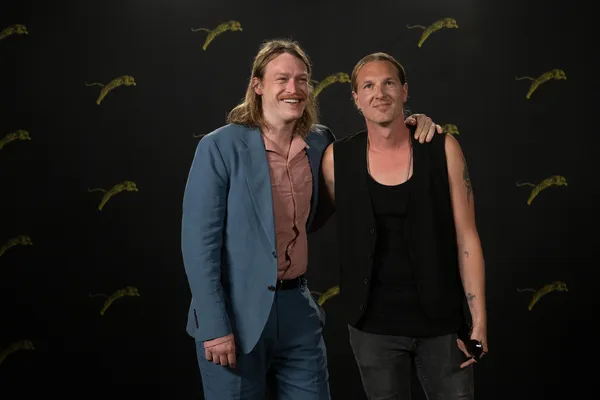 |
| Caleb Landry Jones and Peter Brunner in Locarno. Brunner: 'I knew and Caleb knew because of collaborating together and becoming friends that we wanted to continue this creative relationship and to do something that is very important to us in a personal way' Photo: Locarno Film Festival/Ti-Press |
Bart Guthrie, who is another of the wider cast who drew on personal experience to craft their roles added: “It’s a trust circle. You ask me how it was when this strange Austrian guy walks up to me and goes, “Do you want to be in a movie?” I'm, like, ‘Well, the problem with that is due to my military experience, I've had a lot of traumatic brain injury, I can’t remember hardly anything’. He goes, ‘We’ll figure that out’. And there you go. He would just tell me, ‘Okay, this is what I want you to do. This is kind of what I want.’ it was very organic. A lot of it wasn’t acting, it was being placed in a situation where, this is the way it is… what would you do?
Landry Jones agrees, adding: I think a lot of us are responding in the film in real time. It’s a constant kinetic energy, constant response, and it's a genuine response. When Mike, one of the cast members, gets up and starts talking about his time in the military, John gets up and basically says, ‘I don't believe you. You were never in the military.’ He calls him out, and it starts something.
“There are so many scenes in the film, like that scene, in particular, where all of a sudden a life of its own takes place, and we are no longer pushing anything, the thing is rolling on its own and it feels like we’re more documenting something. That's not to say that we didn't understand what was going on, or we didn't understand what this was going to be. But regardless, it was easier in this film for me personally to find myself in that situation or in that place where I wasn't thinking in terms of character, or anything like that. I was just thinking of a genuine response to what is being said or done. I like Brando more than some other guys because I think he was more interested in searching for something.”
Cross adds: “I think it's really interesting that trust just keeps surfacing. It seems like just a part of the process in totality, but I feel like there was a real aspect of having to gain trust. And then there was a cinematic aspect because you had to trust your other actors, you had to trust that if you hit the ball to them, they’re going to hit the ball back to you, and I think that journey just elevated our natural connections in the scenes.”
Speaking about the collaboration with The Art of Elysium, which you can read more about here, Brunner said: “Our goal is very much about the reflection of the audience. Culture is giving and taking, 60 per cent is always the audience, maybe it’s even more. We just tried to do our job right, to formulate the problem as well as we can. So it’s about your reflection and what you can do.
Landry Jones adds: “We are trying to use this film as a true conversational starter when it comes to the epidemic [of homelessness] and eradicating stereotypes overall.”
Cross says there is an element of “shame” that could be experienced by a viewer that could be productive in terms of what comes next
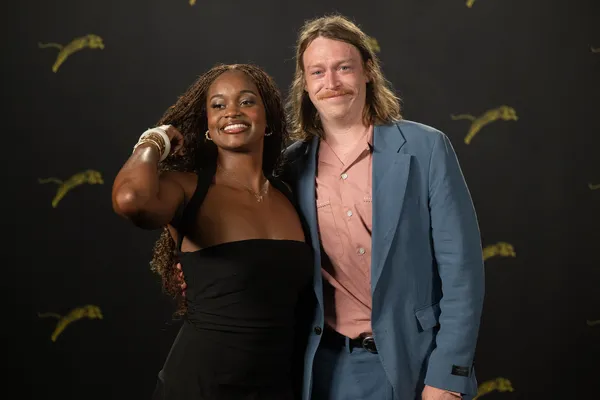 |
| India Marie Cross and Caleb Landry Jones in Locarno Photo: Locarno Film Festival/Ti-Press |
On homelessness in general in the US, she adds: “Overall it's really a humanitarian issue. And the powers that be in the capitalistic society that governs America right now uses race, religion, whether you're housed or unhoused, it uses all of those different spectrum moves to cloud the bigger picture, which is that there are people governing, who are not [acting] in the best interests of other Americans. It’s all just confusion. Whether you’re housed or not, you’re a human being and you deserve the bare minimum of food, water and shelter. So I think if we could get over that hump, America would live more beautifully, the world would live more beautifully but it takes a lot of consciousness, it takes a lot of effort, it takes a lot of willingness. Hopefully this film can be the thing that perpetuates that.”
The fact that the crew were working with people who were still homeless at the time it was being written means that it wasn’t easy for them to find or sustain financing for it.
Landry Jones adds: “Finding a way of making this film in the way it needed to be made meant going against most ways that people think about making films, which was difficult for many people – nobody here, but people who have been part of films in the past – to wrap their minds around how to make this film. So, Peter and I are desperately looking for more people that can kind of radicalise their thoughts to understand that there is not only one way to make a movie.
“I think we all here believe that the kind of story that we're trying to tell with this film is not just needed, but people want more of deep down inside.”
And the pair are already working on a new project, which although they didn’t go into great detail they describe as “another care movie” in a very specific setting.
He adds: “All of these relationships we found in the movie, we continue with those and with the social impact campaign for Down The Arm Of God. This has to be the beginning of a conversation. We are pushing it and we need all of you guys to push it. We want to get the Vatican involved and you have to think, what can we do to get people to talk about it. But when it comes to filmmaking we have a different project and are trying to work on something that is also a taboo in American society.”
Landry Jones adds: “It is our responsibility, as filmmakers, to do this responsibly, correctly and respectfully but I hope to see more champions of this kind of material in the future because it’s becoming more and more impossible to make something that does open the conversation so widely and does try to show both sides of the coin and break down some of these ideas of good and bad.”
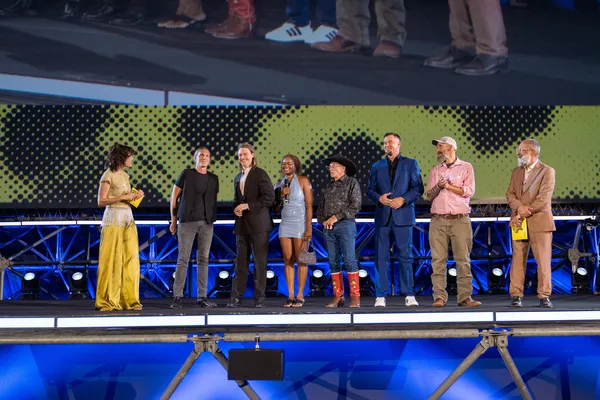 |
| Down The Arm Of God delegation in Locarno including Bart Guthrie, Caleb Landry Jones, India Marie Cross, Kip Lee Billups, Peter Brunner, John PW Jones and Christopher Israel Photo: Locarno Film Festival/Ti-Press |