




|
|
The Cull
Photo: Frightfest
|
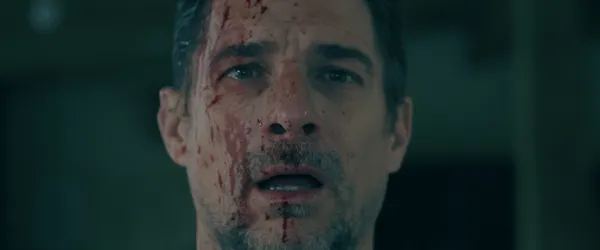
Craig Russell plays Niall, a recently released prisoner trying to rebuild his life in difficult circumstances, in JP Davidson’s latest film, The Cull – but when Niall moves into a cabin in ancient woodland, he has no idea what he will have to contend with. Just before the Halloween edition of Frightfest, where it had its première, I caught up with them to discuss the way that it developed.
“My process is always the same,” says JP. “Writing doesn't come naturally to me. It's quite difficult. It's probably the most rewarding part of the process, but it's quite hard going for me. So I try to create a kind of a guide, an idea that takes me through the project from the start, all the way through the shoot, to delivery. And with this one, it was just exploration of the idea of justice.
“I'm always looking for ideas that are relevant to the world I'm living in now, and it felt particularly important at the moment. It's the foundation upon which we build our entire society, is law and justice. Having a feeling that it was fundamentally flawed made me want to explore that further. So, yeah, I suppose I'm just posing a question. It's not an answer. There’s no message in it. It's just an exploration of an idea in the form of a kind of contemporary folk horror.”
There are a few different ideas about justice in the film, I observe.
“Yeah, definitely. I'm always looking for that opposition. You need the antagonism and the protagonist to really keep driving the story forward, so I sort of envisioned all the opposites that come about through the canon of law, and the first and most obvious was religion. We've got this Christian religious tradition which is also where a lot of our laws are derived from. Although law's constantly changing. That's the weird thing. Law now is not the same as law two years ago. Then I looked at pre-Christian ideas of justice and wanted to create that kind of opposition in the story. Without giving too much away, I wanted the opposite to everything we regard as normal to be the outcome that succeeded.”
I mention that I had a conversation with Robin Hardy about this a few years back, and he saw the fundamental complexity of British society as stemming from it being built on these two ideas, with Christian tradition and the things that came before that never really having been resolved. Is that something JP would agree with?
“Yeah, 100%. And I think that also Christianity moved very quickly away from ideas of being connected to nature, seasons and crops. It seems to have formalised those in a way that doesn't feel natural at all. Those older ideas, even going back to like animistic religions, those ideas are commonplace and it feels like we've lost that. I have really noticed over the last 20, 30 years, a real resurgence in an interest in Wicca and those kind of land-based, nature-based ideas. I don't even know if people are necessarily religious. I think people are just looking for ritual, something that roots them to the earth that they're living in. And those are the two opposing forces: the doctrine of Christianity versus the sort of non-doctrine of nature. I suppose we’d call it paganism, but I think it's more than that, there's a lot more to it.”
I ask Craig how he came on board.
“I remember it very clearly,” he says. “A mutual friend of ours called me up. He's a brilliant first AD, at the time he was attached to the project and he said ‘Look, I've just read this script, you're perfect for it, can I recommend you?’ I said ‘Yeah, great, thanks.’ I didn't really know much about it, I just said ‘Yeah, go for it,’ and then I think JP had asked ‘Is there anything I can see him in?’ So JP watched Protein and luckily he thought I was decent enough in that to do this. It happened quite quickly then.
“I had a long chat with JP on the phone. I really liked him. It's important that you work with nice people, isn't it? He told me the story, which I thought was brilliant, and then he sent me the script. There's a lot of secrecy involved in the plots and the stuff. Not as in for the public, as in within the story. You know, everyone knows what's going on but my character doesn't know what's going on. So I just read my bits and I tried to forget about the rest so that I didn't know what was happening day to day.
“My wife is actually in this film as well. She said ‘After you do that scene, what happens?’ I said ‘I don't know.’ She said ‘What?’ ‘I don't know. I've worked on my bits.’ And then the night before I filmed scenes, I prepared myself properly for those scenes, but literally just learned my bits. I tried to keep it as vague – without being unprofessional – as I could, because that's what I liked about it. The fact that there are a few different camps in the film, but he's the outsider.
“He doesn't realise he's not quite the outsider he thought he was, and we learn that as we go along. So as an actor, I tried to keep it so everything that JP had told me was enough for me to want to do it. Because I'm a gigantic fan of the occult and of myths and legends and nature. Anything that's set outdoors. How often do you take a photo of beautiful scenery in nature and you think that hasn't done it justice at all on your phone? I'm obsessed with nature. I'm obsessed with wildlife. I'm obsessed with what nature can do to teach us a lesson, which it shows at this time of year, certainly, down here in the Southwest. We're reminded of how powerful nature is. Add in to that witchcraft, and I was sold.”
They spent a lot of time outside whilst filming, he remembers, and JP recalls that it was around this time of year that they shot.
“We filmed it around Halloween. Now it's getting its world premiere on Halloween. And Halloween, of course, Hallows Eve, is one of the most ancient of all the ritualistic events.”
Niall is a complicated character, with parts of his past that, thanks to drink and drugs, are a mystery even to him.
“I decided to ignore that as an actor in the hope that it would all be new to me as well,” he says. “If I have a prominent role in the project, I always enjoy the idea that if I play this right, the audience will come with me on this. And so I can show the audience around, I can introduce them to the other characters, I can show them the world. And often with my character, he was the doorway, the conduit for the audience.
“A lot of what I say isn't the important stuff. You get the important stuff from the other characters because I don't know what's going on. You get the important stuff from those around him, and once you get your head around that, it's an interesting way of doing it and it's really good fun because then I get to learn at the same time as the audience, so we create some sort of teamwork effect which I hope gets the audience on side and going along for the journey. And I think with the ensemble that we had and this incredible cast, a lovely bunch of people, and the crew were exceptional. The location, in Cornwall, was a character in itself. Hopefully we put those things together and got something interesting.”
It's cabin of the woods film, I note, but it's got a very different personality from what we'd expect from that. The cabin itself seems like a safe place and it isn't really very remote. It's everybody else who keeps turning up there who creates problems for Niall.
“The drama, yeah,” he agrees.
“I didn't want it to be classic cabin in the woods,” says JP. “I was trying to play on those themes and invert them a little bit. I've worked on documentaries and some other projects, but I've only actually directed films I wanted to direct. I'm not really results driven. I have a picture in my mind of what I'm making, but it's more about what it means than what it ends up looking and sounding like. I'm more focused on the journey than I am on what this final product or film will look like, so it's almost experimental all the way through.
“Even at this stage, as the film is finished, it still sits in front of me every day when I'm working in my studio. I could tinker on it forever because that's kind of the thing that I like about filmmaking: the creativity, the experimentation. I think for some people who write and direct, once they've written it, the creativity almost stops and it becomes a very technical process. The opposite come true for me. It just never stops being creative.”
Is it something that also affects the way that he collaborate with his team, when he’s experimenting like that?
“Yeah, because I'm with the actors, I want them to feel like they're free, that this is an open set and the script is not a blueprint, it's just a guide. I'm always very confident that if I start with that idea, what is justice?, something about that process means that you're forced to stay quite close to the path all the way through to the end. It keeps you on track, and it's something I need to do to make it work for me. But I have noticed the two times I've done it now – my first time was about property – that comes through, even though the film maybe ended up being nothing like what I imagined at the beginning of the process. Now I really embrace that. We can afford to embrace it because we're not taking money from somewhere like the BFI or Channel Four.”
“You had complete control, I think, didn't you?” Craig asks him, then looks at me. “He's brilliant to work with. He just wants what's best for the film, you know, even though he's worked hard writing this script. I remember a scene I did with Donny [Ollie Mcfarlane] where we were both talking, all important stuff, but when I went through it as I was preparing it and learning it, [I noticed that] Donny has all the important stuff, and that's what the audience need to hear. So I said to JP the night before, ‘I think we should cut most of my dialogue here.’
“I thought it was more important that I just listen. JP said ‘Yeah, great, go for it.’ I remember something similar shooting a movie in Ireland. It all builds this one big moment and I've got this big monologue. I said to the director and the writer who was in the room – two different people – I said ‘I think we should cut my stuff. The audience aren't going to care what I've got to say right now,’ and the writer was really trying to put his foot down. But the director was like, ‘He's right, that's got to go.’ It created a bit of tension, but we had none of that.
“I think when you're that free with the idea of art and what can be achieved creatively – when you're like that at the top, it does filter down, so everyone is open to and it's the best environment.”
“The script's not sacrosanct at all,” says JP. “I'm not like David Mamet, screaming at people for forgetting a comma.”
I mention that I know other directors who say that they get their best work, especially with thriller type material, when they chop a lot of it out. It’s often what’s taken away that makes it more powerful.
JP nods. “And you'd be surprised how much I took out through the process of writing. I like to schedule my own films in a way that trims fat. Then I do a shot list that trims more fat. And then you get on set and you start interacting with actors and then you realise ‘Oh God, that's right. And it all just boils down to being a lot quieter than where you started.”
“Yeah,” says Craig. “I'm a big fan of less is more. Anyway, the less we say as people, the more the audience can guess or assume. That therefore, subconsciously or otherwise, gives them ownership of the film because they think ‘Oh, I get where it’s going. This is what they're doing.’ And so they start to fall in line with what you're doing. Again, if you get that right as a team of creatives, then anything is possible.”
“All art has to have meaning,” muses JP. “Knowing that kept me on track. I knew certain things about characters, like I knew the three women were like, I was going to keep them off screen and treat them like they're gods. You don't see God, but you're aware God's there and God's omnipotent and God is kind of the puppet master controlling things. So I had that in mind right from the start. I was always aware that they were there. We just can't see them. They're doing things and they're controlling things and they're making stuff happen and it's all on them, but we don't see them because they're divine.”
I note that we do see three corvids, who seem to represent them.
“Yeah,” he says. “I had an idea of having a raven, a hare and a cat.”
Getting them in the same place, if one had real animals, would be difficult, I suggest.
He nods. “When I told Cat [Catherine Laine], the producer, she nearly fainted. There was talk of a goat at one point as well, and she was like, ‘Oh, my God.’ I think she looked at the price of animal handlers for a goat and was like, ‘No we can't.’”
It would eat a lot of the set, I say.
“And a lot of the budget,” says Craig.
We talk about Craig’s character’s vulnerability. We know from how he fixes up the cabin that he’s a physically competent man, and we know he’s been in prison, yet we quickly get the sense that he’s under threat.
“For me, it was the notion that he'd been in prison for a long time – long enough to become institutionalised,” says Craig. “I thought ‘If I just go with that, then everything else is scary.’ I researched prisoners and how it affected them. The only time they meet new people is if a new guard starts working there or a new inmate comes in, and then often they're unpleasant anyway. So you don't really look forward to meeting new people, just in case. Once I got my head around that, that was the starting point with him.
“He wanted to be a good person. He wanted to be liked and he wanted to get on and he wanted to make this new go at life work for him. But with everything that he'd been on, whether or not he could remember his past or not, everything he'd done, all the hard living, the bad living, the imprisonment, the living in the cage, all of that, no matter how much he tried to distance it, he couldn't. And another thing about these people is constant paranoia, so everything becomes an issue. You can't live a normal life. They have to have therapy and that sort of thing, a lot of them.
“Once I got my head around that, it was really interesting to play on it. Once you tap into that energy, it all starts to happen, because there was a great cast around me. With JP's help, it took care of itself, really. For me, anyway, if I get it right before day one, then it all just comes.”
“With Niall I was thinking of the kind of remorseless narcissist that he is,” says JP. “Like his sobriety and his faith, they're all ideas he wants to project to the world and to himself as well.”
“That was key for me. To himself,” says Craig.
“He's very focused on what he deserves and what he wants from the world,” says JP. “He's not really capable of looking in the mirror and seeing the truth. That's the main reason for the mirror scene, because what's really in that mirror is a monster. But he doesn't want to look at the monster. He doesn't want to revisit that part of himself and deal with that. He just wants everyone to believe that he's this sober born again Christian, you know? And born again Christianity is a bit of a trope in our culture for when someone's had a dubious past. Especially men. They turn to Christianity, and I don't think it's real faith. I think it’s something else. Yeah, that's definitely Niall. He believes he deserves a fresh start regardless of whether he's ever truly looked at his reflection.”
They’re both excited about the première.
“I've been going to Frightfest things for years and it's just wonderful,” says Craig. “I can't think of a better festival to première this movie at really. Especially the Halloween edition of Frightfest, with the loyal crowd that go to the festival at this time of year. Everything about it, I think it's perfect. And I'm really chuffed for JP because the amount of work he's put in, in post alone, forget about writing it and making it, you know – it’s been a massive weight around his neck. He likes it and he likes the tinkering as he said, but still. So I think it's a great send off for the film to the next phase of its journey. I can't be there, which I'm very disappointed with, but I can't wait to hear all about it.”
“I'm really excited,” says JP. “It's also the fact that it's happening on Halloween when the film was shot, but also I feel like it'll be quite an accepting crowd, because there's so many different kinds of horror. You know, I remember speaking to a distributor in the States at Uncorked Entertainment, and they said ‘Please don't make any more just straightforward horror. We've got too much of it over here. We want things that are slightly more diverse and interesting. If you've got a creature feature, please give us a call.’ That kind of thing. I'm just excited to show it to a crowd of horror fans and see what they say. I imagine the audience will be split like it usually is with my films.”
Craig shakes his head. “No. No, it won't be split. It won't be split at Frightfest.”
“I hope they love it,” says JP. “I hope that they go away with curiosity and new ideas, thinking a little bit about meaning in horror films. Because I don't think people really register just how profoundly meaningful films like Backrooms or Talk To Me are. You know, they've got something to say. Whether the filmmakers intended it that way or not, they're speaking very loudly about the world that they were made in, right now. I think that's important. I think maybe places like the BFI and BBC or don't really realise that horror films can be spectacular, and still be commercial, or maybe they'd start opening the purse strings up and investing in a lot more. Because that's why Frightfest is important. There's not much out there waving the flag for UK horror. I think it's a necessity to have a thriving horror film industry in the UK.”
“Thank God it's now BAFTA-qualifying,” says Craig. “The Welsh BAFTAs, they now recognise Frightfest as being a BAFTA-affiliated festival. And they've also got Abertoir, the horror festival up in Aberystwyth: that's been BAFTA credited for years. So they recognise it, but it's still...”
“I think they've always played it quite safe,” says JP. “If they do horror, they do a very palatable kind of horror. They wouldn't do the French new extremity.”
“No,” Craig agrees. “It will be interesting to see how Robert Eggers’ werewolf film goes down, because it'll obviously be amazing.”
The country’s recent output, JP says, doesn’t feel like kitchen sink drama. “It feels like something new and special. I think we've got something to offer over here that people in America and Australia and France, who all have thriving genre industries, I think they would be interested in. They'd want to watch it, because it's unique.”